Division of Public Health Nutrition, Indian Council of Medical Research (ICMR)-National Institute of Nutrition, Hyderabad, India.
Division of Clinical Epidemiology, Indian Council of Medical Research (ICMR)-National Institute of Nutrition, Hyderabad, India.
Front Public Health. 2022 Jun 15;10:877073. doi: 10.3389/fpubh.2022.877073. eCollection 2022.
Malnutrition among adolescents is a persistent problem with a profound impact on different dimensions of health. The objective of this analysis is to assess the burden of malnutrition (Stunting, Thinness, Overweight, and Obesity) and their associated socio-demographic factors among Indian adolescents (10-19 years) from the Comprehensive National Nutritional Survey (CNNS 2016-18) data.
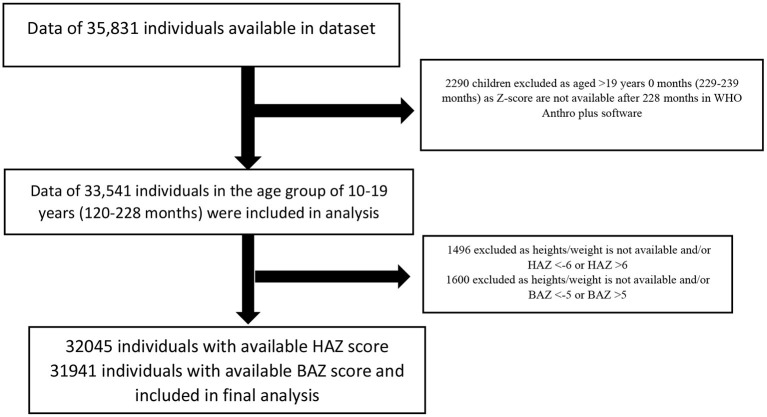
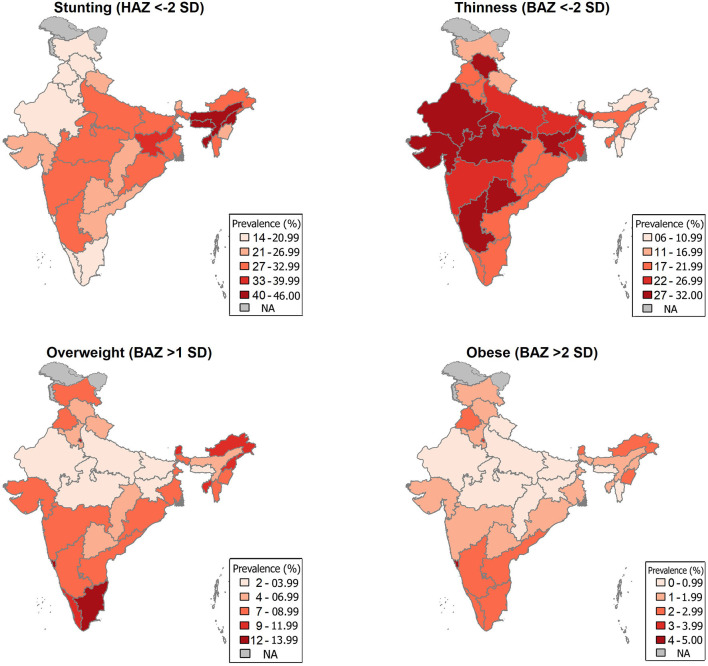
We used Individual-level data of 35,831 adolescents from the CNNS conducted in 2016-18 for this analysis. CNNS collected data on the nutritional status of adolescents along with socio-demographic variables from all states of India. Burden of stunting (Height for age Z score, HAZ < -2 SD), thinness (BMI for age Z score, BAZ < -2 SD), overweight (BAZ > 1 SD) and obesity (BAZ > 2 SD) were estimated for the entire country and individual states. A multivariable logistic regression analysis was used to assess the socio-demographic factors associated with stunting, thinness, and overweight.
CNNS collected data from 35,831 adolescents, of which 31,941 with BAZ scores, and 32,045 with HAZ scores were included in the final analysis. The burden of stunting and thinness among Indian adolescents was 27.4% (95% CI 26.4, 28.4%) and 24.4% (23.5, 25.4%), respectively. The burden of overweight and obesity was 4.8% (4.5, 5.1%) and 1.1% (0.9, 1.3%), respectively. Adolescents in the age group of 15-19 years (AOR 1.23, 95% CI 1.11, 1.36) compared to 10-14 years, females (AOR 1.20; 1.08, 1.33) compared to males, were at increased odds of getting stunted. Adolescents from lowest wealth index families (AOR 1.66; 1.33, 2.07) were at increased odds of thinness compared to peers of higher wealth index families. Adolescents of 10-14 years (AOR 1.26, 95% CI 1.06, 1.49) compared to 15-19 years, urban residents (AOR 1.43, 95% CI 1.19, 1.71) compared to rural residents, were at increased odds of overweight.
Indian adolescents face the double burden of malnutrition that is undernutrition (stunting and thinness) alongside overnutrition (overweight and obesity) that are linked with socio-demographic factors. The National Nutritional Programs (POSHAN Abhiyan) should prioritize high-risk groups specifically older age group (15-19 years), females, and low wealth Index quintile families identified in this analysis.
青少年营养不良是一个长期存在的问题,对健康的不同方面都有深远的影响。本分析的目的是评估印度青少年(10-19 岁)营养不良(发育迟缓、消瘦、超重和肥胖)及其相关社会人口因素的负担,该分析基于 2016-18 年综合国家营养调查(CNNS)的数据。
我们使用了 2016-18 年进行的 CNNS 的 35831 名青少年的个人数据进行了本次分析。CNNS 从印度所有邦收集了青少年营养状况以及社会人口变量的数据。我们对整个国家和各个邦的发育迟缓(身高年龄 Z 分数,HAZ <-2 SD)、消瘦(体重年龄 Z 分数,BAZ <-2 SD)、超重(BAZ > 1 SD)和肥胖(BAZ > 2 SD)的负担进行了估计。我们使用多变量逻辑回归分析评估了与发育迟缓、消瘦和超重相关的社会人口因素。
CNNS 共收集了 35831 名青少年的数据,其中 31941 名青少年有 BAZ 评分,32045 名青少年有 HAZ 评分,这些数据被纳入最终分析。印度青少年发育迟缓的负担为 27.4%(95%CI 26.4,28.4%),消瘦的负担为 24.4%(23.5,25.4%)。超重和肥胖的负担分别为 4.8%(4.5,5.1%)和 1.1%(0.9,1.3%)。与 10-14 岁的青少年相比,15-19 岁的青少年(AOR 1.23,95%CI 1.11,1.36),女性(AOR 1.20;1.08,1.33),超重的风险更高。与高财富指数家庭的同龄人相比,来自最低财富指数家庭的青少年(AOR 1.66;1.33,2.07),消瘦的风险更高。与 15-19 岁的青少年相比,10-14 岁的青少年(AOR 1.26,95%CI 1.06,1.49),城市居民(AOR 1.43,95%CI 1.19,1.71),超重的风险更高。
印度青少年面临营养不良的双重负担,既有营养不足(发育迟缓、消瘦),也有营养过剩(超重和肥胖),这些都与社会人口因素有关。国家营养计划(POSHAN Abhiyan)应优先考虑本分析中确定的高风险群体,特别是年龄较大的群体(15-19 岁)、女性和低财富指数五分位数家庭。