School of Sport, Exercise and Rehabilitation Sciences, University of Birmingham, Birmingham, United Kingdom.
MRC-Versus Arthritis Centre for Musculoskeletal Ageing Research, Birmingham, United Kingdom.
Physiol Rep. 2022 Jul;10(13):e15345. doi: 10.14814/phy2.15345.
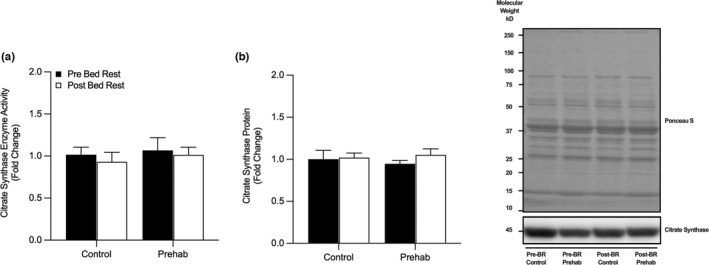
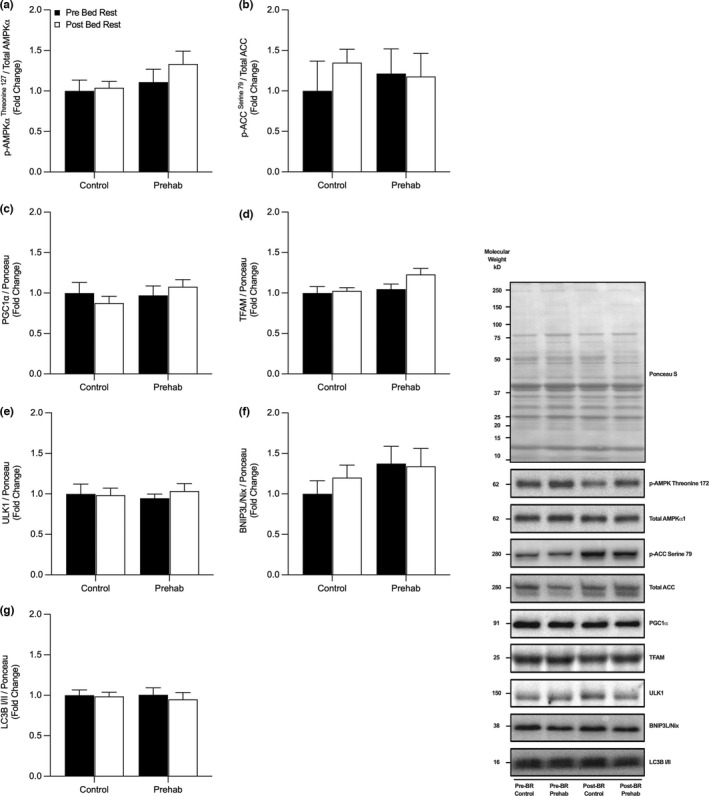
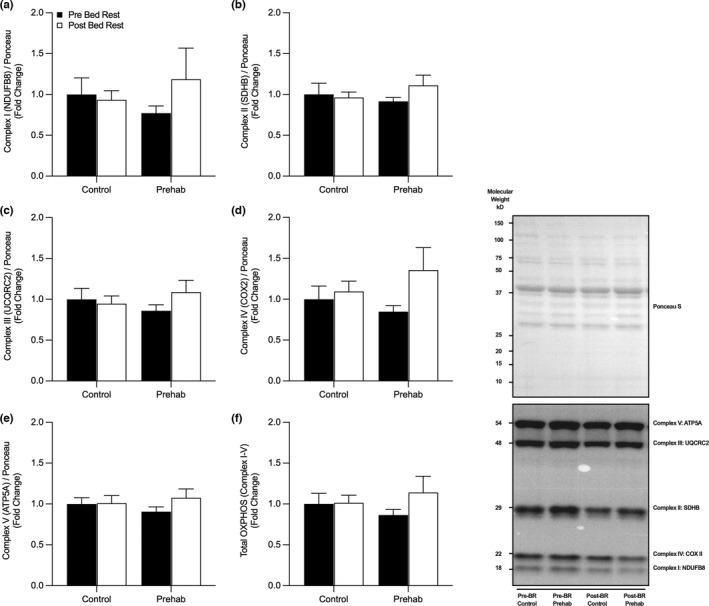
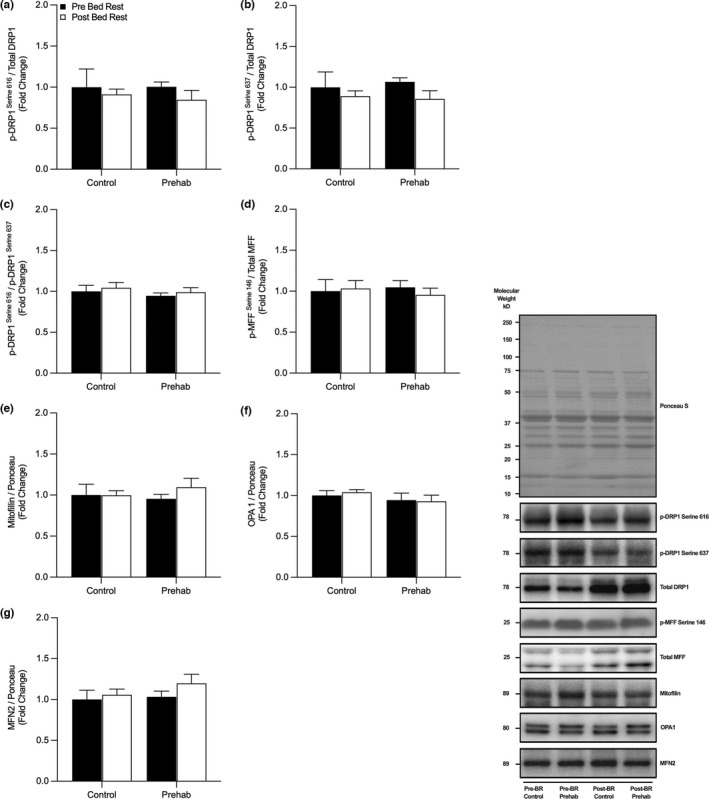
Bed rest (BR) results in significant impairments in skeletal muscle metabolism. Mitochondrial metabolism is reportedly highly sensitive to disuse, with dysregulated fission-fusion events and impaired oxidative function previously reported. The effects of clinically relevant short-term BR (≤5 days) on mitochondrial protein expression are presently unclear, as are the effects of exercise prehabilitation as a potential counteractive intervention. The present study examined the effects of a 5-day period of BR and short-term resistance exercise prehabilitation (ST-REP) on mitochondrial-protein content. Ten older men (71 ± 4 years) underwent 5 days of BR, completing four sessions of high-volume unilateral resistance exercise prehabilitation over 7 days beforehand. Muscle biopsies were obtained from the vastus lateralis in the non-exercised control and exercised legs, both pre- and post-prehabilitation and pre- and post-BR, to determine changes in citrate synthase enzyme activity and the expression of key proteins in the mitochondrial electron transport chain and molecular regulators of fission-fusion dynamics, biosynthesis, and mitophagy. We observed no significant effect of either BR or ST-REP on citrate synthase protein content, enzyme activity, or ETC complex I-V protein content. Moreover, we observed no significant changes in markers of mitochondrial fission and fusion (p-DRP1 , p-DRP1 , p-DRP1 ratio, p-MFF , Mitofillin, OPA1, or MFN2 (p > 0.05 for all). Finally, we observed no differences in markers of biosynthesis (p-AMPK , p-ACC , PGC1a, TFAM) or mitophagy-related signaling (ULK-1, BNIP3/NIX, LC3B I/II) (p > 0.05 for all). In contrast to previous longer-term periods of musculoskeletal disuse (i.e., 7-14 days), a clinically relevant, 5-day period of BR resulted in no significant perturbation in muscle mitochondrial protein signaling in healthy older adults, with no effect of ST-REP in the week prior to BR. Accordingly, disuse-induced muscle atrophy may precede alterations in mitochondrial content.
卧床休息(BR)会导致骨骼肌代谢显著受损。据报道,线粒体代谢对废用非常敏感,先前有报道称其分裂-融合事件失调和氧化功能受损。目前尚不清楚临床上相关的短期 BR(≤5 天)对线粒体蛋白表达的影响,以及运动预康复作为潜在的对抗性干预的效果如何。本研究探讨了 5 天 BR 和短期抗阻运动预康复(ST-REP)对线粒体蛋白含量的影响。10 名老年男性(71±4 岁)接受了 5 天的 BR,在此之前的 7 天内完成了 4 次高容量单侧抗阻运动预康复。在预康复和 BR 前、后,从非运动的对照侧和运动侧的股外侧肌获得肌肉活检,以确定柠檬酸合酶酶活性以及线粒体电子传递链中的关键蛋白和分裂-融合动力学、生物合成和线粒体自噬的分子调节剂的表达变化。我们观察到 BR 或 ST-REP 均未对柠檬酸合酶蛋白含量、酶活性或 ETC 复合物 I-V 蛋白含量产生显著影响。此外,我们观察到线粒体分裂和融合的标志物(p-DRP1、p-DRP1、p-DRP1 比值、p-MFF、Mitofillin、OPA1 或 MFN2(p>0.05 所有)没有明显变化。最后,我们观察到生物合成标志物(p-AMPK、p-ACC、PGC1a、TFAM)或与线粒体自噬相关的信号(ULK-1、BNIP3/NIX、LC3B I/II)没有差异(p>0.05 所有)。与先前较长时间的肌肉骨骼废用(即 7-14 天)不同,在健康老年人中,临床上相关的 5 天 BR 不会导致肌肉线粒体蛋白信号显著紊乱,BR 前一周的 ST-REP 没有效果。因此,废用性肌肉萎缩可能先于线粒体含量的改变。