State Key Laboratory for Managing Biotic and Chemical Threats to the Quality and Safety of Agro-products, Key Laboratory of Biotechnology in Plant Protection of Ministry of Agriculture and Zhejiang Province, Institute of Plant Virology, Ningbo University, Ningbo 315211, China.
Department of Microbiology, Biomedicine Discovery Institute, Monash University, Clayton, VIC 3800, Australia.
FEMS Microbiol Rev. 2022 Nov 2;46(6). doi: 10.1093/femsre/fuac034.
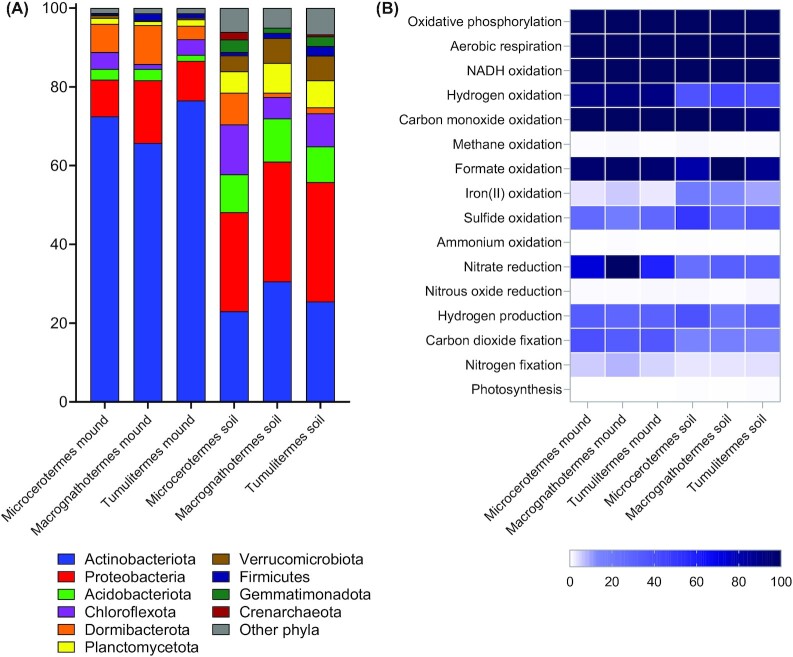
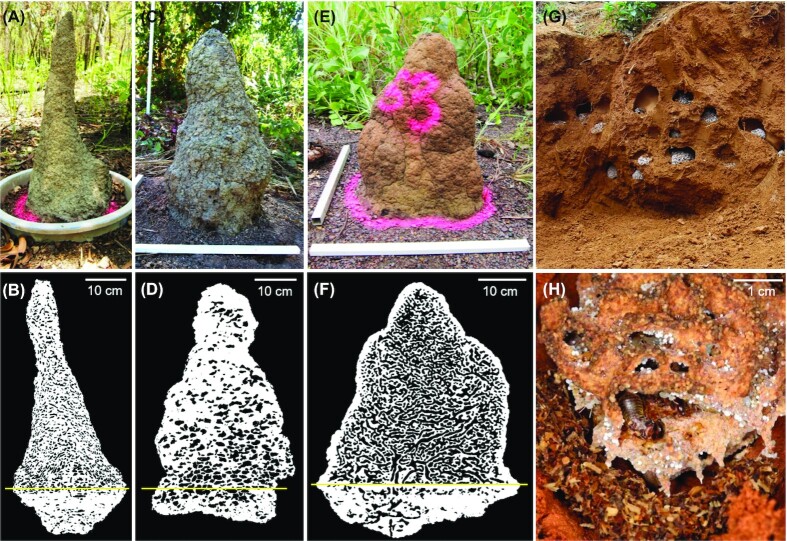
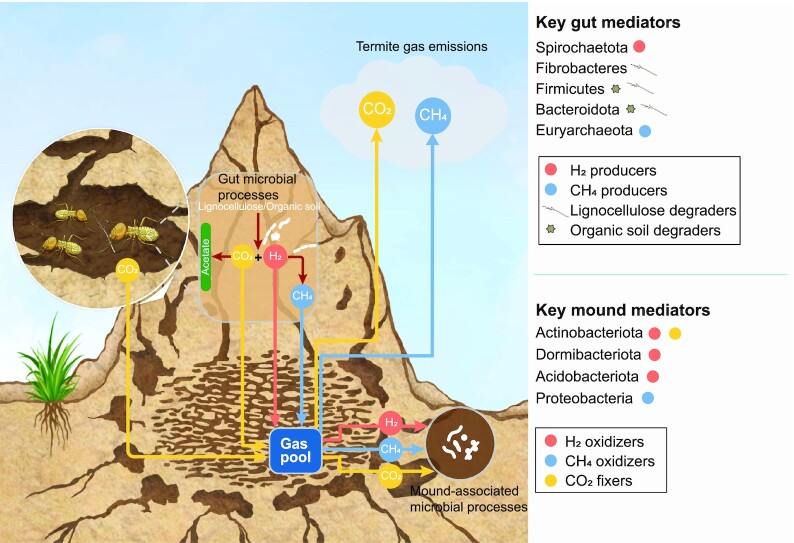
Termites are a prototypical example of the 'extended phenotype' given their ability to shape their environments by constructing complex nesting structures and cultivating fungus gardens. Such engineered structures provide termites with stable, protected habitats, and nutritious food sources, respectively. Recent studies have suggested that these termite-engineered structures harbour Actinobacteria-dominated microbial communities. In this review, we describe the composition, activities, and consequences of microbial communities associated with termite mounds, other nests, and fungus gardens. Culture-dependent and culture-independent studies indicate that these structures each harbour specialized microbial communities distinct from those in termite guts and surrounding soils. Termites select microbial communities in these structures through various means: opportunistic recruitment from surrounding soils; controlling physicochemical properties of nesting structures; excreting hydrogen, methane, and other gases as bacterial energy sources; and pretreating lignocellulose to facilitate fungal cultivation in gardens. These engineered communities potentially benefit termites by producing antimicrobial compounds, facilitating lignocellulose digestion, and enhancing energetic efficiency of the termite 'metaorganism'. Moreover, mound-associated communities have been shown to be globally significant in controlling emissions of methane and enhancing agricultural fertility. Altogether, these considerations suggest that the microbiomes selected by some animals extend much beyond their bodies, providing a new dimension to the 'extended phenotype'.
白蚁是“延伸表型”的典型范例,因为它们能够通过构建复杂的巢穴结构和培养真菌园来塑造环境。这些工程结构分别为白蚁提供了稳定、受保护的栖息地和营养丰富的食物来源。最近的研究表明,这些由白蚁工程化的结构中蕴藏着以放线菌为主导的微生物群落。在这篇综述中,我们描述了与白蚁丘、其他巢穴和真菌园相关的微生物群落的组成、活性和后果。基于培养的和非培养的研究表明,这些结构各自蕴藏着与白蚁肠道和周围土壤中不同的专门微生物群落。白蚁通过多种方式在这些结构中选择微生物群落:从周围土壤中机会性招募;控制巢穴结构的物理化学性质;排泄氢气、甲烷和其他气体作为细菌的能源;以及预处理木质纤维素以促进真菌在花园中的生长。这些工程化的群落通过产生抗菌化合物、促进木质纤维素的消化以及提高白蚁“后生生物体”的能量效率,为白蚁提供潜在的益处。此外,已经表明,与土丘相关的群落对控制甲烷排放和提高农业肥力具有全球意义。总而言之,这些考虑表明,一些动物选择的微生物组远远超出了它们的身体范围,为“延伸表型”提供了一个新的维度。