Department of Women's and Children's Health, Institute of Life Course and Medical Sciences, Faculty of Health and Life Sciences, University of Liverpool, Liverpool, UK
Malawi-Liverpool-Wellcome Trust Clinical Research Programme, Blantyre, Blantyre, Malawi.
BMJ Glob Health. 2022 Jul;7(7). doi: 10.1136/bmjgh-2022-009330.
Severe childhood malnutrition impairs growth and development short-term, but current understanding of long-term outcomes is limited. We aimed to identify studies assessing neurodevelopmental, cognitive, behavioural and mental health outcomes following childhood malnutrition.
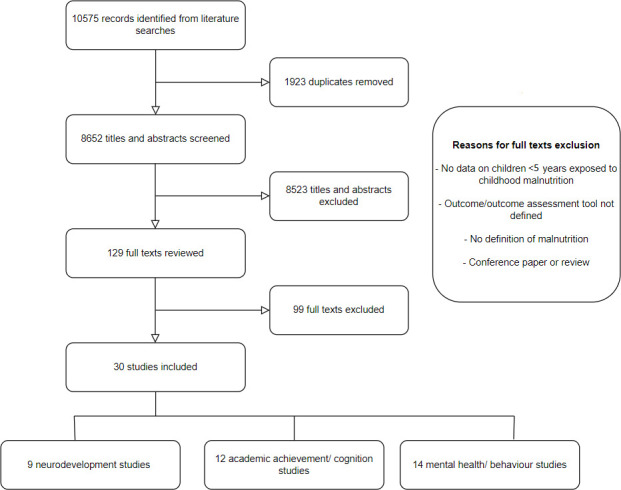
We systematically searched MEDLINE, EMBASE, Global Health and PsycINFO for studies assessing these outcomes in those exposed to childhood malnutrition in low-income and middle-income settings. We included studies assessing undernutrition measured by low mid-upper arm circumference, weight-for-height, weight-for-age or nutritional oedema. We used guidelines for synthesis of results without meta-analysis to analyse three outcome areas: neurodevelopment, cognition/academic achievement, behaviour/mental health.
We identified 30 studies, including some long-term cohorts reporting outcomes through to adulthood. There is strong evidence that malnutrition in childhood negatively impacts neurodevelopment based on high-quality studies using validated neurodevelopmental assessment tools. There is also strong evidence that malnutrition impairs academic achievement with agreement across seven studies investigating this outcome. Eight of 11 studies showed an association between childhood malnutrition and impaired cognition. This moderate evidence is limited by some studies failing to measure important confounders such as socioeconomic status. Five of 7 studies found a difference in behavioural assessment scores in those exposed to childhood malnutrition compared with controls but this moderate evidence is similarly limited by unmeasured confounders. Mental health impacts were difficult to ascertain due to few studies with mixed results.
Childhood malnutrition is associated with impaired neurodevelopment, academic achievement, cognition and behavioural problems but evidence regarding possible mental health impacts is inconclusive. Future research should explore the interplay of childhood and later-life adversities on these outcomes. While evidence on improving nutritional and clinical therapies to reduce long-term risks is also needed, preventing and eliminating child malnutrition is likely to be the best way of preventing long-term neurocognitive harms.
CRD42021260498.
严重的儿童营养不良会对短期生长和发育造成损害,但目前对长期后果的了解有限。我们旨在确定评估儿童营养不良后神经发育、认知、行为和心理健康结果的研究。
我们系统地检索了 MEDLINE、EMBASE、全球卫生和 PsycINFO,以寻找在中低收入国家评估这些结果的研究。我们纳入了评估因低中上臂围、身高体重比、年龄体重比或营养性水肿而导致营养不良的研究。我们使用了没有荟萃分析的结果综合指南来分析三个结果领域:神经发育、认知/学业成绩、行为/心理健康。
我们确定了 30 项研究,其中一些长期队列报告了直至成年的结果。有强有力的证据表明,儿童期营养不良会对神经发育产生负面影响,这是基于使用经过验证的神经发育评估工具的高质量研究得出的。也有强有力的证据表明,营养不良会损害学业成绩,有 7 项研究对此结果进行了调查,结果一致。11 项研究中有 8 项表明儿童期营养不良与认知受损之间存在关联。这种中等证据受到一些研究未能衡量重要混杂因素(如社会经济地位)的限制。7 项研究中有 5 项发现暴露于儿童期营养不良的人与对照组之间行为评估分数存在差异,但这种中等证据同样受到未测量混杂因素的限制。由于研究结果混杂,心理健康影响难以确定。
儿童期营养不良与神经发育受损、学业成绩下降、认知障碍和行为问题有关,但关于可能的心理健康影响的证据尚无定论。未来的研究应探讨儿童期和以后生活中的逆境对这些结果的相互作用。虽然也需要探索改善营养和临床治疗以降低长期风险的证据,但预防和消除儿童营养不良可能是预防长期神经认知损害的最佳方法。
PROSPERO 注册号:CRD42021260498。