Project for Muscle Stem Cell Biology, Graduate School of Pharmaceutical Sciences, Osaka University, 1-6 Yamada-oka, Suita, Osaka, 565-0871, Japan.
Biological/Pharmacological Research Laboratories, Central Pharmaceutical Research Institute, Japan Tobacco Inc., 1-1 Murasaki-cho, Takatsuki, Osaka, 569-1125, Japan.
Skelet Muscle. 2022 Jul 6;12(1):17. doi: 10.1186/s13395-022-00300-0.
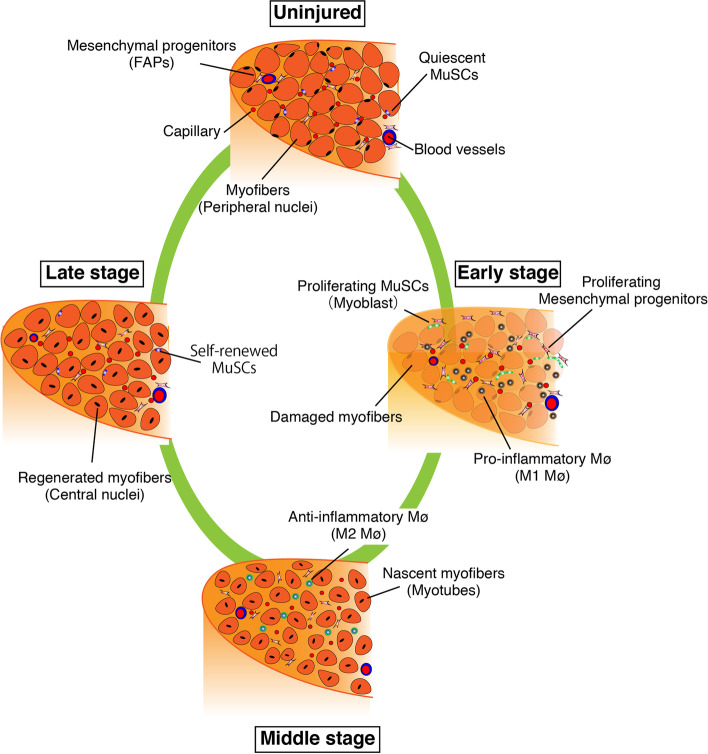
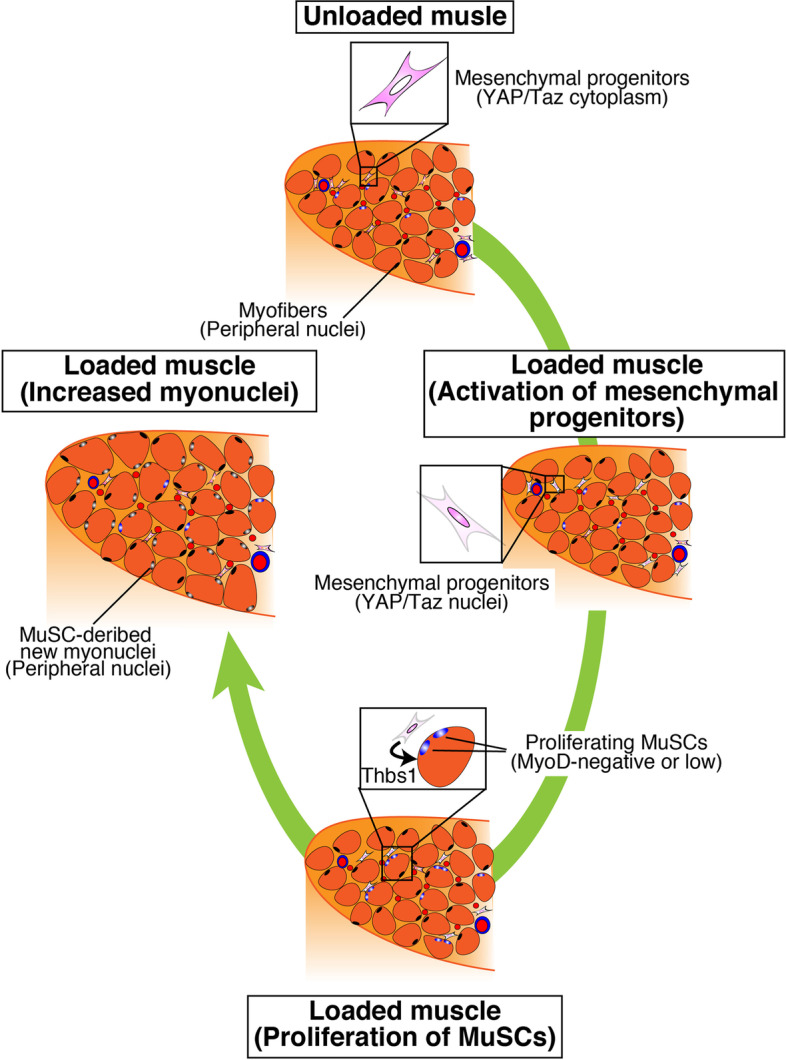
Skeletal muscle homeostasis and function are ensured by orchestrated cellular interactions among several types of cells. A noticeable aspect of skeletal muscle biology is the drastic cell-cell communication changes that occur in multiple scenarios. The process of recovering from an injury, which is known as regeneration, has been relatively well investigated. However, the cellular interplay that occurs in response to mechanical loading, such as during resistance training, is poorly understood compared to regeneration. During muscle regeneration, muscle satellite cells (MuSCs) rebuild multinuclear myofibers through a stepwise process of proliferation, differentiation, fusion, and maturation, whereas during mechanical loading-dependent muscle hypertrophy, MuSCs do not undergo such stepwise processes (except in rare injuries) because the nuclei of MuSCs become directly incorporated into the mature myonuclei. In this review, six specific examples of such differences in MuSC dynamics between regeneration and hypertrophy processes are discussed.
骨骼肌的稳态和功能是由几种类型的细胞之间协调的细胞间相互作用来保证的。骨骼肌生物学的一个显著特点是在多种情况下发生的剧烈的细胞间通讯变化。众所周知,损伤后的恢复过程(即再生)已经得到了相对较好的研究。然而,与再生相比,机械加载(如抗阻训练)所引起的细胞相互作用还知之甚少。在肌肉再生过程中,肌肉卫星细胞(MuSCs)通过增殖、分化、融合和成熟的逐步过程重建多核肌纤维,而在机械加载依赖性肌肉肥大过程中,MuSCs 不会经历这样的逐步过程(除了罕见的损伤),因为 MuSCs 的核直接被纳入成熟的肌核中。在这篇综述中,讨论了 MuSC 动力学在再生和肥大过程中的六个具体差异的例子。