Wunderlich Stephanie, Haase Alexandra, Merkert Sylvia, Jahn Kirsten, Deest Maximillian, Frieling Helge, Glage Silke, Korte Wilhelm, Martens Andreas, Kirschning Andreas, Zeug Andre, Ponimaskin Evgeni, Göhring Gudrun, Ackermann Mania, Lachmann Nico, Moritz Thomas, Zweigerdt Robert, Martin Ulrich
Leibniz Research Laboratories for Biotechnology and Artificial Organs (LEBAO), Department of Cardiothoracic, Transplantation and Vascular Surgery, Hannover Medical School, 30625 Hannover, Germany.
REBIRTH - Research Center for Translational Regenerative Medicine, 30625 Hannover, Germany.
Mol Ther Methods Clin Dev. 2022 May 31;26:84-94. doi: 10.1016/j.omtm.2022.05.011. eCollection 2022 Sep 8.
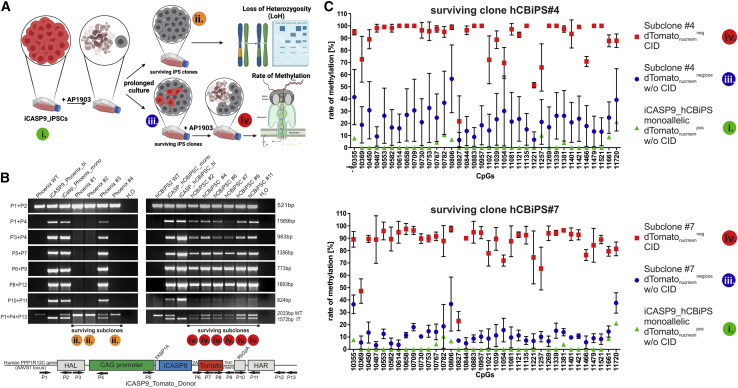
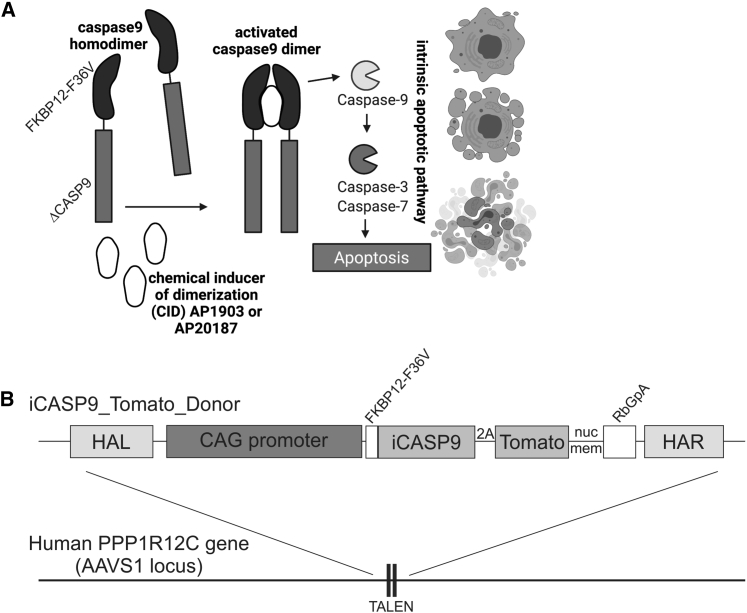
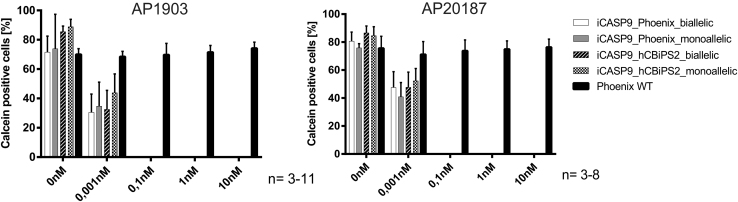
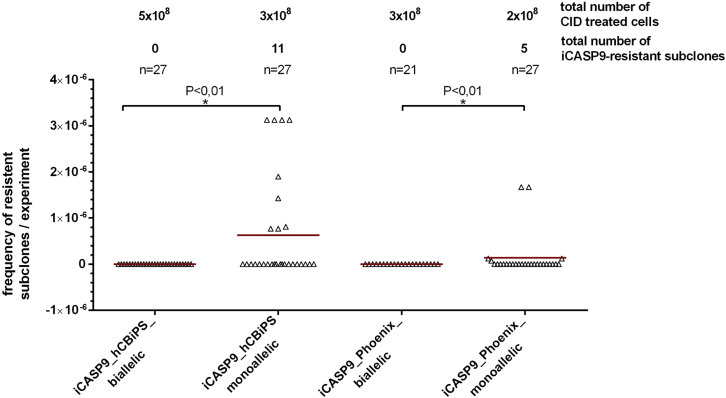
Drug-inducible suicide systems may help to minimize risks of human induced pluripotent stem cell (hiPSC) therapies. Recent research challenged the usefulness of such systems since rare drug-resistant subclones were observed. We have introduced a drug-inducible Caspase 9 suicide system (iCASP9) into the AAVS1 safe-harbor locus of hiPSCs. In these cells, apoptosis could be efficiently induced . After transplantation into mice, drug treatment generally led to rapid elimination of teratomas, but single animals subsequently formed tumor tissue from monoallelic iCASP9 hiPSCs. Very rare drug-resistant subclones of monoallelic iCASP9 hiPSCs appeared with frequencies of ∼ 3 × 10. Besides transgene elimination, presumably via loss of heterozygosity (LoH), silencing via aberrant promoter methylation was identified as a major underlying mechanism. In contrast to monoallelic iCASP9 hiPSCs, no escapees from biallelic iCASP9 cells were observed after treatment of up to 0.8 billion hiPSCs. The highly increased safety level provided by biallelic integration of the iCASP9 system may substantially contribute to the safety level of iPSC-based therapies.
药物诱导性自杀系统可能有助于将人类诱导多能干细胞(hiPSC)疗法的风险降至最低。最近的研究对这类系统的实用性提出了质疑,因为观察到了罕见的耐药亚克隆。我们已将一种药物诱导性Caspase 9自杀系统(iCASP9)引入hiPSC的AAVS1安全港位点。在这些细胞中,可有效诱导细胞凋亡。将其移植到小鼠体内后,药物治疗通常会导致畸胎瘤迅速消除,但单只动物随后会由单等位基因iCASP9 hiPSC形成肿瘤组织。单等位基因iCASP9 hiPSC出现了非常罕见的耐药亚克隆,频率约为3×10。除了可能通过杂合性缺失(LoH)消除转基因外,异常启动子甲基化导致的沉默被确定为一个主要的潜在机制。与单等位基因iCASP9 hiPSC不同,在处理多达8亿个hiPSC后,未观察到双等位基因iCASP9细胞出现逃逸细胞。iCASP9系统双等位基因整合所提供的高度提高的安全水平可能会对基于iPSC的疗法的安全水平做出重大贡献。