Department of Cardiovascular Biology and Medicine, Juntendo University Graduate School of Medicine, Tokyo, Japan.
Department of Cardiology, Juntendo University Shizuoka Hospital, Shizuoka, Japan.
Int J Cancer. 2022 Nov 1;151(9):1482-1490. doi: 10.1002/ijc.34164. Epub 2022 Jul 7.
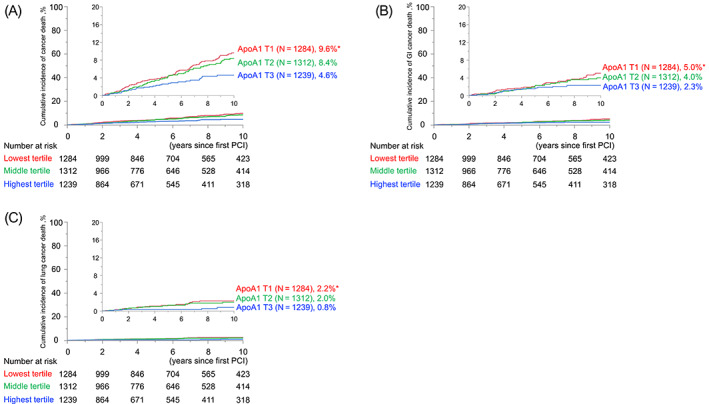
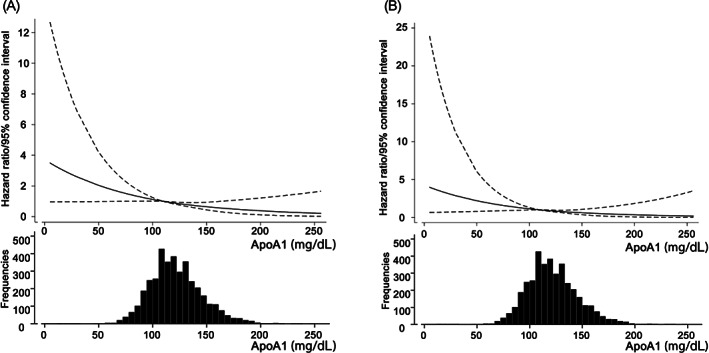
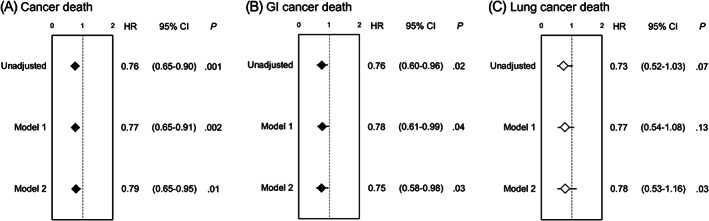
Previous studies showed that elevated apolipoprotein A1 (ApoA1) and high-density lipoprotein cholesterol (HDL-C) predicted reduced risk of cardiovascular-related (CV) mortality in patients following percutaneous coronary intervention (PCI). Nevertheless, as the association between ApoA1 and cancer mortality in this population has been rarely addressed, our study aimed to evaluate prognostic impact of ApoA1 on multiple types of cancer mortality after PCI. This is a retrospective analysis of a single-center prospective registry database of patients who underwent PCI between 2000 and 2018. The present study enrolled 3835 patients whose data of serum ApoA1 were available and they were divided into three groups according to the tertiles of the preprocedural level of ApoA1. The outcome measures were total, gastrointestinal, and lung cancer mortalities. The median and range of the follow-up period between the index PCI and latest follow-up were 5.9 and 0-17.8 years, respectively. Consequently, Kaplan-Meier analyses showed significantly higher rates of the cumulative incidences of total, gastrointestinal, and lung cancer mortality in the lowest ApoA1 tertile group compared to those in the highest. In contrast, there were no significant differences in all types of cancer mortality rates in the groups divided by the tertiles of HDL-C. Multivariable Cox proportional hazard regression analysis adjusted by cancer-related prognostic factors, such as smoking status, identified the elevated ApoA1 as an independent predictor of decreased risk of total and gastrointestinal cancer mortalities. Our study demonstrates the prognostic implication of preprocedural ApoA1 for predicting future risk of cancer mortality in patients undergoing PCI.
先前的研究表明,载脂蛋白 A1(ApoA1)升高和高密度脂蛋白胆固醇(HDL-C)升高可降低经皮冠状动脉介入治疗(PCI)后心血管相关(CV)死亡率。然而,由于 ApoA1 与该人群癌症死亡率之间的关联很少被提及,我们的研究旨在评估 ApoA1 对 PCI 后多种类型癌症死亡率的预后影响。这是对 2000 年至 2018 年间接受 PCI 的患者的单中心前瞻性注册数据库进行的回顾性分析。本研究纳入了 3835 名患者,他们的数据中包含血清 ApoA1 水平,根据 ApoA1 术前水平的三分位数将他们分为三组。主要终点是全因、胃肠道和肺癌死亡率。指数 PCI 和最新随访之间的中位和范围随访时间分别为 5.9 年和 0-17.8 年。结果,Kaplan-Meier 分析显示,在最低 ApoA1 三分位数组中,总、胃肠道和肺癌死亡率的累积发生率明显更高。相反,按 HDL-C 三分位数分组的各组之间的所有类型癌症死亡率没有显著差异。多变量 Cox 比例风险回归分析调整了与癌症相关的预后因素,如吸烟状况,结果表明,ApoA1 升高是全因和胃肠道癌症死亡率降低的独立预测因素。本研究表明,术前 ApoA1 对预测 PCI 后癌症死亡率的未来风险具有预后意义。