Center for Food Safety and Applied Nutrition, US Food and Drug Administration, College Park, MD, 20740, USA.
Center for Urban Waters, University of Washington Tacoma, Tacoma, WA, 98421, USA.
Anal Bioanal Chem. 2022 Sep;414(22):6455-6471. doi: 10.1007/s00216-022-04203-3. Epub 2022 Jul 7.
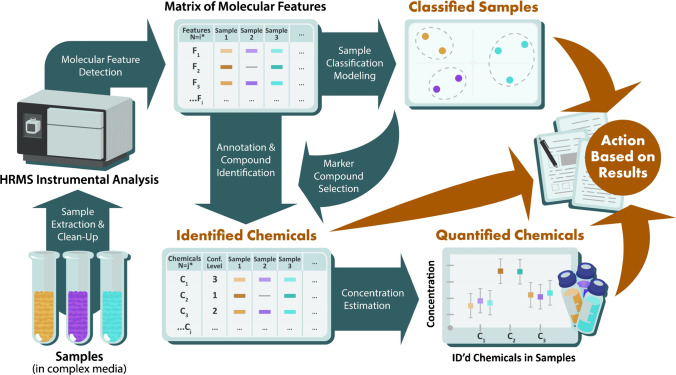
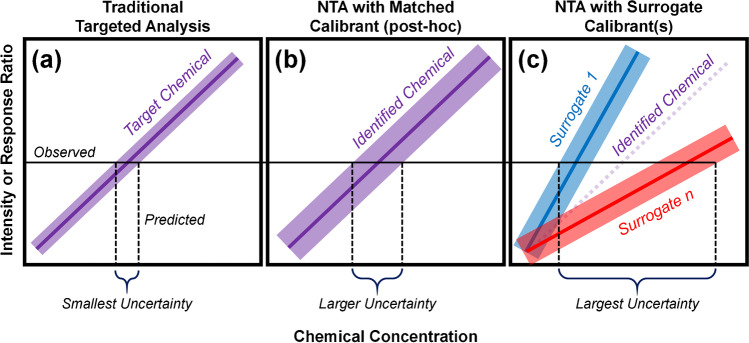
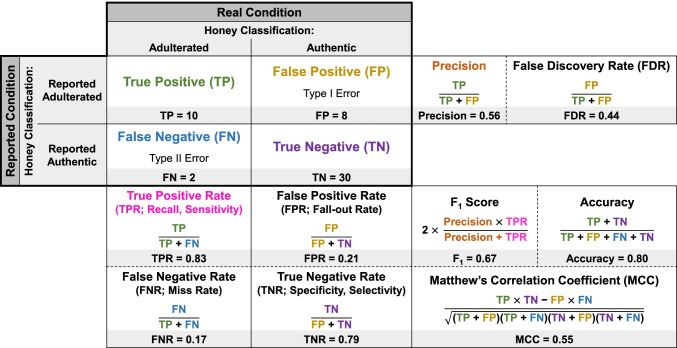
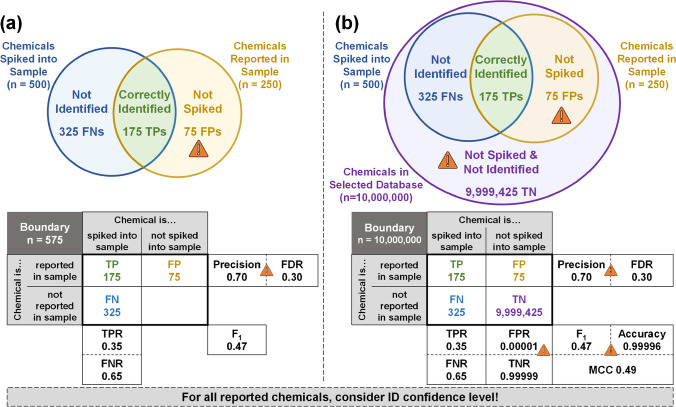
Non-targeted analysis (NTA) using high-resolution mass spectrometry has enabled the detection and identification of unknown and unexpected compounds of interest in a wide range of sample matrices. Despite these benefits of NTA methods, standardized procedures do not yet exist for assessing performance, limiting stakeholders' abilities to suitably interpret and utilize NTA results. Herein, we first summarize existing performance assessment metrics for targeted analyses to provide context and clarify terminology that may be shared between targeted and NTA methods (e.g., terms such as accuracy, precision, sensitivity, and selectivity). We then discuss promising approaches for assessing NTA method performance, listing strengths and key caveats for each approach, and highlighting areas in need of further development. To structure the discussion, we define three types of NTA study objectives: sample classification, chemical identification, and chemical quantitation. Qualitative study performance (i.e., focusing on sample classification and/or chemical identification) can be assessed using the traditional confusion matrix, with some challenges and limitations. Quantitative study performance can be assessed using estimation procedures developed for targeted methods with consideration for additional sources of uncontrolled experimental error. This article is intended to stimulate discussion and further efforts to develop and improve procedures for assessing NTA method performance. Ultimately, improved performance assessments will enable accurate communication and effective utilization of NTA results by stakeholders.
非靶向分析(NTA)使用高分辨率质谱技术,能够在广泛的样品基质中检测和鉴定未知和意外的感兴趣化合物。尽管 NTA 方法具有这些优势,但目前还没有评估性能的标准化程序,限制了利益相关者适当解释和利用 NTA 结果的能力。在此,我们首先总结了现有的靶向分析性能评估指标,以提供上下文并阐明靶向和 NTA 方法之间可能共享的术语(例如,准确性、精密度、灵敏度和选择性等术语)。然后,我们讨论了评估 NTA 方法性能的有前途的方法,列出了每种方法的优点和关键注意事项,并强调了需要进一步开发的领域。为了组织讨论,我们定义了 NTA 研究的三种目标类型:样品分类、化学识别和化学定量。定性研究性能(即专注于样品分类和/或化学识别)可以使用传统的混淆矩阵进行评估,其中存在一些挑战和限制。定量研究性能可以使用针对靶向方法开发的估计程序进行评估,同时考虑到额外的不可控实验误差来源。本文旨在激发讨论并进一步努力开发和改进评估 NTA 方法性能的程序。最终,改进的性能评估将使利益相关者能够准确地交流和有效地利用 NTA 结果。