Department of Neurology, University Hospital Knappschaftskrankenhaus, Ruhr University Bochum, In der Schornau 23-25, D-44892, Bochum, Germany.
Institute of Neuropathology, Heinrich Heine University Medical Faculty and University Hospital Düsseldorf, Düsseldorf, Germany.
J Neurooncol. 2022 Aug;159(1):65-79. doi: 10.1007/s11060-022-04044-1. Epub 2022 Jul 7.
Cognitive functioning represents an essential determinant of quality of life. Since significant advances in neuro-oncological treatment have led to prolonged survival it is important to reliably identify possible treatment-related neurocognitive dysfunction in brain tumor patients. Therefore, the present study specifically evaluates the effects of standard treatment modalities on neurocognitive functions in glioma patients within two years after surgery.
Eighty-six patients with World Health Organization (WHO) grade 1-4 gliomas were treated between 2004 and 2012 and prospectively followed within the German Glioma Network. They received serial neuropsychological assessment of attention, memory and executive functions using the computer-based test battery NeuroCog FX. As the primary outcome the extent of change in cognitive performance over time was compared between patients who received radiotherapy, chemotherapy or combined radio-chemotherapy and patients without any adjuvant therapy. Additionally, the effect of irradiation and chemotherapy was assessed in subgroup analyses. Furthermore, the potential impact of the extent of tumor resection and histopathological characteristics on cognitive functioning were referred to as secondary outcomes.
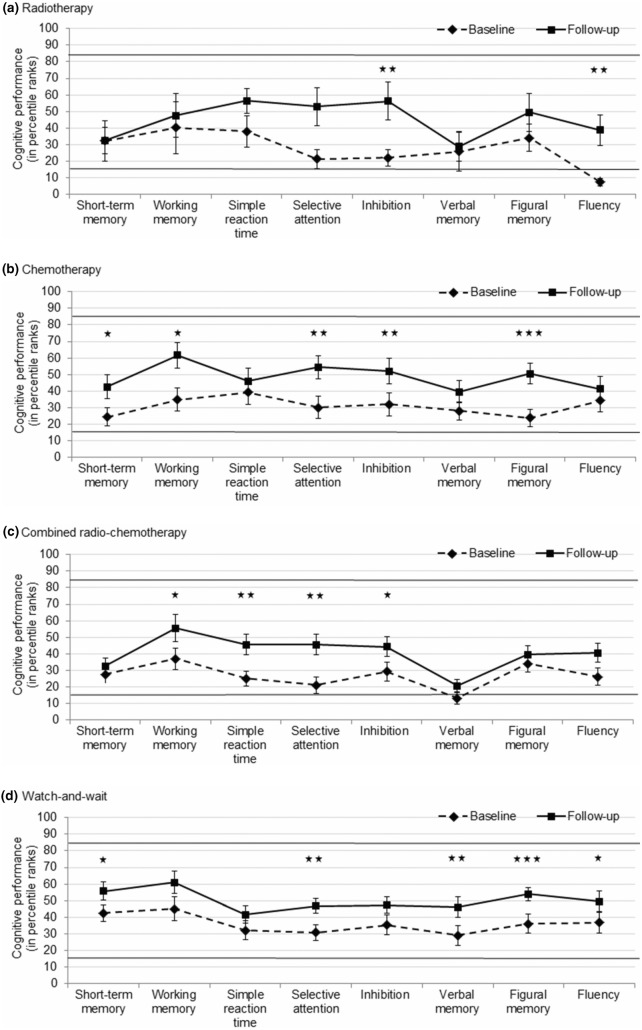
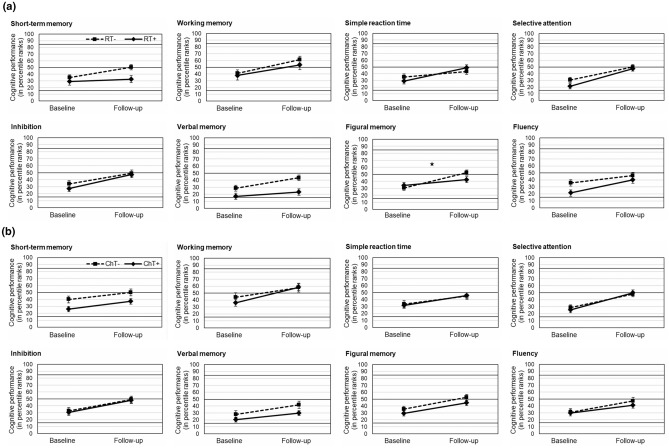
After a median of 16.8 (range 5.9-31.1) months between post-surgery baseline neuropsychological assessment and follow-up assessment, all treatment groups showed numerical and often even statistically significant improvement in all cognitive domains. The extent of change in cognitive functioning showed no difference between treatment groups. Concerning figural memory only, irradiated patients showed less improvement than non-irradiated patients (p = 0.029, η = 0.06). Resected patients, yet not patients with biopsy, showed improvement in all cognitive domains. Compared to patients with astrocytomas, patients with oligodendrogliomas revealed a greater potential to improve in attentional and executive functions. However, the heterogeneity of the patient group and the potentially selected cohort may confound results.
Within a two-year post-surgery interval, radiotherapy, chemotherapy or their combination as standard treatment did not have a detrimental effect on cognitive functions in WHO grade 1-4 glioma patients. Cognitive performance in patients with adjuvant treatment was comparable to that of patients without.
认知功能是生活质量的重要决定因素。由于神经肿瘤治疗的显著进步导致了生存期的延长,因此,重要的是要可靠地识别脑肿瘤患者可能存在的与治疗相关的神经认知功能障碍。因此,本研究专门评估了标准治疗方式对手术后两年内胶质瘤患者神经认知功能的影响。
86 名世界卫生组织(WHO)1-4 级胶质瘤患者于 2004 年至 2012 年在德国神经胶质瘤网络中接受前瞻性治疗。他们使用基于计算机的神经认知 FX 测试电池进行了注意力、记忆和执行功能的连续神经心理学评估。作为主要结果,比较了接受放疗、化疗或联合放化疗的患者与未接受任何辅助治疗的患者的认知功能随时间的变化程度。此外,在亚组分析中评估了放疗和化疗的作用。此外,将肿瘤切除程度和组织病理学特征对认知功能的潜在影响作为次要结果。
在术后基线神经心理学评估和随访评估之间的中位数为 16.8 个月(范围 5.9-31.1)后,所有治疗组在所有认知领域均表现出数值上的、甚至统计学上的显著改善。治疗组之间的认知功能变化程度没有差异。关于图形记忆,仅接受放疗的患者改善程度低于未接受放疗的患者(p=0.029,η=0.06)。接受肿瘤切除术的患者,而非活检患者,在所有认知领域均有改善。与星形细胞瘤患者相比,少突胶质细胞瘤患者在注意力和执行功能方面有更大的改善潜力。然而,患者群体的异质性和潜在的选择队列可能会混淆结果。
在手术后两年的时间间隔内,放疗、化疗或其联合作为标准治疗方案不会对 WHO 1-4 级胶质瘤患者的认知功能产生不利影响。辅助治疗患者的认知表现与未接受治疗的患者相当。