Chukwu Emeka, Garg Lalit, Obande-Ogbuinya Nkiruka, Chattu Vijay Kumar
Department of Computer Information Systems, Faculty of Information Communication Technology, University of Malta, Msida, Malta.
Digital Health Interoperability Network, Abuja, Nigeria.
JMIR Form Res. 2022 Jul 7;6(7):e28510. doi: 10.2196/28510.
Referral linkages are crucial for efficient functioning of primary health care (PHC) systems. Fast Healthcare Interoperability Resource (FHIR) is an open global standard that facilitates structuring of health information for coordinated exchange among stakeholders.
The objective of this study is to design FHIR profiles and present methodology and the profiled FHIR resource for Maternal and Child Health referral use cases in Ebonyi state, Nigeria-a typical low- and middle-income country (LMIC) setting.
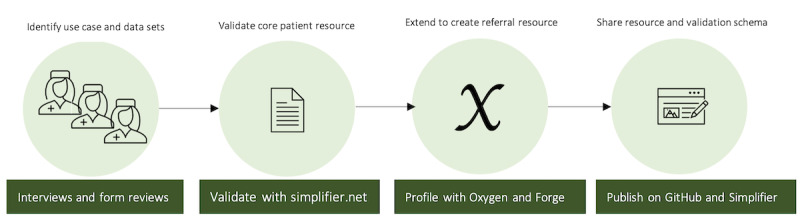
Practicing doctors, midwives, and nurses were purposefully sampled and surveyed. Different referral forms were reviewed. The union of data sets from surveys and forms was aggregated and mapped to base patient FHIR resource elements, and extensions were created for data sets not in the core FHIR specification. This study also introduced FHIR and its relation to the World Health Organization's (WHO's) International Classification of Diseases.
We found many different data elements from the referral forms and survey responses even in urban settings. The resulting FHIR standard profile is published on GitHub for adaptation or adoption as necessary to aid alignment with WHO recommendations. Understanding data sets used in health care and clinical practice for information sharing is crucial in properly standardizing information sharing, particularly during the management of COVID-19 and other infectious diseases. Development organizations and governments can use this methodology and profile to fast-track FHIR standards adoption for paper and electronic information sharing at PHC systems in LMICs.
We presented our methodology for profiling the referral resource crucial for the standardized exchange of new and expectant moms' information. Using data from frontline providers and mapping to the FHIR profile helped contextualize the standardized profile.
转诊联系对于初级卫生保健(PHC)系统的高效运作至关重要。快速医疗保健互操作性资源(FHIR)是一项开放的全球标准,有助于构建健康信息,以便利益相关者之间进行协调交换。
本研究的目的是设计FHIR配置文件,并介绍尼日利亚埃邦伊州母婴健康转诊用例的方法和配置后的FHIR资源,埃邦伊州是典型的低收入和中等收入国家(LMIC)环境。
有目的地抽取执业医生、助产士和护士进行调查。审查了不同的转诊表格。将调查和表格中的数据集合并并汇总,映射到基础患者FHIR资源元素,并为不在FHIR核心规范中的数据集创建扩展。本研究还介绍了FHIR及其与世界卫生组织(WHO)国际疾病分类的关系。
我们发现,即使在城市环境中,转诊表格和调查回复中也有许多不同的数据元素。生成的FHIR标准配置文件已在GitHub上发布,以便根据需要进行调整或采用,以帮助与WHO的建议保持一致。了解医疗保健和临床实践中用于信息共享的数据集对于正确规范信息共享至关重要,尤其是在COVID-19和其他传染病的管理期间。发展组织和政府可以使用这种方法和配置文件,快速推动低收入和中等收入国家初级卫生保健系统采用FHIR标准进行纸质和电子信息共享。
我们展示了对转诊资源进行配置的方法,这对于规范新妈妈和准妈妈信息的交换至关重要。使用一线提供者的数据并映射到FHIR配置文件有助于将标准化配置文件与实际情况相结合。