LADR Laboratory Group Dr Kramer & Colleagues, Geesthacht, Germany.
IT Center for Clinical Research, University of Luebeck, Luebeck, Germany.
JMIR Med Inform. 2024 Oct 18;12:e57569. doi: 10.2196/57569.
Reaching meaningful interoperability between proprietary health care systems is a ubiquitous task in medical informatics, where communication servers are traditionally used for referring and transforming data from the source to target systems. The Mirth Connect Server, an open-source communication server, offers, in addition to the exchange functionality, functions for simultaneous manipulation of data. The standard Fast Healthcare Interoperability Resources (FHIR) has recently become increasingly prevalent in national health care systems. FHIR specifies its own standardized mechanisms for transforming data structures using StructureMaps and the FHIR mapping language (FML).
In this study, a generic approach is developed, which allows for the application of declarative mapping rules defined using FML in an exchangeable manner. A transformation engine is required to execute the mapping rules.
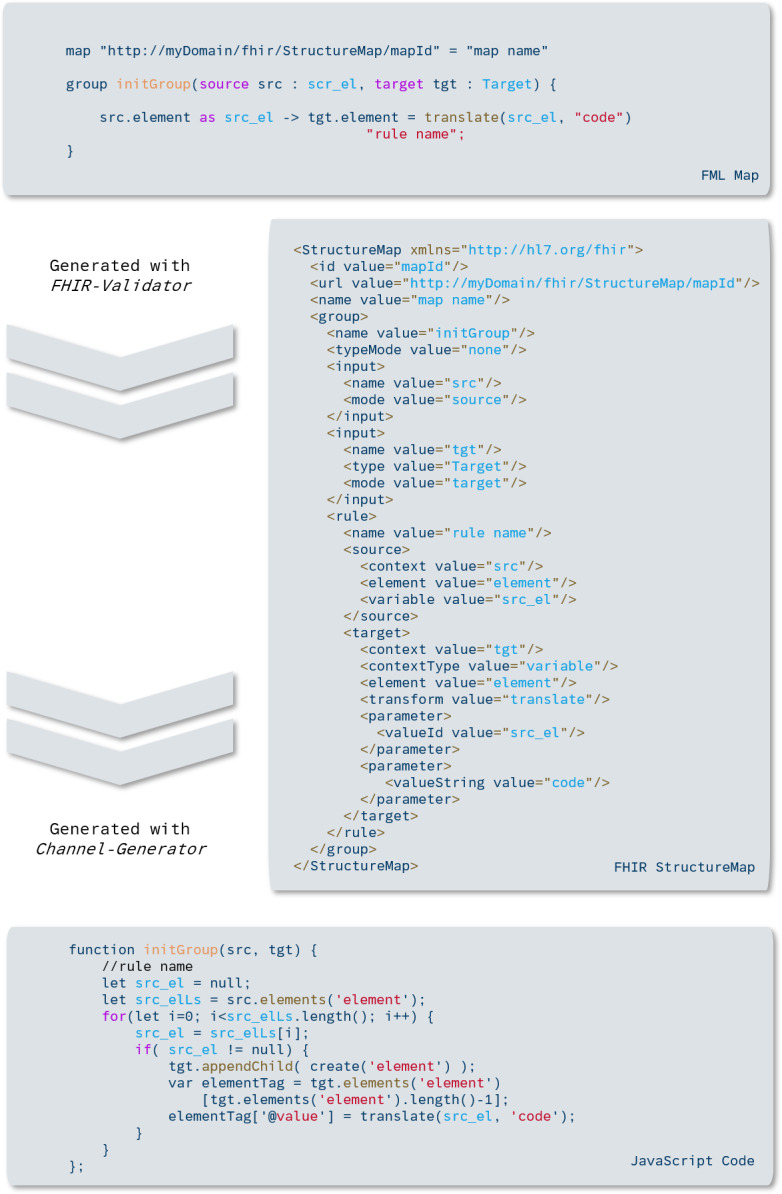
FHIR natively defines resources to support the conversion of instance data, such as an FHIR StructureMap. This resource encodes all information required to transform data from a source system to a target system. In our approach, this information is defined in an implementation-independent manner using FML. Once the mapping has been defined, executable Mirth channels are automatically generated from the resources containing the mapping in JavaScript format. These channels can then be deployed to the Mirth Connect Server.
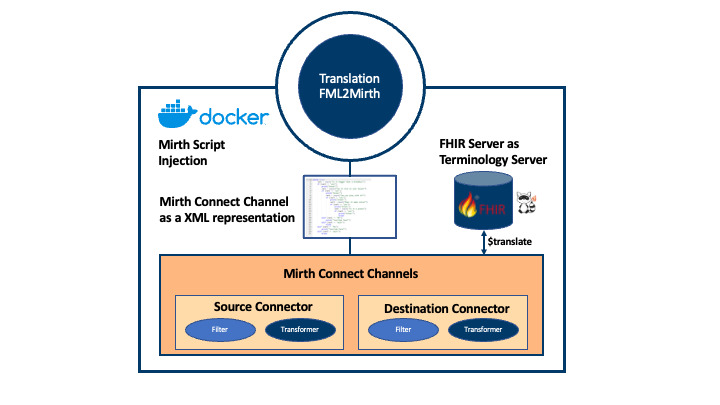
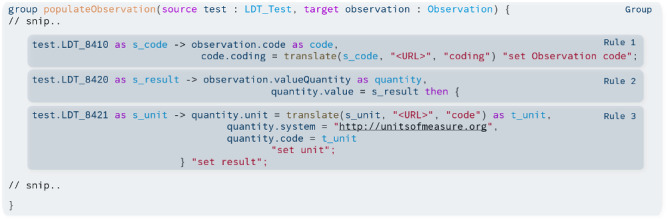
The resulting tool is called FML2Mirth, a Java-based transformer that derives Mirth channels from detailed declarative mapping rules based on the underlying StructureMaps. Implementation of the translate functionality is provided by the integration of a terminology server, and to achieve conformity with existing profiles, validation via the FHIR validator is built in. The system was evaluated for its practical use by transforming Labordatenträger version 2 (LDTv.2) laboratory results into Medical Information Object (Medizinisches Informationsobjekt) laboratory reports in accordance with the National Association of Statutory Health Insurance Physicians' specifications and into the HL7 (Health Level Seven) Europe Laboratory Report. The system could generate complex structures, but LDTv.2 lacks some information to fully comply with the specification.
The tool for the auto-generation of Mirth channels was successfully presented. Our tests reveal the feasibility of using the complex structures of the mapping language in combination with a terminology server to transform instance data. Although the Mirth Server and the FHIR are well established in medical informatics, the combination offers space for more research, especially with regard to FML. Simultaneously, it can be stated that the mapping language still has implementation-related shortcomings that can be compensated by Mirth Connect as a base technology.
在医学信息学中,实现专有医疗保健系统之间有意义的互操作性是一项普遍任务,传统上使用通信服务器来引用和转换来自源系统到目标系统的数据。Mirth Connect Server 是一个开源的通信服务器,除了提供交换功能外,还提供了同时操作数据的功能。最近,标准的快速医疗保健互操作性资源 (FHIR) 在国家医疗保健系统中越来越流行。FHIR 指定了自己的用于使用 StructureMaps 和 FHIR 映射语言 (FML) 转换数据结构的标准化机制。
本研究开发了一种通用方法,允许以可交换的方式应用使用 FML 定义的声明性映射规则。执行映射规则需要一个转换引擎。
FHIR 原生定义了资源来支持实例数据的转换,例如 FHIR StructureMap。此资源编码了将数据从源系统转换到目标系统所需的所有信息。在我们的方法中,使用 FML 以独立于实现的方式定义此信息。定义映射后,将以 JavaScript 格式包含映射的资源自动生成可执行的 Mirth 通道。然后可以将这些通道部署到 Mirth Connect Server。
生成的工具称为 FML2Mirth,这是一个基于 Java 的转换器,它根据基础的 StructureMaps 从详细的声明性映射规则中派生 Mirth 通道。translate 功能的实现是通过集成术语服务器提供的,并且为了与现有配置文件保持一致,内置了通过 FHIR 验证器进行验证。通过根据国家法定健康保险医师规范将 Labordatenträger version 2 (LDTv.2) 实验室结果转换为符合医疗信息对象 (Medizinisches Informationsobjekt) 实验室报告,并转换为 HL7(Health Level Seven)欧洲实验室报告,对该系统进行了实际使用的评估。该系统能够生成复杂的结构,但 LDTv.2 缺少一些信息,无法完全符合规范。
成功展示了用于自动生成 Mirth 通道的工具。我们的测试表明,使用映射语言的复杂结构结合术语服务器来转换实例数据是可行的。尽管 Mirth Server 和 FHIR 在医学信息学中已经得到很好的应用,但这种组合为更多的研究提供了空间,特别是关于 FML。同时,可以说映射语言仍然存在与实现相关的缺点,这可以通过作为基础技术的 Mirth Connect 来弥补。