Department of Microbiology & Molecular Genetics, University of California, Davis, USA.
Department of Plant Pathology, University of California, Davis, USA; Genome Center, University of California, Davis, USA.
J Biol Chem. 2022 Aug;298(8):102232. doi: 10.1016/j.jbc.2022.102232. Epub 2022 Jul 5.
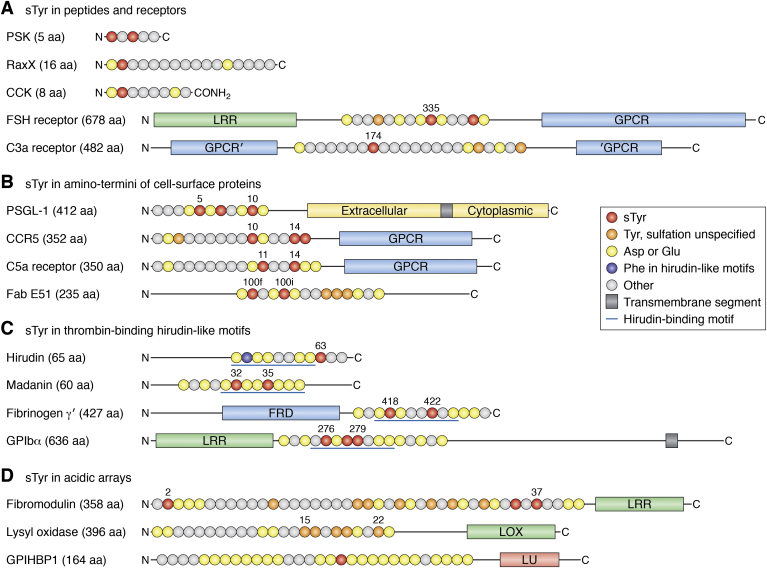
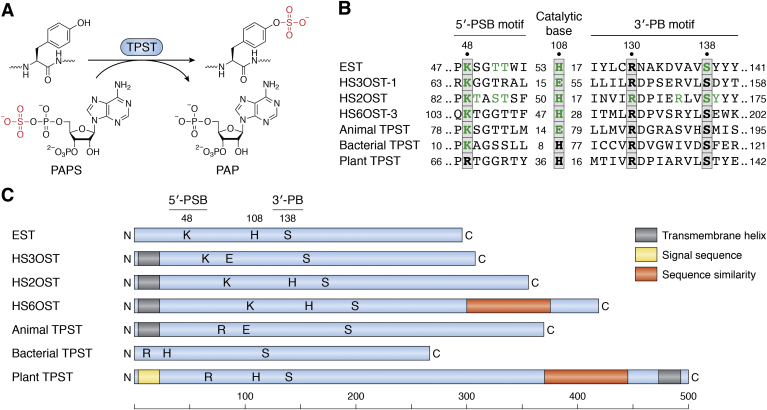
Tyrosine sulfation, a post-translational modification, can determine and often enhance protein-protein interaction specificity. Sulfotyrosyl residues (sTyrs) are formed by the enzyme tyrosyl-protein sulfotransferase during protein maturation in the Golgi apparatus and most often occur singly or as a cluster within a six-residue span. With both negative charge and aromatic character, sTyr facilitates numerous atomic contacts as visualized in binding interface structural models, thus there is no discernible binding site consensus. Found exclusively in secreted proteins, in this review, we discuss the four broad sequence contexts in which sTyr has been observed: first, a solitary sTyr has been shown to be critical for diverse high-affinity interactions, such as between peptide hormones and their receptors, in both plants and animals. Second, sTyr clusters within structurally flexible anionic segments are essential for a variety of cellular processes, including coreceptor binding to the HIV-1 envelope spike protein during virus entry, chemokine interactions with receptors, and leukocyte rolling cell adhesion. Third, a subcategory of sTyr clusters is found in conserved acidic sequences termed hirudin-like motifs that enable proteins to interact with thrombin; consequently, many proven and potential therapeutic proteins derived from blood-consuming invertebrates depend on sTyrs for their activity. Finally, several proteins that interact with collagen or similar proteins contain one or more sTyrs within an acidic residue array. Refined methods to direct sTyr incorporation in peptides synthesized both in vitro and in vivo, together with continued advances in mass spectrometry and affinity detection, promise to accelerate discoveries of sTyr occurrence and function.
酪氨酸硫酸化是一种翻译后修饰,可确定并经常增强蛋白质-蛋白质相互作用的特异性。硫酸酪氨酰残基(sTyr)是在高尔基体内蛋白质成熟过程中由酶酪氨酸蛋白硫转移酶形成的,通常以单个形式或在六残基跨度内形成簇。由于具有负电荷和芳香性,sTyr 在结合界面结构模型中可视化时促进了许多原子接触,因此没有可识别的结合位点共识。仅在分泌蛋白中发现,在本综述中,我们讨论了观察到 sTyr 的四个广泛的序列上下文:首先,已经证明单个 sTyr 对于多种高亲和力相互作用至关重要,例如植物和动物中的肽激素与其受体之间的相互作用。其次,结构灵活的阴离子片段内的 sTyr 簇对于各种细胞过程至关重要,包括病毒进入时辅助受体与 HIV-1 包膜刺突蛋白的结合、趋化因子与受体的相互作用以及白细胞滚动细胞黏附。第三,在称为水蛭素样基序的保守酸性序列中发现了 sTyr 簇的一个亚类,使蛋白质能够与凝血酶相互作用;因此,许多已证明和潜在的治疗性蛋白质来源于吸血无脊椎动物,其活性依赖于 sTyrs。最后,一些与胶原蛋白或类似蛋白质相互作用的蛋白质在酸性残基阵列内含有一个或多个 sTyr。在体外和体内合成肽时指导 sTyr 掺入的改进方法,以及质谱和亲和检测的持续进展,有望加速发现 sTyr 的发生和功能。