Institute for Physical Activity and Nutrition (IPAN), Deakin University, Geelong, Australia.
Alliance for Research in Exercise, Nutrition and Activity (ARENA), University of South Australia, Adelaide, South Australia, Australia.
Int J Behav Nutr Phys Act. 2022 Jul 7;19(1):76. doi: 10.1186/s12966-022-01314-z.
It is unknown if and how children's movement behaviour accumulation patterns change as a result of physical activity and/or sedentary behaviour interventions. It is important to establish the effectiveness of interventions targeting changes in such accumulation patterns. This study aimed to investigate the effect of the Transform-Us! school- and home-based intervention program on children's movement behaviour accumulation patterns, focusing on sporadic accumulation versus time in bouts.
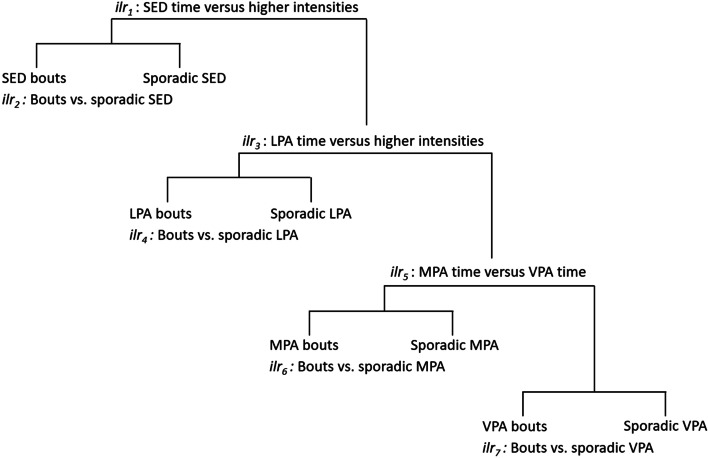
Baseline and post-intervention (18 months) accelerometer data from the Transform-Us! 2 × 2 factorial design cluster randomised controlled trial was used (Melbourne, 2010-2012; analytical sample n = 267; aged 8-9 years). Linear mixed models were fitted to examine effects of three different interventions (targeting increases in physical activity [PA-I], reductions in sedentary time [SB-I], or both [PA + SB-I]) compared to a usual practice (control) group on post-intervention movement behaviour accumulation compositions with eight components, including sporadic time and bouts of sedentary time, and light-, moderate- and vigorous-intensity physical activity.
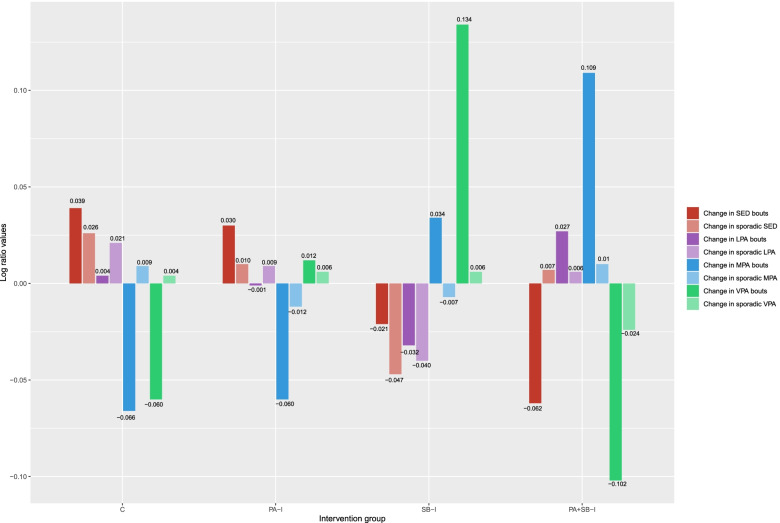
Intervention effects on distribution of time in the post-intervention waking movement behaviour accumulation composition (adjusted for baseline composition) were small and not significant. However, visual inspection of the change in compositions over time revealed that only groups with a sedentary behaviour intervention component (SB-I and PA + SB-I) reduced time in sedentary bouts, compared to the overall sample compositional mean. In addition, the SB-I group was the only group with an increase in vigorous-intensity physical activity. The combined intervention group (PA + SB-I) was characterized by the largest proportional increase in MPA bouts. The usual practice group was characterized by the largest proportional increases in both sporadic and bouts of sedentary time.
This study showed some early evidence to suggest that the "break up your sitting" message may result in greater impact than the "move more" message. Future research, including larger sample sizes, should investigate if this type of messaging is indeed more effective in changing movement behaviours and ultimately child health.
International Standard Randomized Controlled Trial Number ISRCTN83725066 ; Australian New Zealand Clinical Trials Registry Number ACTRN12609000715279 .
目前尚不清楚儿童的运动行为积累模式是否会因身体活动和/或久坐行为干预而发生变化,以及会如何变化。因此,确定针对此类积累模式变化的干预措施的有效性非常重要。本研究旨在调查 Transform-Us!基于学校和家庭的干预计划对儿童运动行为积累模式的影响,重点关注零星积累与成块时间。
本研究使用了 Transform-Us!2×2 析因设计的群组随机对照试验的基线和干预后(18 个月)加速度计数据(墨尔本,2010-2012 年;分析样本 n=267;年龄 8-9 岁)。使用线性混合模型来检验三种不同干预措施(旨在增加身体活动[PA-I]、减少久坐时间[SB-I]或两者兼顾[PA+SB-I])与常规实践(对照组)相比,对干预后运动行为积累组成的影响,该组成有 8 个成分,包括零星时间和久坐时间的成块时间,以及低强度、中强度和高强度身体活动。
干预对干预后清醒运动行为积累组成部分的时间分布的影响较小且无统计学意义(调整基线组成后)。然而,从时间推移上观察组成部分的变化表明,只有具有久坐行为干预成分的组(SB-I 和 PA+SB-I)与总体样本组成均值相比,减少了久坐时间的成块时间。此外,SB-I 组是唯一增加高强度身体活动的组。联合干预组(PA+SB-I)的特点是中高强度身体活动的比例增加最大。常规实践组的特点是零星时间和久坐时间的成块时间都有最大的比例增加。
本研究初步表明,“分散久坐时间”的信息可能比“多运动”的信息更具影响力。未来的研究,包括更大的样本量,应该调查这种类型的信息是否确实更有效地改变运动行为,最终影响儿童健康。
国际标准随机对照试验编号 ISRCTN83725066;澳大利亚新西兰临床试验注册编号 ACTRN12609000715279。