Deutsch-Feldman Molly, Springer Yuri P, Felix Derrick, Tsang Clarisse A, Brostrom Richard, Haddad Maryam
Division of Tuberculosis Elimination, National Center for HIV, Viral Hepatitis, STDs, and TB Prevention, Centers for Disease Control and Prevention, Atlanta, Georgia, USA.
Epidemic Intelligence Service, Centers for Disease Control and Prevention, Atlanta, Georgia, USA.
Health Equity. 2022 Jun 27;6(1):476-484. doi: 10.1089/heq.2022.0065. eCollection 2022.
In recent years, tuberculosis (TB) incidence in the United States has declined overall but remained high among Native Hawaiian and Other Pacific Islander (NH/PI) persons. Few studies have examined the epidemiology of TB among NH/PI persons, particularly in the U.S.-Affiliated Pacific Islands (USAPI). We describe TB incidence and characteristics of NH/PI patients during 2010-2019.
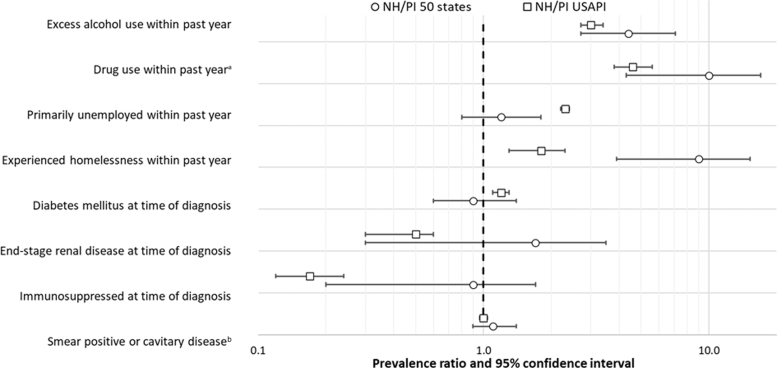
We used data from the National Tuberculosis Surveillance System to characterize TB cases reported among NH/PI persons born in the 50 U.S. states (defined to include District of Columbia) and the USAPI. We calculated annual TB incidence among NH/PI patients, stratified by place of birth (U.S. states or USAPI). Using Asian persons born outside the United States-persons historically grouped with NH/PI persons as one racial category-as the reference, we compared demographic, clinical, and socio-behavioral characteristics of NH/PI TB patients.
During 2010-2019, 4359 TB cases were reported among NH/PI patients born in the U.S. states (=205) or the USAPI (=4154). Median annual incidence per 100,000 persons was 6.5 cases (persons born in the U.S. states) and 150.7 cases (persons born in the USAPI). The proportion of TB patients aged <15 years was higher among NH/PI persons (U.S. states: 54%, USAPI: 24%) than among Asian persons born outside the United States (1%).
TB incidence among NH/PI persons is high, particularly among persons born in the USAPI, emphasizing the need to enhance TB prevention strategies in these communities. Interventions should be tailored toward those who experience the highest risk, including NH/PI children and adolescents.
近年来,美国结核病发病率总体呈下降趋势,但在夏威夷原住民和其他太平洋岛民(NH/PI)中仍居高不下。很少有研究调查NH/PI人群中的结核病流行病学情况,尤其是在美属太平洋岛屿(USAPI)。我们描述了2010 - 2019年期间NH/PI患者的结核病发病率及特征。
我们使用了国家结核病监测系统的数据,以描述在美国50个州(包括哥伦比亚特区)和美属太平洋岛屿出生的NH/PI人群中报告的结核病病例。我们计算了NH/PI患者的年度结核病发病率,并按出生地(美国各州或美属太平洋岛屿)进行分层。以在美国境外出生的亚洲人(历史上与NH/PI人群归为同一种族类别)作为参照,我们比较了NH/PI结核病患者的人口统计学、临床和社会行为特征。
在2010 - 2019年期间,在美国各州(=205)或美属太平洋岛屿(=4154)出生的NH/PI患者中报告了4359例结核病病例。每10万人的年发病率中位数为6.5例(在美国各州出生的人)和150.7例(在美属太平洋岛屿出生的人)。年龄<15岁的结核病患者比例在NH/PI人群中(美国各州:54%,美属太平洋岛屿:24%)高于在美国境外出生的亚洲人(1%)。
NH/PI人群中的结核病发病率很高,尤其是在美属太平洋岛屿出生的人群中,这凸显了在这些社区加强结核病预防策略的必要性。干预措施应针对那些风险最高人群,包括NH/PI儿童和青少年。