Department of Optometry, Eulji University, Seongnam-si, Gyeonggi-do, Korea.
Department of Optometry, GM St. Mary's Eye Clinic 2, Saessak-ro, Busanjin-gu, Busan-si, Korea.
Medicine (Baltimore). 2022 Jul 8;101(27):e29859. doi: 10.1097/MD.0000000000029859.
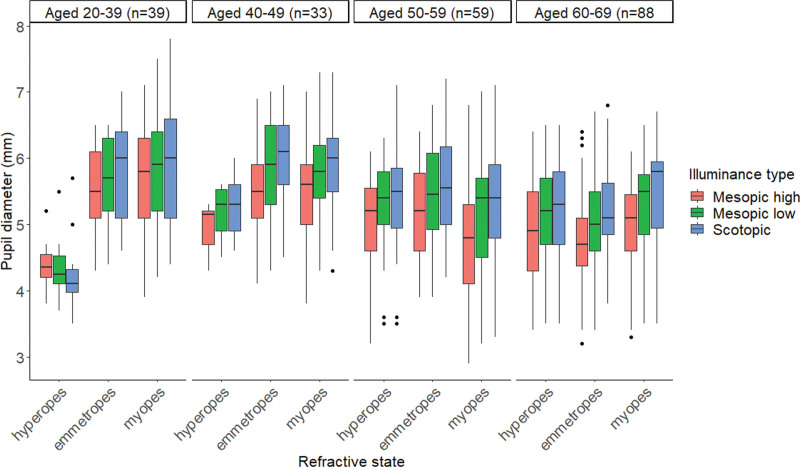
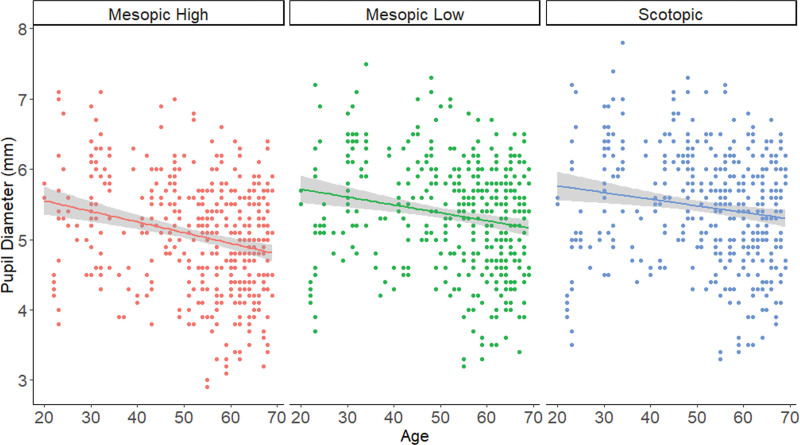
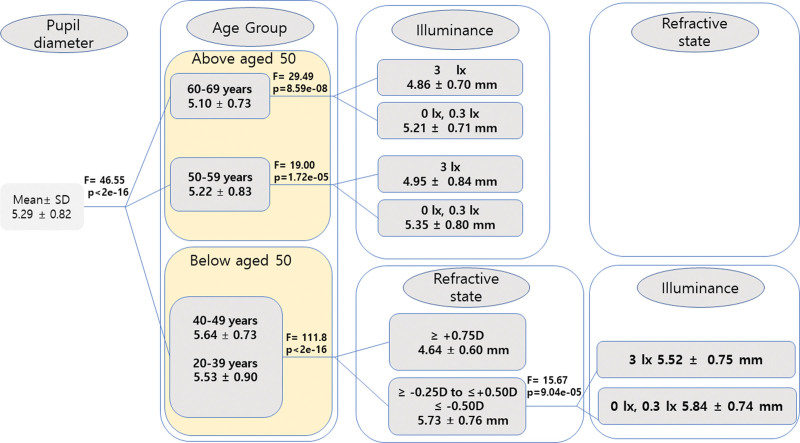
To assess the most influential factor for pupil diameter changes among age, illuminance, and refractive state and reestablish the optimal procedures for clinical applications based on refractive state and illuminance for different age groups. The study was an observational study (repeated measure study). Participants included 219 Korean adults aged 20 to 69 years. Pupil diameters were measured using a pupilometer under scotopic, mesopic-low, and mesopic-high lighting conditions. Factor interactions among age, illuminance, and refractive state were evaluated using mixed linear model and chi-square automated interaction detection. Illuminance mainly contributed to variations in pupil diameter of participants over 50 years, whereas the refractive state was the dominant controlling factor for the pupil variation in participants below 50 years. For more generalized application, the pupil diameter decreased with older age and brighter illuminance (P < .001, inverse correlation, all comparisons). The mean pupil diameter was significantly higher in myopes and emmetropes than in hyperopes (P < .001). Pupil diameter variation modeled using the mixed model confirmed age, illuminance, and refractive error as significant factors (P < .001). Accounting for the interactions among age, illuminance, and refractive error and establishing their hierarchical dominance can be generalized using the chi-square automated interaction detection method and mixed model. Promoting age-dependent consideration for both illuminance and refractive state is necessary when pupil diameters play significant roles in clinical and manufacturing circumstances.
为了评估年龄、光照度和屈光状态对瞳孔直径变化的最具影响力的因素,并基于屈光状态和光照度为不同年龄组重新建立最佳的临床应用程序。本研究为观察性研究(重复测量研究)。参与者包括 219 名年龄在 20 至 69 岁的韩国成年人。在暗视、中视低光和中视高光照明条件下,使用瞳孔计测量瞳孔直径。使用混合线性模型和卡方自动交互检测评估年龄、光照度和屈光状态之间的因子相互作用。光照度主要影响 50 岁以上参与者的瞳孔直径变化,而屈光状态是 50 岁以下参与者瞳孔变化的主要控制因素。为了更广泛的应用,瞳孔直径随年龄的增加和光照度的增加而减小(P <.001,负相关,所有比较)。近视者和正视者的平均瞳孔直径明显高于远视者(P <.001)。使用混合模型模拟的瞳孔直径变化证实年龄、光照度和屈光误差是显著因素(P <.001)。使用卡方自动交互检测方法和混合模型,可以对年龄、光照度和屈光误差之间的相互作用进行综合考虑,并确定其层级优势。在瞳孔直径在临床和制造环境中发挥重要作用时,需要根据年龄考虑光照度和屈光状态。