Salgado Ramiro, Torres Paulo, Marinho António, Ribeiro Filomena J
Departamento de Oftalmologia do Hospital da Arrábida, Hospital de Santo António, Centro Hospitalar e Universitário do Porto, Vila Nova de Gaia, Portugal.
Departamento de Oftalmologia do Hospital da Prelada, Universidade do Porto, Porto, Portugal.
Clin Ophthalmol. 2023 Aug 2;17:2193-2200. doi: 10.2147/OPTH.S420931. eCollection 2023.
This study presents a comparison of pupil changes according to cataract grade between low-energy femtosecond laser-assisted cataract surgery (FLACS) and conventional phacoemulsification (CP) in the same patient.
Data from surgical records from patients submitted to cataract surgery with CP in one eye and FLACS in the other were retrospectively reviewed. The inclusion criterion was both eyes of the same patient having the same cataract grade in accordance with Lens Opacity Classification System (LOCS) III. Total pupil variation (TPV) was measured after recorded images, with intraindividual comparison between techniques, according to cataract grade (≤3 and >3), age and cumulative dissipated energy (CDE).
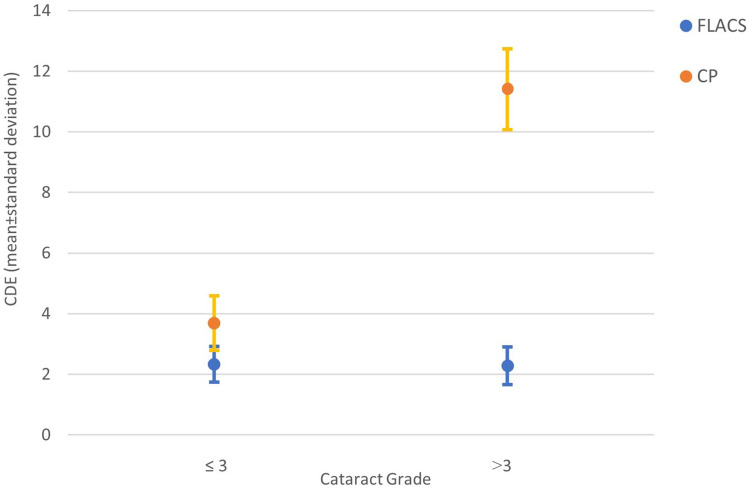
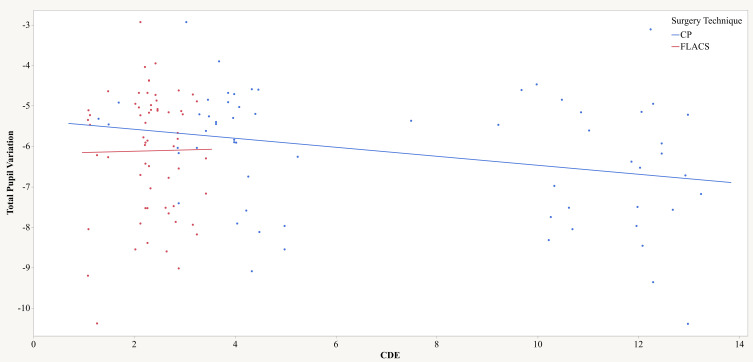
The study included a total of 124 eyes of 62 patients (mean age 72.65 ± 7.64 years). Analysis showed a statistically significant difference in TPV between techniques in the grade ≤3 cataract group (0.08 ± 0.22 mm²; =0.034), with less pupil narrowing with FLACS, but not in the grade >3 group (0.01 ± 0.23 mm²; =0.849). Regarding CDE, a significant difference (<0.001) was found between techniques in both softer and harder cataracts, with lower values for FLACS. Correlation between CDE and TPV was significant for CP (=0.021) but not for FLACS (=0.922). TPV was significantly lower in older patients (age >74 years) for both techniques (<0.001).
There was a statistically significant difference between techniques (although of mild clinical relevance), with less reduction of pupil area with FLACS in softer cataracts (grade ≤3), as compared to CP. Higher levels of CDE are associated with more pupil narrowing in CP.
本研究比较了同一患者在低能量飞秒激光辅助白内障手术(FLACS)和传统超声乳化白内障吸除术(CP)中,根据白内障分级的瞳孔变化情况。
回顾性分析了接受过白内障手术患者的手术记录数据,这些患者一只眼睛接受CP手术,另一只眼睛接受FLACS手术。纳入标准为同一患者的双眼根据晶状体混浊分级系统(LOCS)III具有相同的白内障分级。在记录图像后测量总瞳孔变化(TPV),并根据白内障分级(≤3级和>3级)、年龄和累积耗散能量(CDE)对两种技术进行个体内比较。
该研究共纳入62例患者的124只眼睛(平均年龄72.65±7.64岁)。分析显示,在≤3级白内障组中,两种技术在TPV方面存在统计学显著差异(0.08±0.22mm²;P=0.034),FLACS导致的瞳孔缩小较少,但在>3级组中无差异(0.01±0.23mm²;P=0.849)。关于CDE,在软性和硬性白内障中,两种技术之间均存在显著差异(P<0.001),FLACS的值更低。CDE与TPV之间的相关性在CP中显著(P=0.021),但在FLACS中不显著(P=0.922)。对于两种技术,年龄较大(>74岁)的患者TPV显著更低(P<0.001)。
两种技术之间存在统计学显著差异(尽管临床相关性较小),与CP相比,在软性白内障(≤3级)中,FLACS导致的瞳孔面积缩小较少。较高水平的CDE与CP中更多的瞳孔缩小相关。