Department of Ophthalmology, Henry Ford Hospital, Detroit, Michigan, United States of America.
PLoS One. 2022 Jul 8;17(7):e0268451. doi: 10.1371/journal.pone.0268451. eCollection 2022.
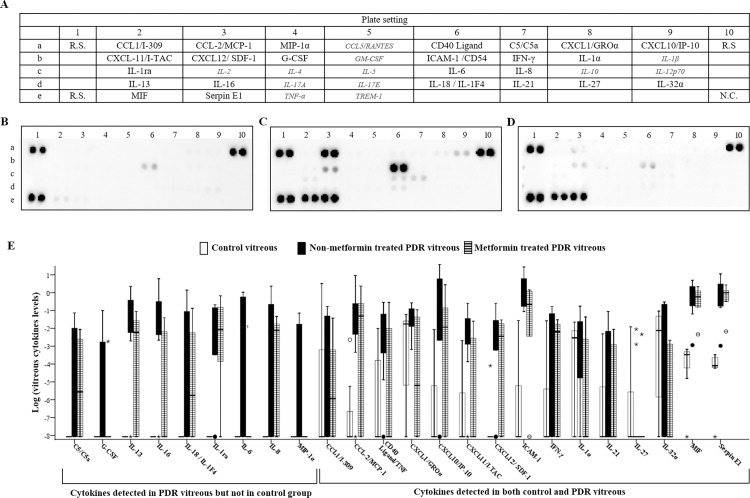
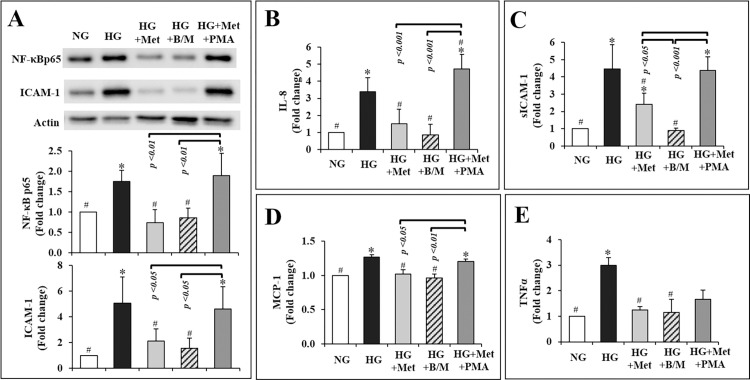
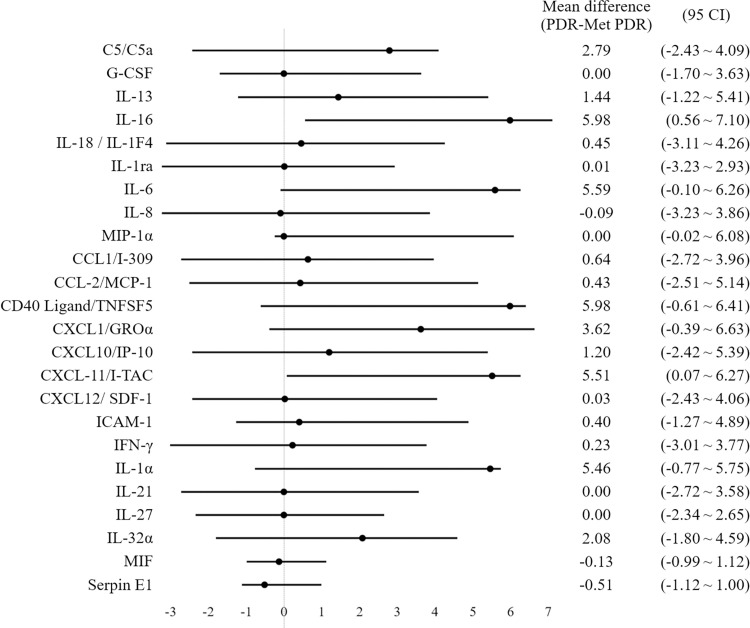
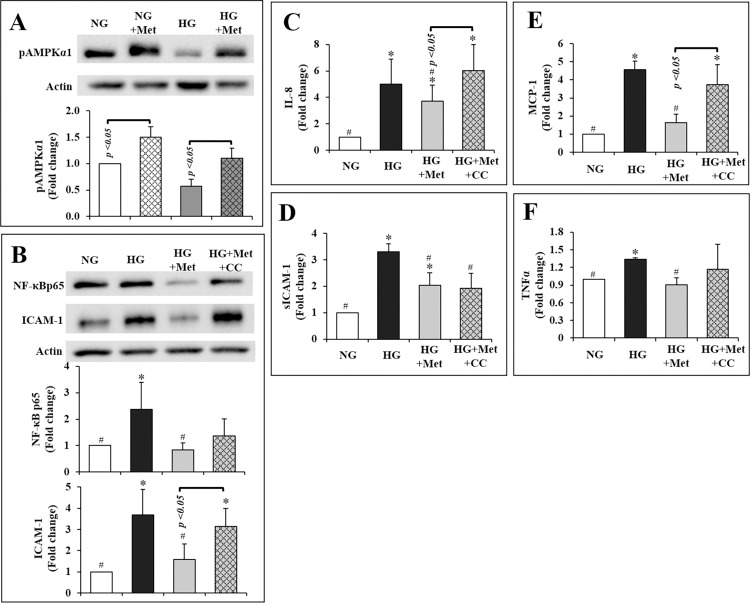
Metformin is a traditional anti-hyperglycemic medication that has recently been shown to benefit vascular complications of diabetes via an anti-inflammatory mechanism other than glycemic control. This study aims to test the hypothesis that metformin suppresses diabetic retinopathy (DR) associated intraocular inflammation. Human vitreous from control and proliferative diabetic retinopathy (PDR) patients with or without long-term metformin treatment (> 5 years) were collected for multiple inflammatory cytokines measurements with a cytokine array kit. The vast majority of the measurable cytokines in PDR vitreous has a lower level in metformin group than non-metformin group. Although the p values are not significant due to a relatively small sample size and large deviations, the 95% confidence interval (CI) for the mean difference between the two groups shows some difference in the true values should not be neglected. Using quantitative ELISA, soluble intercellular adhesion molecule -1 (ICAM-1) and monocyte chemoattractant protein -1 (MCP-1) presented with significantly lower concentrations in metformin group versus non-metformin group. Metformin group also has significantly less up-regulated cytokines and diminished positive correlations among the cytokines when compared to non-metformin group. Possible role of AMP-activated protein kinase (AMPK) and nuclear factor kappa-light-chain-enhancer of activated B cells (NF-κB) in metformin's anti-inflammatory effects were studied in human retinal vascular endothelial cells (hRVECs) cultured in normal glucose (NG) and high glucose (HG) conditions. Metformin inhibited HG-induced ICAM-1, IL-8, and MCP-1 via AMPK activation, whereas pharmacological AMPK inhibition had no effect on its inhibition of NF-κB p65, sICAM-1, and tumor necrosis factor-α (TNF-α). Metformin-induced suppression of the inflammatory cytokines could also be mediated through its direct inhibition of NF-κB, independent of AMPK pathway. This is a proof-of-concept study that found metformin treatment was associated with reduced inflammatory responses in vitreous of diabetes patients and retinal vascular endothelial cells, supporting the rationale for using metformin to treat DR at an early stage.
二甲双胍是一种传统的抗高血糖药物,最近的研究表明,它通过一种非血糖控制的抗炎机制有益于糖尿病的血管并发症。本研究旨在验证二甲双胍抑制糖尿病视网膜病变(DR)相关眼内炎症的假说。收集来自对照组和增殖性糖尿病视网膜病变(PDR)患者的玻璃体,这些患者有或没有长期(> 5 年)二甲双胍治疗,并用细胞因子阵列试剂盒测量多种炎症细胞因子。PDR 玻璃体中绝大多数可测量的细胞因子在二甲双胍组中的水平低于非二甲双胍组。尽管由于样本量较小且偏差较大,p 值没有意义,但两组之间均值差异的 95%置信区间(CI)表明,真实值之间的差异不应被忽视。使用定量 ELISA,可溶性细胞间黏附分子-1(ICAM-1)和单核细胞趋化蛋白-1(MCP-1)在二甲双胍组中的浓度明显低于非二甲双胍组。与非二甲双胍组相比,二甲双胍组的上调细胞因子也明显减少,细胞因子之间的正相关关系也减弱。在正常葡萄糖(NG)和高葡萄糖(HG)条件下培养的人视网膜血管内皮细胞(hRVECs)中研究了 AMP 激活的蛋白激酶(AMPK)和核因子 kappa-轻链增强子的激活 B 细胞(NF-κB)在二甲双胍抗炎作用中的可能作用。二甲双胍通过 AMPK 激活抑制 HG 诱导的 ICAM-1、IL-8 和 MCP-1,而药理学 AMPK 抑制对其抑制 NF-κB p65、sICAM-1 和肿瘤坏死因子-α(TNF-α)没有影响。二甲双胍诱导的炎症细胞因子抑制也可能通过其对 NF-κB 的直接抑制来介导,而不依赖于 AMPK 途径。这是一项概念验证研究,发现二甲双胍治疗与糖尿病患者玻璃体和视网膜血管内皮细胞中炎症反应的减少有关,支持在早期使用二甲双胍治疗 DR 的原理。