Department of Surgery, Johns Hopkins University School of Medicine, Baltimore, MD, USA.
Center for Health Services and Outcomes Research, Northwestern University Feinberg School of Medicine, Chicago, IL, USA.
BMC Geriatr. 2022 Jul 8;22(1):566. doi: 10.1186/s12877-022-03209-x.
Among adult kidney transplant (KT) candidates, 21% are frail and 55% have cognitive impairment, increasing the risk of pre- and post-KT mortality. Centers often assess frailty status and cognitive function during transplant evaluation to help identify appropriate candidate. Yet, there are no ethical guidelines regarding the use of frailty and cognitive function during this evaluation. We seek to develop a clinical consensus on balancing utility and justice in access to KT for frail and cognitively impaired patients.
Twenty-seven experts caring for ESRD patients completed a two-round Delphi panel designed to facilitate consensus (> 80% agreement).
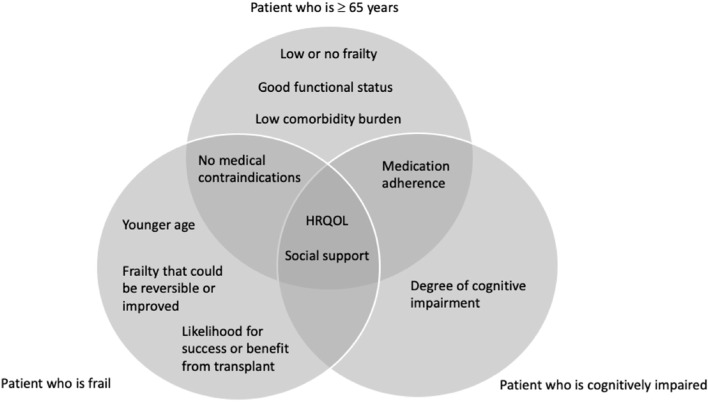
Experts believed that denying patients transplantation based solely on expected patient survival was inequitable to frail or cognitively impaired candidates; 100% agreed that frailty and cognitive impairment are important factors to consider during KT evaluation. There was consensus that health related quality of life and social support are important to consider before waitlisting frail or cognitively impaired patients. Experts identified important factors to consider before waitlisting frail (likely to benefit from KT, frailty reversibility, age, and medical contraindications) and cognitively impaired (degree of impairment and medication adherence) patients.
Clinical experts believed it was ethically unacceptable to allocate organs solely based on patients' expected survival; frailty and cognitive impairment should be measured at evaluation when weighed against other clinical factors. Ethical guidelines regarding the use of frailty and cognitive function during KT evaluation ought to be developed.
在成年肾脏移植(KT)候选者中,21%的人身体虚弱,55%的人认知功能受损,这增加了移植前和移植后死亡的风险。中心在移植评估期间经常评估虚弱状态和认知功能,以帮助识别合适的候选者。然而,在评估过程中,关于使用虚弱和认知功能,并没有道德准则。我们旨在就身体虚弱和认知受损患者获得 KT 的实用性和公正性达成临床共识。
27 名照顾 ESRD 患者的专家完成了两轮德尔菲小组设计,旨在促进共识(>80%的同意率)。
专家认为,仅根据预期患者生存拒绝患者移植是对身体虚弱或认知受损候选者的不公平;100%的专家一致认为,虚弱和认知障碍是 KT 评估中需要考虑的重要因素。健康相关生活质量和社会支持在将身体虚弱或认知受损患者列入候补名单之前被认为是重要的考虑因素。专家确定了在将身体虚弱(可能从 KT 中受益,虚弱可逆性,年龄和医学禁忌症)和认知受损(受损程度和药物依从性)患者列入候补名单之前需要考虑的重要因素。
临床专家认为,仅根据患者的预期生存分配器官在道德上是不可接受的;在权衡其他临床因素时,应在评估时测量虚弱和认知障碍。应当制定 KT 评估期间使用虚弱和认知功能的道德准则。