• 文献检索
  • 文档翻译
  • 深度研究
  • 学术资讯
  • Suppr Zotero 插件Zotero 插件
  • 邀请有礼
  • 套餐&价格
  • 历史记录
应用&插件
Suppr Zotero 插件Zotero 插件浏览器插件Mac 客户端Windows 客户端微信小程序
定价
高级版会员购买积分包购买API积分包
服务
文献检索文档翻译深度研究API 文档MCP 服务
关于我们
关于 Suppr公司介绍联系我们用户协议隐私条款
关注我们

Suppr 超能文献

核心技术专利:CN118964589B侵权必究
粤ICP备2023148730 号-1Suppr @ 2026

文献检索

告别复杂PubMed语法,用中文像聊天一样搜索,搜遍4000万医学文献。AI智能推荐,让科研检索更轻松。

立即免费搜索

文件翻译

保留排版,准确专业,支持PDF/Word/PPT等文件格式,支持 12+语言互译。

免费翻译文档

深度研究

AI帮你快速写综述,25分钟生成高质量综述,智能提取关键信息,辅助科研写作。

立即免费体验

综合强化认知行为疗法(I-CBTE)在现实生活环境中显著提高了神经性厌食症住院治疗的效果。

Integrated enhanced cognitive behavioural (I-CBTE) therapy significantly improves effectiveness of inpatient treatment of anorexia nervosa in real life settings.

作者信息

Ibrahim Ali, Ryan Sharon, Viljoen David, Tutisani Ellen, Gardner Lucy, Collins Lorna, Ayton Agnes

机构信息

Oxford Health NHS Foundation Trust, Oxford, UK.

Arts and Sciences, University College London, London, UK.

出版信息

J Eat Disord. 2022 Jul 8;10(1):98. doi: 10.1186/s40337-022-00620-y.

DOI:10.1186/s40337-022-00620-y
PMID:35804403
原文链接:https://pmc.ncbi.nlm.nih.gov/articles/PMC9264571/
Abstract

BACKGROUND

Inpatient treatment of anorexia nervosa can be lifesaving but is associated with high rates of relapse and poor outcomes. To address this, the Oxford service has adapted the enhanced cognitive behavioural treatment (CBTE) model, first developed for inpatients in Italy to a UK national health service (NHS) setting. In this study, we compared the outcomes from treatment as usual (TAU), integrated CBTE (I-CBTE), and alternative treatment models in routine UK clinical practice.

METHODS

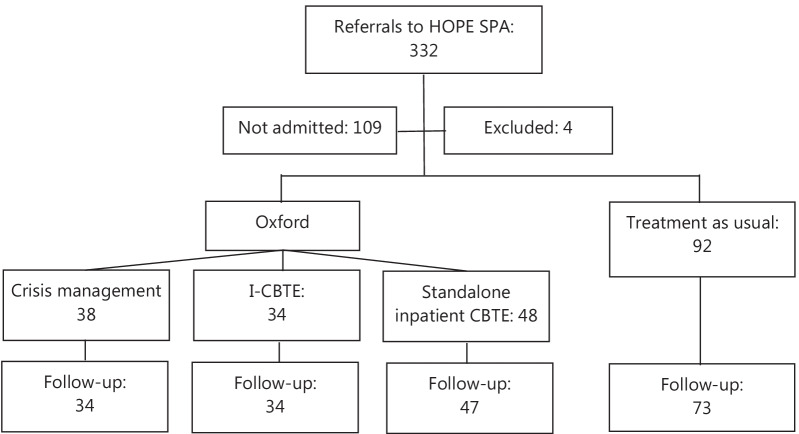
This is a longitudinal cohort study, using routinely collected data between 2017 and 2020 involving all adults with anorexia nervosa admitted to specialist units from a large geographical area in England covering a total population of 3.5 million. We compared TAU with (1) I-CBTE (13 weeks inpatient CBTE, restoration to a healthy weight, combined with 7 weeks day treatment followed by 20 weeks of outpatient CBTE; (2) standalone inpatient CBTE (due to insufficient resources since the pandemic; and (3) 6-8 weeks admission with partial weight restoration as crisis management. Primary outcome measures (min. 1 year after discharge from hospital) were defined as: (1) good outcome: Body Mass Index (BMI) > 19.5 and no abnormal eating or compensatory behaviours; (2) poor outcome: BMI < 19.5 and/or ongoing eating disorder behaviours; (3) readmission; or (4) deceased. Secondary outcomes were BMI on discharge, and length of stay.

RESULTS

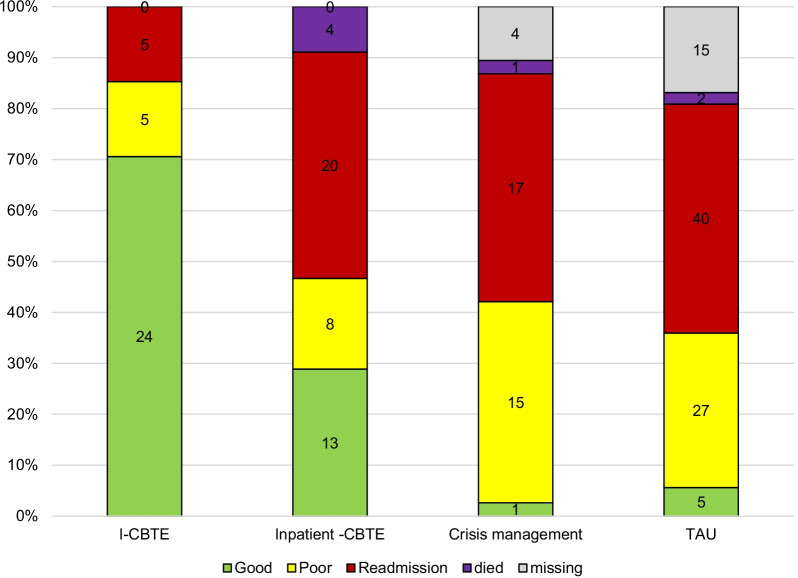
212 patients were admitted to 15 specialist units in the UK depending on bed availability. The mean age was 28.9 (18-60) years, mean admission BMI was 14.1 (10-18.3), 80% were voluntary. At minimum 1-year follow up after discharge, 70% of patients receiving I-CBTE and 29% standalone inpatient CBTE maintained good outcomes, in contrast with < 5% TAU and crisis management admission. Readmission rates of I-CBTE were 14.3% vs ~ 50% (χ < 0.0001) in the other groups. The main predictors of good outcome were reaching healthy BMI by discharge, I-CBTE and voluntary status. Age, psychiatric comorbidity and length of stay did not predict outcomes. BMI on discharge and length of stay were significantly better in the CBTE groups than in TAU.

CONCLUSIONS

Our main finding is that in a real-life setting, I-CBTE has superior short- and minimum 1 year outcomes as compared with alternative inpatient treatment models. Dissemination of I-CBTE across the care pathway has the potential to transform outcomes of inpatient treatment for this high-risk patient population and reduce personal and societal costs.

摘要

背景

神经性厌食症的住院治疗可能挽救生命,但与高复发率和不良预后相关。为解决这一问题,牛津服务机构对强化认知行为疗法(CBTE)模型进行了调整,该模型最初是为意大利的住院患者开发的,以适应英国国家医疗服务体系(NHS)的环境。在本研究中,我们比较了常规治疗(TAU)、综合CBTE(I-CBTE)以及英国常规临床实践中其他替代治疗模式的疗效。

方法

这是一项纵向队列研究,使用2017年至2020年期间常规收集的数据,涉及英格兰一个地理区域内所有因神经性厌食症入住专科病房的成年人,该区域总人口为350万。我们将TAU与以下治疗方法进行比较:(1)I-CBTE(13周住院CBTE,恢复到健康体重,再加上7周日间治疗,随后20周门诊CBTE);(2)独立住院CBTE(由于疫情后资源不足);(3)作为危机管理的6 - 8周住院及部分体重恢复。主要结局指标(出院后至少1年)定义为:(1)良好结局:体重指数(BMI)> 19.5且无异常饮食或代偿行为;(2)不良结局:BMI < 19.5和/或持续的饮食障碍行为;(3)再次入院;或(4)死亡。次要结局指标为出院时的BMI和住院时间。

结果

根据床位情况,212名患者入住了英国的15个专科病房。平均年龄为28.9岁(18 - 60岁),平均入院BMI为14.1(10 - 18.3),80%为自愿入院。出院后至少1年的随访中,接受I-CBTE治疗的患者中有70%保持良好结局,独立住院CBTE治疗的患者中有29%保持良好结局,相比之下,TAU组和危机管理住院组的这一比例均小于5%。I-CBTE的再次入院率为14.3%,而其他组约为50%(χ < 0.0001)。良好结局的主要预测因素是出院时达到健康BMI、I-CBTE治疗和自愿入院状态。年龄、精神疾病共病情况和住院时间并不能预测结局。CBTE组出院时的BMI和住院时间显著优于TAU组。

结论

我们的主要发现是,在现实生活环境中,与其他住院治疗模式相比,I-CBTE在短期和至少1年的结局方面具有优势。在整个护理路径中推广I-CBTE有可能改变这一高风险患者群体的住院治疗结局,并降低个人和社会成本。
https://cdn.ncbi.nlm.nih.gov/pmc/blobs/6261/9264571/c3a83295ba67/40337_2022_620_Fig2_HTML.jpg
https://cdn.ncbi.nlm.nih.gov/pmc/blobs/6261/9264571/e7d3eb09b206/40337_2022_620_Fig1_HTML.jpg
https://cdn.ncbi.nlm.nih.gov/pmc/blobs/6261/9264571/c3a83295ba67/40337_2022_620_Fig2_HTML.jpg
https://cdn.ncbi.nlm.nih.gov/pmc/blobs/6261/9264571/e7d3eb09b206/40337_2022_620_Fig1_HTML.jpg
https://cdn.ncbi.nlm.nih.gov/pmc/blobs/6261/9264571/c3a83295ba67/40337_2022_620_Fig2_HTML.jpg

相似文献

1
Integrated enhanced cognitive behavioural (I-CBTE) therapy significantly improves effectiveness of inpatient treatment of anorexia nervosa in real life settings.综合强化认知行为疗法(I-CBTE)在现实生活环境中显著提高了神经性厌食症住院治疗的效果。
J Eat Disord. 2022 Jul 8;10(1):98. doi: 10.1186/s40337-022-00620-y.
2
A randomised controlled multicentre trial of treatments for adolescent anorexia nervosa including assessment of cost-effectiveness and patient acceptability - the TOuCAN trial.一项针对青少年神经性厌食症治疗方法的随机对照多中心试验,包括成本效益评估和患者可接受性评估——TOuCAN 试验。
Health Technol Assess. 2010 Mar;14(15):1-98. doi: 10.3310/hta14150.
3
Comparing hospitalized adult patients with chronic anorexia nervosa with versus without prior hospitalizations.比较有过与未曾有过住院史的成年慢性神经性厌食症住院患者。
J Eat Disord. 2024 Sep 4;12(1):132. doi: 10.1186/s40337-024-01092-y.
4
Effectiveness and cost-effectiveness of cognitive behavior therapy-enhanced compared with treatment-as-usual for anorexia nervosa in an inpatient and outpatient routine setting: a consecutive cohort study.在住院和门诊常规环境中,与常规治疗相比,认知行为疗法强化治疗神经性厌食症的有效性和成本效益:一项连续队列研究。
J Eat Disord. 2022 Jan 6;10(1):2. doi: 10.1186/s40337-021-00526-1.
5
Individual psychological therapy in the outpatient treatment of adults with anorexia nervosa.成人神经性厌食症门诊治疗中的个体心理治疗。
Cochrane Database Syst Rev. 2015 Jul 27;2015(7):CD003909. doi: 10.1002/14651858.CD003909.pub2.
6
[Diversity of hospital care for anorexia nervosa in psychiatry in France].[法国精神病学领域中神经性厌食症的住院治疗多样性]
Encephale. 2022 Oct;48(5):517-529. doi: 10.1016/j.encep.2021.04.008. Epub 2021 Oct 30.
7
From efficacy to effectiveness: child and adolescent eating disorder treatments in the real world (part 1)-treatment course and outcomes.从疗效到效果:现实世界中的儿童和青少年饮食失调治疗(第1部分)——治疗过程与结果
J Eat Disord. 2022 Feb 21;10(1):27. doi: 10.1186/s40337-022-00553-6.
8
Focal psychodynamic therapy, cognitive behaviour therapy, and optimised treatment as usual in female outpatients with anorexia nervosa (ANTOP study): 5-year follow-up of a randomised controlled trial in Germany.聚焦心理动力学疗法、认知行为疗法和优化的常规治疗对神经性厌食症女性门诊患者的效果(ANTOP 研究):德国一项随机对照试验的 5 年随访
Lancet Psychiatry. 2022 Apr;9(4):280-290. doi: 10.1016/S2215-0366(22)00028-1. Epub 2022 Mar 13.
9
[What factors explain the length of hospitalization for anorexia nervosa: A systematic review].[哪些因素可解释神经性厌食症的住院时长:一项系统综述]
Encephale. 2021 Aug;47(4):362-368. doi: 10.1016/j.encep.2020.11.002. Epub 2021 Mar 19.
10
The clinical effectiveness and cost-effectiveness of a 'stepping into day treatment' approach versus inpatient treatment as usual for anorexia nervosa in adult specialist eating disorder services (DAISIES trial): a study protocol of a randomised controlled multi-centre open-label parallel group non-inferiority trial.一种“步入日间治疗”方法对比常规住院治疗用于成人专科饮食失调服务中神经性厌食症的临床效果和成本效果(DAISIES 试验):一项随机对照多中心开放标签平行组非劣效性试验的研究方案。
Trials. 2022 Jun 16;23(1):500. doi: 10.1186/s13063-022-06386-7.

引用本文的文献

1
Digital augmentation of aftercare for patients with anorexia nervosa: the TRIANGLE RCT and economic evaluation.神经性厌食症患者后期护理的数字化增强:TRIANGLE随机对照试验及经济评估
Health Technol Assess. 2025 Jul;29(31):1-162. doi: 10.3310/ADLS3672.
2
A lifeline or a label? lived experience perspectives on the severe and enduring eating disorder (SEED) classification in eating disorder treatment.一条生命线还是一个标签?饮食失调治疗中关于严重且持久的饮食失调(SEED)分类的生活经历视角。
J Eat Disord. 2025 Jul 11;13(1):136. doi: 10.1186/s40337-025-01335-6.
3
Medical management and differential diagnosis of restrictive eating disorders in men: a case study report with co-produced recommendations.

本文引用的文献

1
Effectiveness and cost-effectiveness of cognitive behavior therapy-enhanced compared with treatment-as-usual for anorexia nervosa in an inpatient and outpatient routine setting: a consecutive cohort study.在住院和门诊常规环境中,与常规治疗相比,认知行为疗法强化治疗神经性厌食症的有效性和成本效益:一项连续队列研究。
J Eat Disord. 2022 Jan 6;10(1):2. doi: 10.1186/s40337-021-00526-1.
2
Efficacy of post-inpatient aftercare treatments for anorexia nervosa: a systematic review of randomized controlled trials.神经性厌食症住院后护理治疗的疗效:随机对照试验的系统评价
J Eat Disord. 2021 Oct 15;9(1):129. doi: 10.1186/s40337-021-00487-5.
3
男性限制性饮食失调的医学管理与鉴别诊断:一份共同制定建议的病例研究报告
J Eat Disord. 2025 Jul 1;13(1):124. doi: 10.1186/s40337-025-01250-w.
4
Equity in eating disorders: a dialectical approach to stigma, expertise, and the coproduction of knowledge.饮食失调中的公平性:一种关于污名、专业知识及知识共同生产的辩证方法。
J Eat Disord. 2025 Feb 17;13(1):31. doi: 10.1186/s40337-024-01176-9.
5
Redefining prevention and early intervention to include longstanding and severe eating disorders.重新定义预防和早期干预,将长期存在的严重饮食失调纳入其中。
J Eat Disord. 2025 Feb 14;13(1):28. doi: 10.1186/s40337-025-01203-3.
6
Improving eating disorder care for underserved groups: a lived experience and quality improvement perspective.改善弱势群体的饮食失调护理:基于生活经历和质量改进的视角
J Eat Disord. 2025 Jan 22;13(1):11. doi: 10.1186/s40337-024-01145-2.
7
Applying integrated enhanced cognitive behaviour therapy (I-CBTE) to severe and longstanding eating disorders (SEED) Paper 2: An in-depth case study for clinicians.将综合强化认知行为疗法(I-CBTE)应用于严重且长期存在的饮食失调症(SEED) 论文2:面向临床医生的深入案例研究
J Eat Disord. 2024 Oct 31;12(1):172. doi: 10.1186/s40337-024-01116-7.
8
Applying Integrated Enhanced Cognitive Behaviour Therapy (I-CBTE) to Severe and Longstanding Eating Disorders (SEED) Paper 1: I am no longer a SEED patient.将综合强化认知行为疗法(I-CBTE)应用于严重及长期饮食失调症(SEED) 论文1:我不再是一名SEED患者。
J Eat Disord. 2024 Sep 12;12(1):139. doi: 10.1186/s40337-024-01089-7.
9
Harm reduction in severe and long-standing Anorexia Nervosa: part of the journey but not the destination-a narrative review with lived experience.重度及长期神经性厌食症的危害降低:旅程的一部分而非终点——基于亲身经历的叙述性综述
J Eat Disord. 2024 Sep 12;12(1):140. doi: 10.1186/s40337-024-01063-3.
10
Experiences of intensive treatment for people with eating disorders: a systematic review and thematic synthesis.饮食失调患者的强化治疗经验:系统评价与主题综合分析
J Eat Disord. 2024 Aug 14;12(1):115. doi: 10.1186/s40337-024-01061-5.
Risk, demand, capacity and outcomes in adult specialist eating disorder services in South-East of England before and since COVID-19.
新冠疫情前后英格兰东南部成人专科饮食失调服务中的风险、需求、能力及结果
BJPsych Bull. 2022 Apr;46(2):89-95. doi: 10.1192/bjb.2021.73.
4
Lifetime Weight Characteristics of Adult Inpatients With Severe Anorexia Nervosa: Maximal Lifetime BMI Predicts Treatment Outcome.成年重度神经性厌食症住院患者的终生体重特征:终生最大体重指数可预测治疗结果。
Front Psychiatry. 2021 Jul 15;12:682952. doi: 10.3389/fpsyt.2021.682952. eCollection 2021.
5
Specialized post-inpatient psychotherapy for sustained recovery in anorexia nervosa via videoconference - study protocol of the randomized controlled SUSTAIN trial.通过视频会议进行的神经性厌食症持续康复的专科住院后心理治疗——随机对照SUSTAIN试验的研究方案
J Eat Disord. 2021 May 19;9(1):61. doi: 10.1186/s40337-021-00416-6.
6
Improving mealtimes for patients and staff within an eating disorder unit: understanding of the problem and first intervention during the pandemic-an initial report.改善饮食障碍病房患者和工作人员的用餐时间:大流行期间对问题的理解和首次干预——初步报告。
BMJ Open Qual. 2021 Apr;10(2). doi: 10.1136/bmjoq-2021-001366.
7
The First Episode Rapid Early Intervention for Eating Disorders - Upscaled study: Clinical outcomes.进食障碍早期快速干预的首个病例报告——扩展研究:临床结局。
Early Interv Psychiatry. 2022 Jan;16(1):97-105. doi: 10.1111/eip.13139. Epub 2021 Mar 29.
8
Discharge Body Mass Index, Not Illness Chronicity, Predicts 6-Month Weight Outcome in Patients Hospitalized With Anorexia Nervosa.出院时体重指数而非疾病慢性程度可预测神经性厌食症住院患者6个月后的体重结果。
Front Psychiatry. 2021 Feb 25;12:641861. doi: 10.3389/fpsyt.2021.641861. eCollection 2021.
9
Optimising care pathways for adult anorexia nervosa. What is the evidence to guide the provision of high-quality, cost-effective services?优化成人厌食症的护理路径。有哪些证据可以指导高质量、具有成本效益的服务的提供?
Eur Eat Disord Rev. 2021 May;29(3):306-315. doi: 10.1002/erv.2821. Epub 2021 Feb 24.
10
Treatment of Patients With Anorexia Nervosa in the US-A Crisis in Care.美国神经性厌食症患者的治疗——护理危机
JAMA Psychiatry. 2021 Jun 1;78(6):591-592. doi: 10.1001/jamapsychiatry.2020.4796.