Giel Katrin E, Behrens Simone C, Schag Kathrin, Martus Peter, Herpertz Stephan, Hofmann Tobias, Skoda Eva-Maria, Voderholzer Ulrich, von Wietersheim Jörn, Wild Beate, Zeeck Almut, Schmidt Ulrike, Zipfel Stephan, Junne Florian
Department of Psychosomatic Medicine and Psychotherapy, Medical University Hospital Tübingen, Eberhard Karls University, Osianderstr. 5, 72076, Tübingen, Germany.
Center of Excellence in Eating Disorders, Tübingen, Germany.
J Eat Disord. 2021 Oct 15;9(1):129. doi: 10.1186/s40337-021-00487-5.
Early relapse after inpatient treatment is a serious problem in the management of anorexia nervosa (AN). Specialized aftercare interventions have the potential to bridge the gap between inpatient and outpatient care, to prevent relapse and to improve the long-term outcome for patients with AN.
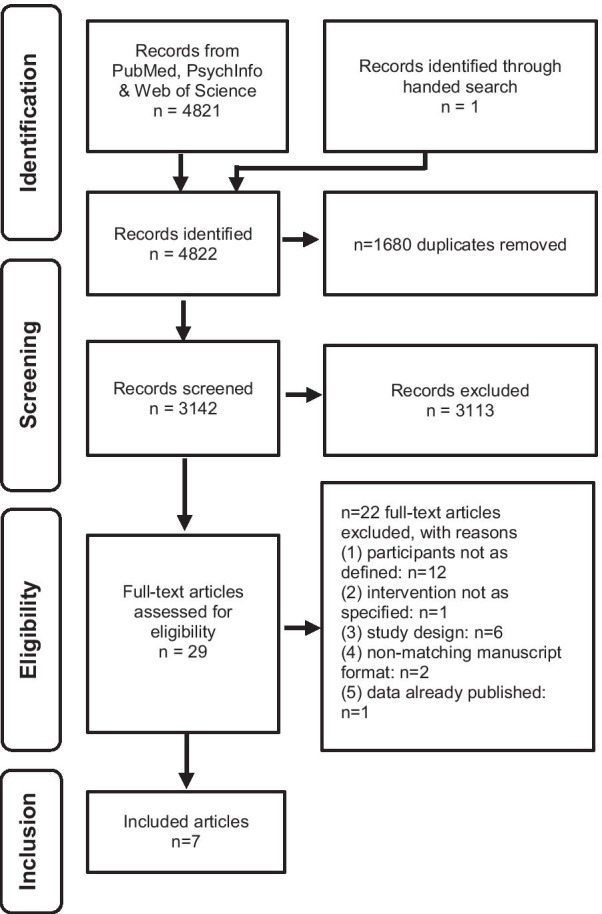
Following the guidelines of the PRISMA statement, we conducted a systematic review, synthesizing the evidence from randomized-controlled trials (RCTs) investigating the efficacy of post-inpatient aftercare treatments for AN.
Our search resulted in seven RCTs and three registered ongoing trials. Pharmacotherapy and low-threshold guided self-help have limited uptake and high dropout. Novel mobile guided self-help approaches seem promising due to high patient satisfaction, but their efficacy has yet to be investigated in larger trials. Cognitive-behavior psychotherapy may be beneficial in delaying relapse, but evidence is based on a single study.
Only a limited number of RCTs investigating aftercare interventions for patients with AN is available. There is no clear evidence favoring any one specific approach for post-inpatient aftercare in adult patients with AN. The field faces many challenges which generally affect intervention research in AN. A specific issue is how to increase uptake of and reduce dropout from aftercare interventions. This calls for better tailoring of interventions to patient needs and the integration of patient perspectives into treatment. Intensified research and care efforts are needed to address the problem of recurrent relapse after intensive inpatient treatment for AN and to eventually improve prognosis for this eating disorder.
住院治疗后早期复发是神经性厌食症(AN)管理中的一个严重问题。专门的后续护理干预措施有可能弥合住院治疗和门诊治疗之间的差距,预防复发,并改善AN患者的长期预后。
按照PRISMA声明的指南,我们进行了一项系统综述,综合了来自随机对照试验(RCT)的证据,这些试验调查了AN住院后后续护理治疗的疗效。
我们的检索产生了7项RCT和3项正在进行的注册试验。药物治疗和低门槛引导式自助的接受度有限且退出率高。新型移动引导式自助方法由于患者满意度高而似乎很有前景,但它们的疗效尚未在更大规模的试验中得到研究。认知行为心理治疗可能有助于延迟复发,但证据仅基于一项研究。
仅有数量有限的RCT对AN患者的后续护理干预措施进行了研究。没有明确证据支持对成年AN患者住院后后续护理采用任何一种特定方法。该领域面临许多挑战,这些挑战通常会影响AN的干预研究。一个具体问题是如何提高后续护理干预措施的接受度并减少退出率。这需要更好地根据患者需求调整干预措施,并将患者观点纳入治疗。需要加强研究和护理工作,以解决AN强化住院治疗后复发的问题,并最终改善这种饮食失调症的预后。