Department of Neurology, University of Massachusetts Chan Medical School, Worcester, MA 01655, USA.
Cells. 2022 Jun 29;11(13):2066. doi: 10.3390/cells11132066.
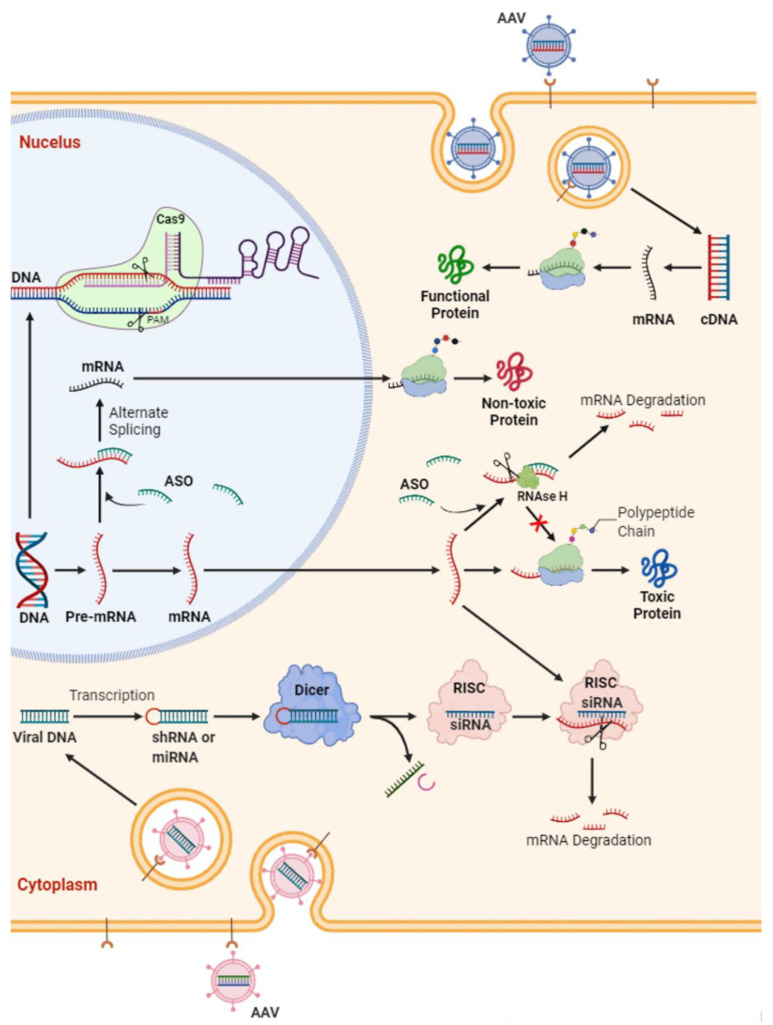
Since the discovery of () gene mutation, in 1993, as the first genetic abnormality in amyotrophic lateral sclerosis (ALS), over 50 genes have been identified as either cause or modifier in ALS and ALS/frontotemporal dementia (FTD) spectrum disease. Mutations in , , (), and () genes are the four most common ones. During the last three decades, tremendous effort has been made worldwide to reveal biological pathways underlying the pathogenesis of these gene mutations in ALS/FTD. Accordingly, targeting etiologic genes (i.e., gene therapies) to suppress their toxic effects have been investigated widely. It includes four major strategies: (i) removal or inhibition of abnormal transcribed RNA using microRNA or antisense oligonucleotides (ASOs), (ii) degradation of abnormal mRNA using RNA interference (RNAi), (iii) decrease or inhibition of mutant proteins (e.g., using antibodies against misfolded proteins), and (iv) DNA genome editing with methods such as clustered regularly interspaced short palindromic repeats (CRISPR)/CRISPR-associated protein (CRISPR/Cas). The promising results of these studies have led to the application of some of these strategies into ALS clinical trials, especially for and . In this paper, we will overview advances in gene therapy in ALS/FTD, focusing on , , , and genes.
自 1993 年发现()基因突变以来,作为肌萎缩侧索硬化症(ALS)的第一个遗传异常,已有超过 50 个基因被确定为 ALS 和 ALS/额颞叶痴呆(FTD)谱疾病的原因或修饰物。()、()、()和()基因突变是最常见的四种。在过去的三十年中,全世界都在努力揭示这些基因突变在 ALS/FTD 发病机制中的生物学途径。因此,广泛研究了针对病因基因(即基因治疗)以抑制其毒性作用的方法。它包括四个主要策略:(i)使用 microRNA 或反义寡核苷酸(ASOs)去除或抑制异常转录的 RNA,(ii)使用 RNA 干扰(RNAi)降解异常 mRNA,(iii)减少或抑制突变蛋白(例如,使用针对错误折叠蛋白的抗体),以及(iv)使用簇状规则间隔短回文重复(CRISPR)/CRISPR 相关蛋白(CRISPR/Cas)等方法进行 DNA 基因组编辑。这些研究的有前景的结果导致了其中一些策略在 ALS 临床试验中的应用,特别是针对()和()。本文将重点介绍()、()、()和()基因,综述 ALS/FTD 中的基因治疗进展。