Department of Pathology, Riga Stradins University, LV-1007 Riga, Latvia.
Latvian Institute of Organic Synthesis, LV-1006 Riga, Latvia.
Int J Mol Sci. 2022 Jun 23;23(13):6981. doi: 10.3390/ijms23136981.
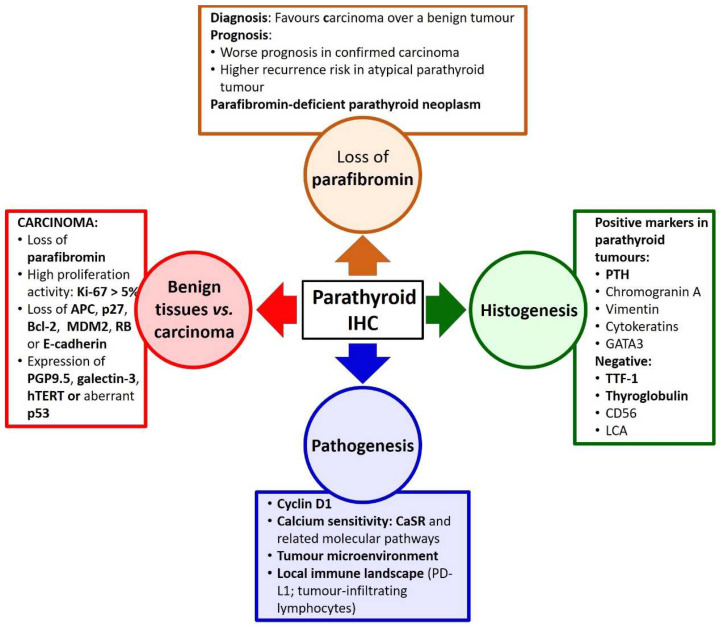
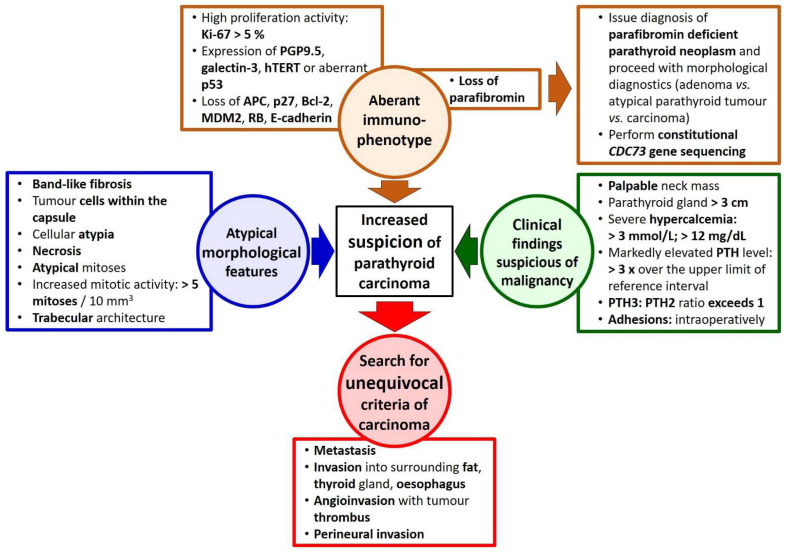
Immunohistochemistry remains an indispensable tool in diagnostic surgical pathology. In parathyroid tumours, it has four main applications: to detect (1) loss of parafibromin; (2) other manifestations of an aberrant immunophenotype hinting towards carcinoma; (3) histogenesis of a neck mass and (4) pathogenetic events, including features of tumour microenvironment and immune landscape. Parafibromin stain is mandatory to identify the new entity of parafibromin-deficient parathyroid neoplasm, defined in the WHO classification (2022). Loss of parafibromin indicates a greater probability of malignant course and should trigger the search for inherited or somatic mutations. Aberrant immunophenotype is characterised by a set of markers that are lost (parafibromin), down-regulated (e.g., APC protein, p27 protein, calcium-sensing receptor) or up-regulated (e.g., proliferation activity by Ki-67 exceeding 5%) in parathyroid carcinoma compared to benign parathyroid disease. Aberrant immunophenotype is not the final proof of malignancy but should prompt the search for the definitive criteria for carcinoma. Histogenetic studies can be necessary for differential diagnosis between thyroid vs. parathyroid origin of cervical or intrathyroidal mass; detection of parathyroid hormone (PTH), chromogranin A, TTF-1, calcitonin or CD56 can be helpful. Finally, immunohistochemistry is useful in pathogenetic studies due to its ability to highlight both the presence and the tissue location of certain proteins. The main markers and challenges (technological variations, heterogeneity) are discussed here in the light of the current WHO classification (2022) of parathyroid tumours.
免疫组织化学仍然是诊断外科病理学中不可或缺的工具。在甲状旁腺肿瘤中,它有四个主要应用:(1)检测parafibromin 的缺失;(2)提示癌的异常免疫表型的其他表现;(3)颈部肿块的组织发生;(4)发病机制事件,包括肿瘤微环境和免疫景观的特征。parafibromin 染色是识别新的 parafibromin 缺乏性甲状旁腺肿瘤实体的必要条件,该实体在世界卫生组织分类(2022 年)中定义。parafibromin 的缺失表明恶性过程的可能性更大,应引发对遗传性或体细胞突变的寻找。异常免疫表型的特征是一组标记物的缺失(parafibromin)、下调(例如 APC 蛋白、p27 蛋白、钙敏感受体)或上调(例如,增殖活性 Ki-67 超过 5%),与良性甲状旁腺疾病相比,在甲状旁腺癌中。异常免疫表型不是恶性的最终证据,但应促使寻找癌症的明确标准。组织发生学研究对于区分甲状腺与甲状旁腺起源的颈部或甲状腺内肿块的鉴别诊断可能是必要的;检测甲状旁腺激素(PTH)、嗜铬粒蛋白 A、TTF-1、降钙素或 CD56 可能会有所帮助。最后,由于其能够突出某些蛋白质的存在和组织位置,免疫组织化学在发病机制研究中也很有用。这里根据当前的世界卫生组织(2022 年)甲状旁腺肿瘤分类讨论了主要标记物和挑战(技术变化、异质性)。