Gerlach Christina, Ullrich Anneke, Berges Natalie, Bausewein Claudia, Oechsle Karin, Hodiamont Farina
Palliative Care Unit, Department of Oncology, Hematology and BMT, University Medical Center Hamburg-Eppendorf, 20246 Hamburg, Germany.
Department of Palliative Care, Heidelberg University Hospital, 69120 Heidelberg, Germany.
J Clin Med. 2022 Jul 3;11(13):3863. doi: 10.3390/jcm11133863.
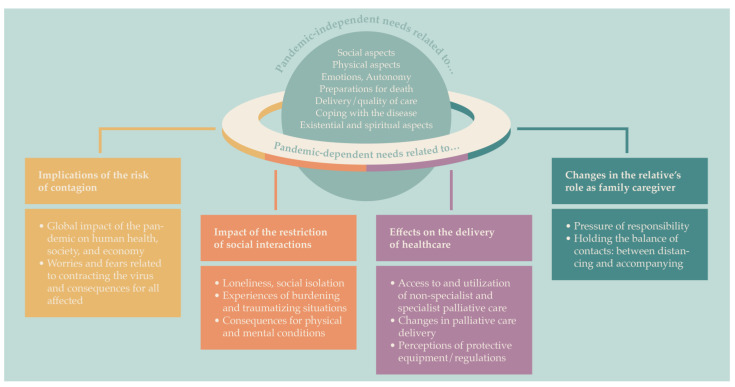
During humanitarian crises, such as a pandemic, healthcare systems worldwide face unknown challenges. This study aimed to explore and describe the effect of the SARS-CoV-2 pandemic on the needs of non-infected patients and family caregivers in specialist palliative care, using qualitative, semi-structured interviews. Data were analyzed using inductive content analysis, following the framework approach. Thirty-one interviews were conducted with patients/family caregivers (15/16) in palliative care units/specialist palliative home care (21/10) from June 2020 to January 2021. Well-known needs of patients and family caregivers at the end of life remained during the pandemic. Pandemic- dependent themes were (1) implications of the risk of contagion, (2) impact of the restriction of social interactions, (3) effects on the delivery of healthcare, and (4) changes in the relative's role as family caregiver. Restriction on visits limited family caregivers' ability to be present in palliative care units. In specialist palliative home care, family caregivers were concerned about the balance between preserving social contacts at the end of life and preventing infection. Specialist palliative care during a pandemic needs to meet both the well-known needs at the end of life and additional needs in the pandemic context. In particular, attention should be given to the needs and burden of family caregivers, which became more multifaceted with regards to the pandemic.
在人道主义危机期间,例如大流行期间,全球医疗系统面临着未知的挑战。本研究旨在通过定性的半结构化访谈,探索并描述2019冠状病毒病大流行对专科姑息治疗中未感染患者及家庭照护者需求的影响。采用框架法,通过归纳性内容分析法对数据进行分析。2020年6月至2021年1月期间,对姑息治疗病房/专科姑息居家护理机构中的患者/家庭照护者(15/16)进行了31次访谈(21/10)。在大流行期间,患者和家庭照护者在生命末期的常见需求依然存在。与大流行相关的主题包括:(1)感染风险的影响;(2)社交互动受限的影响;(3)对医疗服务提供的影响;以及(4)亲属作为家庭照护者角色的变化。探访限制削弱了家庭照护者在姑息治疗病房陪伴患者的能力。在专科姑息居家护理中,家庭照护者担心在生命末期保持社交联系与预防感染之间的平衡。大流行期间的专科姑息治疗需要满足生命末期的常见需求以及大流行背景下的额外需求。尤其应关注家庭照护者的需求和负担,在大流行背景下,这些需求和负担变得更加复杂多样。