El Aou-Ouad Hanan, Montero Rafael, Baraza Elena, Bota Josefina
Research Group on Plant Biology under Mediterranean Conditions (PlantMed), Biology Department, Agro-Environmental and Water Economy Institute-Universitat de les Illes Balears (INAGEA-UIB), Carretera de Valldemossa, km 7.5, 07122 Palma, Spain.
Ecology and Environment Laboratory, Faculty of Science Ben M'sik, University Hassan II, Casablanca 20000, Morocco.
Plants (Basel). 2022 Jun 30;11(13):1754. doi: 10.3390/plants11131754.
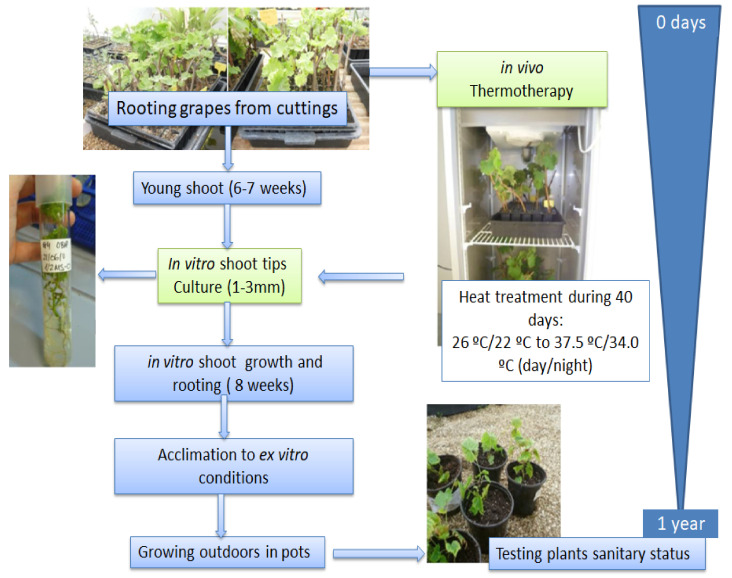
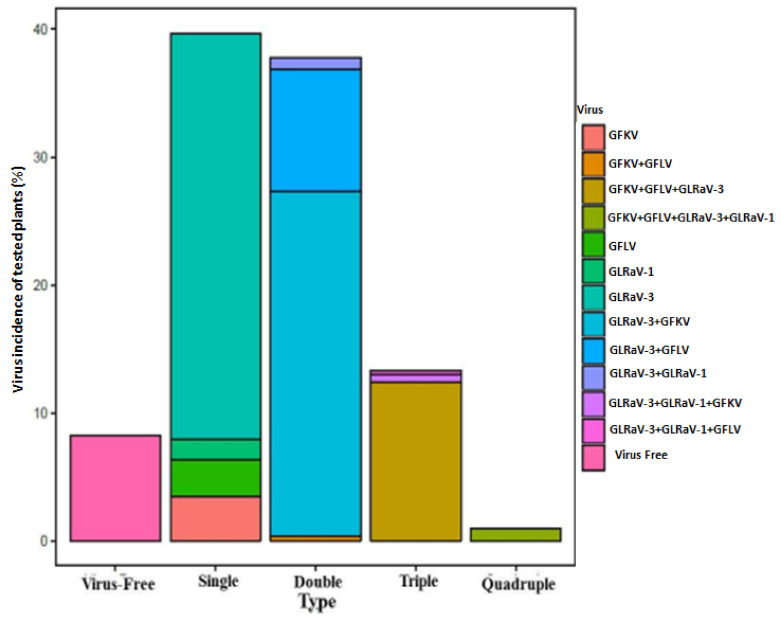
Recuperation and genetic diversity preservation of local cultivars have acquired a huge interest in viticulture areas worldwide. In the Balearic Islands, most of the old cultivars are only preserved in grapevine germplasm banks, and so far, the sanitary status of these local cultivars has remained unexplored. The aim of this study was to survey and detect the virus incidence of all conserved cultivars in the government Grapevine Germplasm Bank of the Balearic Islands and to promote the sanitary recovery of two important minor cultivars, Argamussa and Gorgollassa. Enzyme-linked immunosorbent assay (ELISA) screenings were performed on 315 vines of 33 local cultivars. It was shown that the local cultivars were highly infected with simple (39.7%) and mixed infections (52.1%) and only 8.25% of them were free from the viruses tested. Grapevine leafroll-associated virus 3 (GLRaV-3) infection was the most common (82%). Moreover, Grapevine fanleaf virus (GFLV) and Grapevine fleck virus (GFkV) were also present with considerable incidence (25.4% and 43.5%, respectively). In addition, two sanitation protocols were used: shoot tip culture (ST) and thermotherapy in combination with shoot tip culture (CT). Virus elimination using only ST was effective to obtain "healthy" vines of cvs. Argamussa and Gorgollassa. It is important to emphasize that the methods described in the current study were rapid and effective in eliminating both GLRaV-3 and GFLV, also in combination.
地方品种的恢复与遗传多样性保护在全球葡萄种植区受到了极大关注。在巴利阿里群岛,大多数古老品种仅保存在葡萄种质库中,迄今为止,这些地方品种的健康状况尚未得到探索。本研究的目的是调查和检测巴利阿里群岛政府葡萄种质库中所有保存品种的病毒发生率,并促进两个重要的次要品种阿尔加穆萨(Argamussa)和戈尔戈拉萨(Gorgollassa)的健康恢复。对33个地方品种的315株葡萄藤进行了酶联免疫吸附测定(ELISA)筛选。结果表明,地方品种受到单一感染(39.7%)和混合感染(52.1%)的程度很高,只有8.25%的品种未感染所检测的病毒。葡萄卷叶相关病毒3(GLRaV-3)感染最为常见(82%)。此外,葡萄扇叶病毒(GFLV)和葡萄斑点病毒(GFkV)也有相当高的发生率(分别为25.4%和43.5%)。此外,采用了两种卫生处理方案:茎尖培养(ST)以及热处理与茎尖培养相结合(CT)。仅使用茎尖培养进行病毒清除对于获得阿尔加穆萨和戈尔戈拉萨品种的“健康”葡萄藤是有效的。必须强调的是,本研究中描述的方法在单独或联合消除GLRaV-3和GFLV方面快速且有效。