Boulkhessaim Salim, Gacem Amel, Khan Samreen Heena, Amari Abdelfattah, Yadav Virendra Kumar, Harharah Hamed N, Elkhaleefa Abubakr M, Yadav Krishna Kumar, Rather Sami-Ullah, Ahn Hyun-Jo, Jeon Byong-Hun
Department of Physics, Faculty of Sciences, University 20 Août 1955, 26 El Hadaiek, Skikda 21000, Algeria.
Research & Development Centre, YNC Envis Pvt Ltd., New Delhi 110001, India.
Nanomaterials (Basel). 2022 Jun 22;12(13):2148. doi: 10.3390/nano12132148.
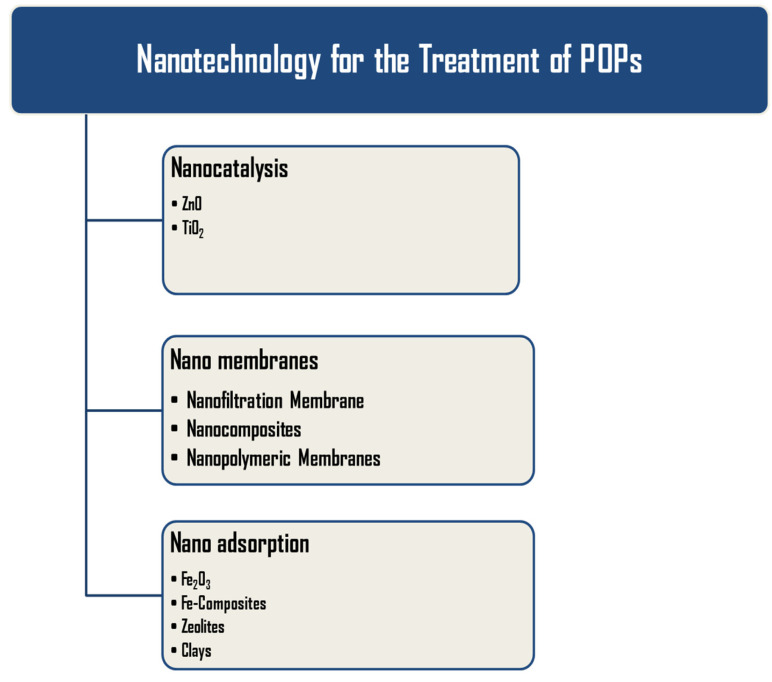
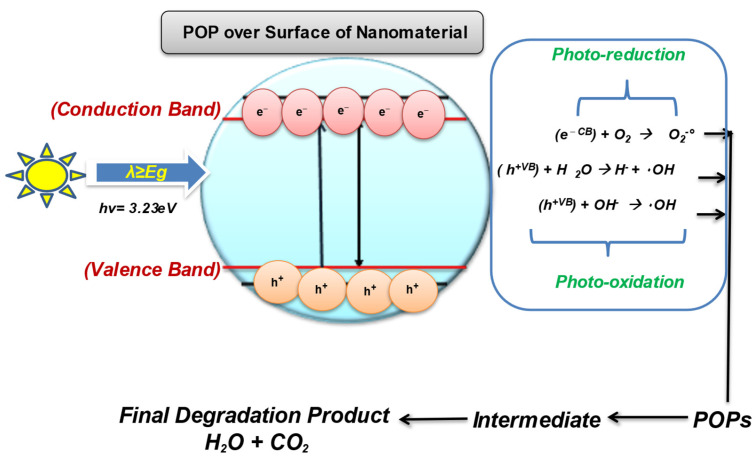
Persistent organic pollutants (POPs) have become a major global concern due to their large amount of utilization every year and their calcitrant nature. Due to their continuous utilization and calcitrant nature, it has led to several environmental hazards. The conventional approaches are expensive, less efficient, laborious, time-consuming, and expensive. Therefore, here in this review the authors suggest the shortcomings of conventional techniques by using nanoparticles and nanotechnology. Nanotechnology has shown immense potential for the remediation of such POPs within a short period of time with high efficiency. The present review highlights the use of nanoremediation technologies for the removal of POPs with a special focus on nanocatalysis, nanofiltration, and nanoadsorption processes. Nanoparticles such as clays, zinc oxide, iron oxide, aluminum oxide, and their composites have been used widely for the efficient remediation of POPs. Moreover, filtrations such as nanofiltration and ultrafiltration have also shown interest in the remediation of POPs from wastewater. From several pieces of literature, it has been found that nano-based techniques have shown complete removal of POPs from wastewater in comparison to conventional methods, but the cost is one of the major issues when it comes to nano- and ultrafiltration. Future research in nano-based techniques for POP remediation will solve the cost issue and will make it one of the most widely accepted and available techniques. Nano-based processes provide a sustainable solution to the problem of POPs.
持久性有机污染物(POPs)由于其每年大量的使用及其难降解的性质,已成为全球主要关注的问题。由于它们的持续使用和难降解性质,导致了若干环境危害。传统方法昂贵、效率低、费力、耗时且成本高。因此,在本综述中,作者指出了使用纳米颗粒和纳米技术的传统技术的缺点。纳米技术已显示出在短时间内高效修复此类持久性有机污染物的巨大潜力。本综述重点介绍了纳米修复技术在去除持久性有机污染物方面的应用,特别关注纳米催化、纳滤和纳米吸附过程。粘土、氧化锌、氧化铁、氧化铝等纳米颗粒及其复合材料已被广泛用于高效修复持久性有机污染物。此外,纳滤和超滤等过滤方法也显示出对从废水中修复持久性有机污染物的兴趣。从多篇文献中发现,与传统方法相比,基于纳米的技术已显示出能完全去除废水中的持久性有机污染物,但成本是纳米和超滤技术的主要问题之一。未来基于纳米技术的持久性有机污染物修复研究将解决成本问题,并使其成为最广泛接受和可用的技术之一。基于纳米的工艺为持久性有机污染物问题提供了可持续的解决方案。