Cologne Health Department, Infektions- und Umwelthygiene, Neumarkt 15-21, 50667, Köln, Germany; Institute for Occupational Medicine and Social Medicine, University Hospital, Medical Faculty, RWTH Aachen University, Aachen, Germany.
Cologne Health Department, Infektions- und Umwelthygiene, Neumarkt 15-21, 50667, Köln, Germany; Institute for Occupational Medicine and Social Medicine, University Hospital, Medical Faculty, RWTH Aachen University, Aachen, Germany.
Public Health. 2022 Aug;209:52-60. doi: 10.1016/j.puhe.2022.05.022. Epub 2022 Jun 15.
The non-pharmacological measures to contain the COVID-19 pandemic may lead to considerable psychological distress. The aim of the CoCo-Fakt study was to investigate possible coping strategies and their effects on psychological distress during legally enforced quarantine of infected persons (IPs) and their close contacts (CPs).
This was a cross-sectional cohort study.
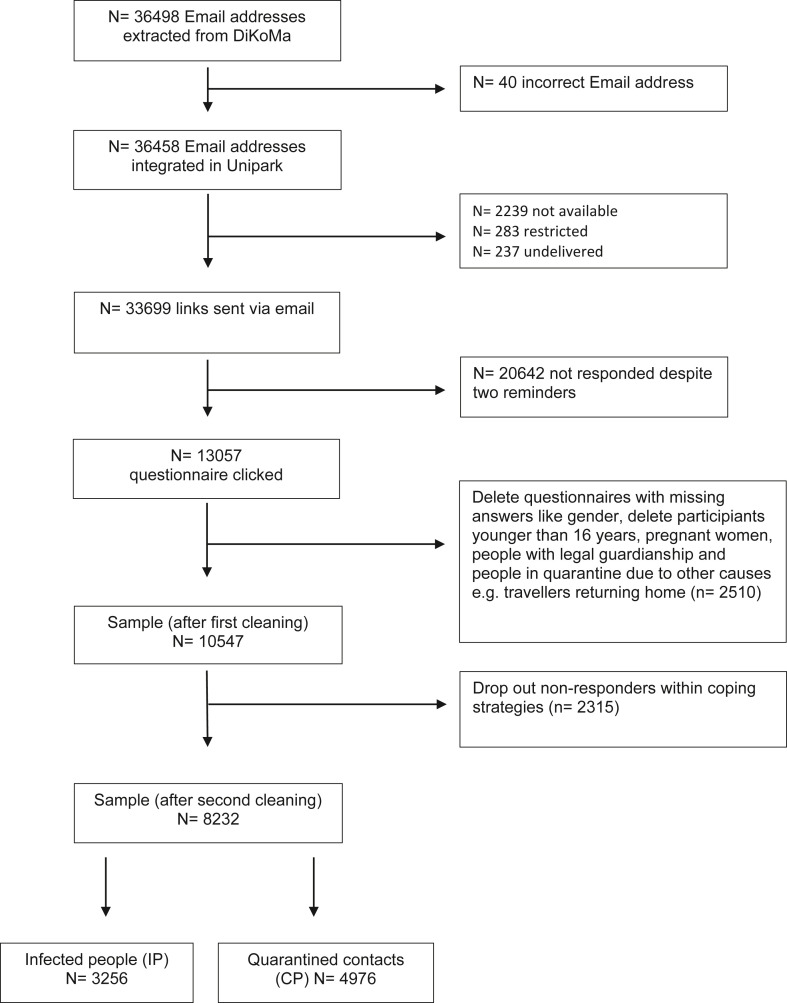
From 12 December 2020 to 6 January 2021, all IPs and their CPs (n = 8232) registered by the public health department (Cologne, Germany) were surveyed online. Psychosocial distress and coping were measured using sum scores; free-text answers related to specific strategies were subsequently categorised.
Psychosocial distress was higher in IPs than in CPs (P < .001). Although the mean coping score did not differ between both groups, it was influenced by the reason for quarantine (IP vs CP) besides gender, age, socio-economic status, living situation, psychological distress, resilience, physical activity and eating behaviour. This final regression model explained 25.9% of the variance. Most participants used active coping strategies, such as contact with the social environment, a positive attitude and hobbies.
Although psychological distress was higher in IPs than in CPs during the quarantine period, the mean coping score did not differ. The strategies most frequently used by IPs and CPs were activating social networks, a healthy lifestyle and professional support systems, such as the health department helpline. Appropriate advice should be implemented to prevent long-term psychological consequences when supporting affected people.
控制 COVID-19 大流行的非药物措施可能会导致相当大的心理困扰。CoCo-Fakt 研究的目的是调查在法定强制隔离感染者(IP)及其密切接触者(CP)期间可能的应对策略及其对心理困扰的影响。
这是一项横断面队列研究。
从 2020 年 12 月 12 日至 2021 年 1 月 6 日,公共卫生部门(德国科隆)登记的所有 IP 及其 CP(n=8232)都在线接受了调查。使用总分来衡量心理社会困扰和应对能力;随后对与特定策略相关的自由文本答案进行分类。
与 CP 相比,IP 的心理困扰更高(P<.001)。尽管两组的应对得分均值没有差异,但除了性别、年龄、社会经济地位、居住状况、心理困扰、适应力、身体活动和饮食行为外,它还受到隔离原因(IP 与 CP)的影响。这个最终的回归模型解释了 25.9%的方差。大多数参与者使用了积极的应对策略,例如与社会环境的接触、积极的态度和爱好。
尽管在隔离期间 IP 的心理困扰高于 CP,但应对得分均值没有差异。IP 和 CP 最常使用的策略是激活社交网络、健康的生活方式和专业的支持系统,如卫生部门热线。在支持受影响的人时,应实施适当的建议,以防止长期的心理后果。