Department of Statistics and Actuarial Science, University of Ghana, Legon-Accra, Ghana.
Department of Microbiology & Immunology, School of Medical Sciences, University of Cape Coast, Cape Coast, Ghana.
PLoS One. 2021 Jun 28;16(6):e0253800. doi: 10.1371/journal.pone.0253800. eCollection 2021.
The COVID-19 pandemic and control measures adopted by countries globally can lead to stress and anxiety. Investigating the coping strategies to this unprecedented crisis is essential to guide mental health intervention and public health policy. This study examined how people are coping with the COVID-19 crisis in Ghana and identify factors influencing it.
This study was part of a multinational online cross-sectional survey on Personal and Family Coping with COVID-19 in the Global South. The study population included adults, ≥18 years and residents in Ghana. Respondents were recruited through different platforms, including social media and phone calls. The questionnaire was composed of different psychometrically validated instruments with coping as the outcome variable measured on the ordinal scale with 3 levels, namely, Not well or worse, Neutral, and Well or better. An ordinal logistic regression model using proportional odds assumption was then applied.
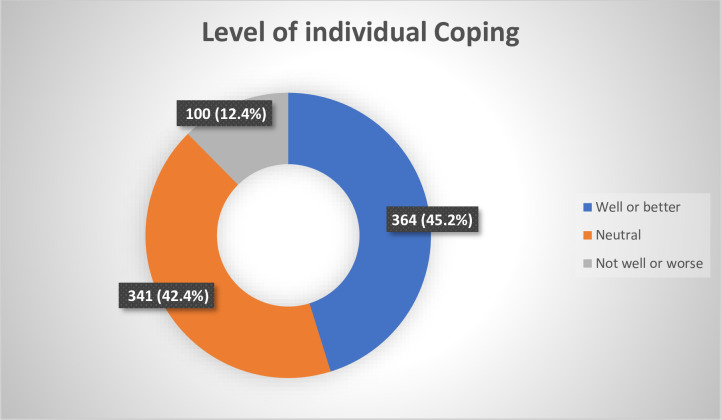
A total of 811 responses were included in the analysis with 45.2% describing their coping level as well/better, 42.4% as neither worse nor better and 12.4% as worse/not well. Many respondents (46.9%) were between 25-34 years, 50.1% were males while 79.2% lived in urban Ghana. Having pre-existing conditions increased the chances of not coping well (aOR = 1.86, 95%CI: 1.15-3.01). Not being concerned about supporting the family financially (aOR = 1.67, 95%CI: 1.06-2.68) or having the feeling that life is better during the pandemic (aOR = 2.37, 95%CI: 1.26-4.62) increased chances of coping well. Praying (aOR: 0.62, 95%CI: 0.43-0.90) or sleeping (aOR: 0.55, 95%CI: 0.34-0.89) more during the pandemic than before reduces coping.
In Ghana, during the COVID-19 pandemic, financial security and optimism about the disease increase one's chances of coping well while having pre-existing medical conditions, praying and sleeping more during the pandemic than before reduces one's chances of coping well. These findings should be considered in planning mental health and public health intervention/policy.
新冠疫情和全球各国采取的控制措施可能会导致压力和焦虑。研究应对这一前所未有危机的策略对于指导心理健康干预和公共卫生政策至关重要。本研究旨在调查加纳人应对新冠危机的方式,并确定影响应对方式的因素。
本研究是个人和家庭应对全球南方新冠疫情多国在线横断面调查的一部分。研究人群包括成年人,年龄≥18 岁,居住在加纳。通过不同平台招募受访者,包括社交媒体和电话。问卷由不同的心理测量学验证工具组成,以 3 个水平测量应对方式,即“不好或更差”、“中性”和“好或更好”。然后应用比例优势假设的有序逻辑回归模型。
共纳入 811 份分析,45.2%的人描述自己的应对水平为“好或更好”,42.4%的人描述为“不好或更差”,12.4%的人描述为“中性”。许多受访者(46.9%)年龄在 25-34 岁之间,50.1%为男性,79.2%居住在加纳城市。有基础疾病的人更有可能无法应对(aOR = 1.86,95%CI:1.15-3.01)。不担心经济上支持家庭(aOR = 1.67,95%CI:1.06-2.68)或感到疫情期间生活更好(aOR = 2.37,95%CI:1.26-4.62)的人更有可能应对良好。疫情期间祈祷(aOR:0.62,95%CI:0.43-0.90)或睡眠(aOR:0.55,95%CI:0.34-0.89)比疫情前更多,应对能力下降。
在加纳,新冠疫情期间,经济保障和对疾病的乐观态度增加了应对良好的机会,而存在基础疾病、疫情期间祈祷和睡眠比疫情前更多会降低应对良好的机会。这些发现应在规划心理健康和公共卫生干预/政策时予以考虑。