Cincidda Clizia, Pizzoli Silvia Francesca Maria, Oliveri Serena, Pravettoni Gabriella
Department of Oncology and Hemato-oncology (DIPO), University of Milan, Via Festa del Perdono 7, 20141 Milan, Italy.
Applied Research Division for Cognitive and Psychological Science, IEO, European Institute of Oncology IRCCS, Via Giuseppe Ripamonti 435, 20141 Milan, Italy.
Eur Rev Appl Psychol. 2022 Nov;72(6):100671. doi: 10.1016/j.erap.2021.100671. Epub 2021 Jun 2.
The COVID-19 outbreak forced Italian citizens into a generalized quarantine from March to May 2020. The quarantine is a successful measure to reduce the virus's spread through physical and social distancing, but it can also have negative psychological consequences on the population. People experience high levels of worry and anxiety and have to cope with the consequences of the health emergency. The aim of this study was to preliminarily assess the causal relations among coping, worry and state anxiety at the time of COVID-19 first wave, and the mediation role of worry between coping and state anxiety.
During March 2020, 1273 Italian citizens completed an ad hoc online survey composed of sociodemographic and preoccupation-related questions, and standardized self-report questionnaire (Brief COPE, Penn State Worry Questionnaire and State-Trait Anxiety Inventory-State form). Three separate mediation models were performed.
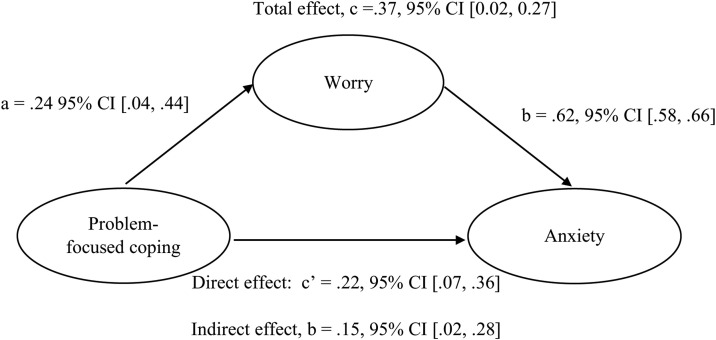
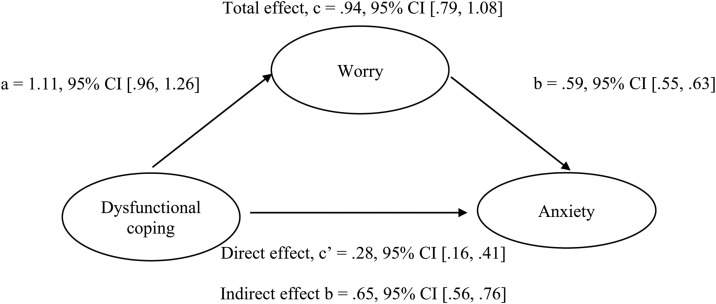
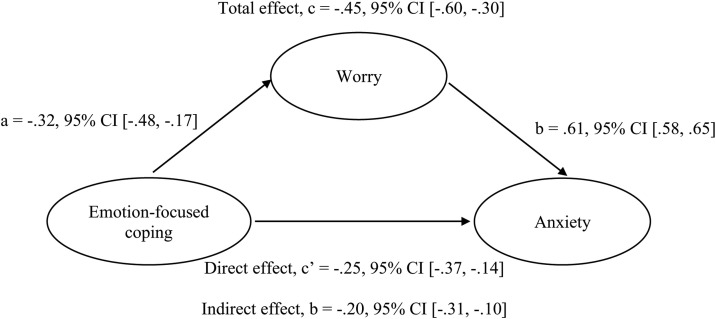
The relationship between coping strategies (i.e.: problem-focused coping, emotion-focused coping and dysfunctional coping) and state anxiety resulted to be mediated by worry. Dysfunctional and problem-focused coping had a negative effect on anxiety scores and this effect was amplified by high levels of worry. Emotion-focused coping reduced state anxiety scores through its effect on reducing the levels of worry, which in turn was related to a reduction in anxiety.
The present study offers first evidence for the mediation role of worry in the relation between coping and anxiety during quarantine caused by COVID-19 pandemic. It supports the clinical importance of investigating people's coping strategies along with the levels of (cognitive) worry and their long-term effects on the psychological well-being during the outbreak, in order to deliver adequate personalized interventions. Psychological support should enhance emotion-focused coping strategies that have a protective effect on both worry and anxiety.
2020年3月至5月,新冠疫情的爆发迫使意大利公民进入全面隔离状态。隔离是一项通过物理和社交距离来减少病毒传播的有效措施,但它也可能对民众产生负面心理影响。人们经历着高度的担忧和焦虑,并且不得不应对健康紧急状况带来的后果。本研究的目的是初步评估在新冠疫情第一波期间应对方式、担忧和状态焦虑之间的因果关系,以及担忧在应对方式和状态焦虑之间的中介作用。
2020年3月期间,1273名意大利公民完成了一项专门的在线调查,该调查由社会人口统计学和与关注事项相关的问题,以及标准化的自我报告问卷(简易应对方式问卷、宾夕法尼亚州立大学担忧问卷和状态-特质焦虑量表-状态分量表)组成。进行了三个独立的中介模型分析。
应对策略(即:问题聚焦应对、情绪聚焦应对和功能失调性应对)与状态焦虑之间的关系由担忧介导。功能失调性应对和问题聚焦应对对焦虑得分有负面影响,而高水平的担忧会放大这种影响。情绪聚焦应对通过降低担忧水平来降低状态焦虑得分,而担忧水平的降低又与焦虑的减轻相关。
本研究首次为担忧在新冠疫情大流行导致的隔离期间应对方式与焦虑之间的中介作用提供了证据。它支持了在疫情爆发期间调查人们的应对策略以及(认知)担忧水平及其对心理健康的长期影响的临床重要性,以便提供适当的个性化干预措施。心理支持应加强对担忧和焦虑都有保护作用的情绪聚焦应对策略。