Department of Psychology, Developmental & Health Psychology Unit, Bundeswehr University Munich, Neubiberg, Germany.
Stress Health. 2021 Dec;37(5):973-985. doi: 10.1002/smi.3057. Epub 2021 May 5.
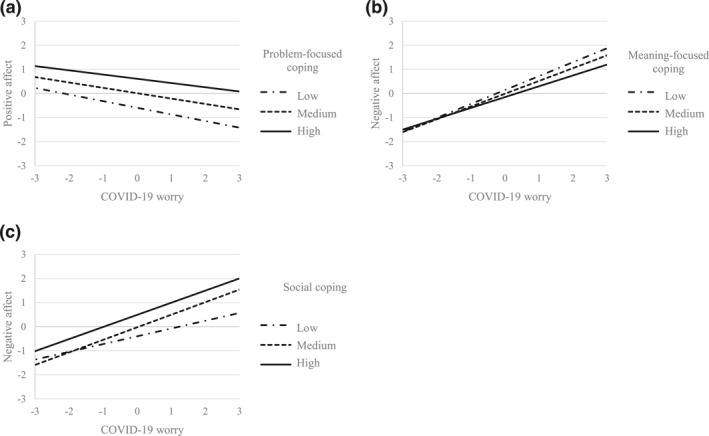
The present study examined the relationships between emotional well-being (positive and negative affect), sleep-related variables (sleep quality, sleep duration, and change in sleep quality and duration compared to weeks before lockdown), and worrying about coronavirus disease (COVID-19) challenges during the beginning of the outbreak in Europe. In addition, four different coping strategies were investigated. The study was conducted in Germany with data from 665 participants (53.8% female; 18-73 years), who completed an online questionnaire in April 2020. The results revealed that COVID-19 worry was associated with impaired well-being and sleep. Meaning- and problem-focused coping were the most frequently used coping strategies, and showed positive associations with well-being and sleep. Social and avoidance coping were associated with decreased well-being and worse sleep outcomes. Three coping strategies showed moderating effects. People who worried more showed higher levels of positive affect when they used problem-focused coping compared to those who did not. Similarly, highly worried participants showed lower levels of negative affect when they reported using meaning-focused coping more often. In contrast, social coping increased the risk of high negative affect levels in worried participants. In conclusion, problem-focused and meaning-focused coping strategies seemed to be most effective in coping with COVID-19 challenges.
本研究考察了情绪健康(积极和消极情绪)、与睡眠相关的变量(睡眠质量、睡眠时间、与封锁前几周相比睡眠质量和时间的变化)以及对冠状病毒病(COVID-19)挑战的担忧之间的关系在欧洲疫情爆发初期。此外,还研究了四种不同的应对策略。该研究在德国进行,共有 665 名参与者(53.8%为女性;18-73 岁)完成了 2020 年 4 月的在线问卷调查。结果表明,COVID-19 的担忧与幸福感和睡眠质量下降有关。意义和问题为导向的应对策略是最常使用的应对策略,与幸福感和睡眠质量呈正相关。社会和回避应对与幸福感下降和睡眠质量下降有关。三种应对策略具有调节作用。与不使用问题为导向应对策略的人相比,更多担心的人在使用问题为导向应对策略时表现出更高的积极情绪水平。同样,高担忧的参与者报告更多地使用意义为导向的应对策略时,负面情绪水平较低。相比之下,社会应对会增加高担忧参与者出现高负面情绪水平的风险。总之,问题为导向和意义为导向的应对策略似乎是应对 COVID-19 挑战最有效的方法。