Perelman School of Medicine at the University of Pennsylvania, Philadelphia, PA 19104, USA.
Warren Alpert Medical School of Brown University, Providence, RI 02903, USA; Department of Diagnostic Radiology, Rhode Island Hospital, 593 Eddy St. Providence, Providence, RI 02903, USA.
EBioMedicine. 2022 Aug;82:104127. doi: 10.1016/j.ebiom.2022.104127. Epub 2022 Jul 8.
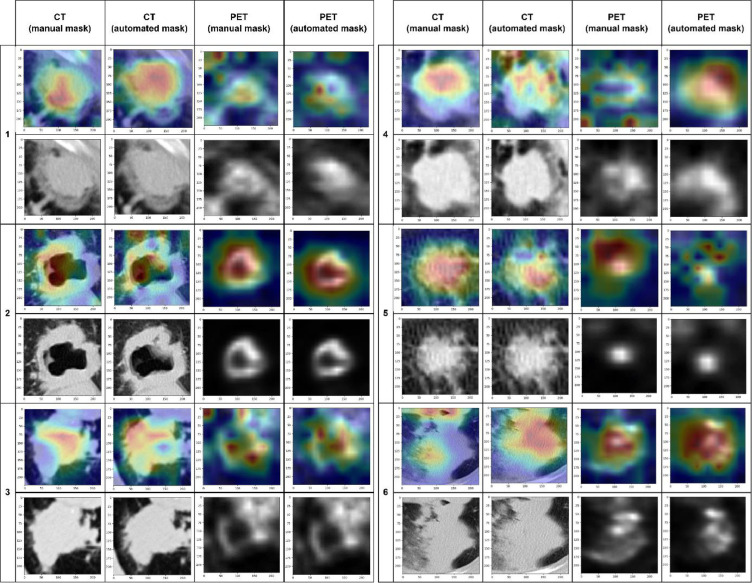
Pre-treatment FDG-PET/CT scans were analyzed with machine learning to predict progression of lung malignancies and overall survival (OS).
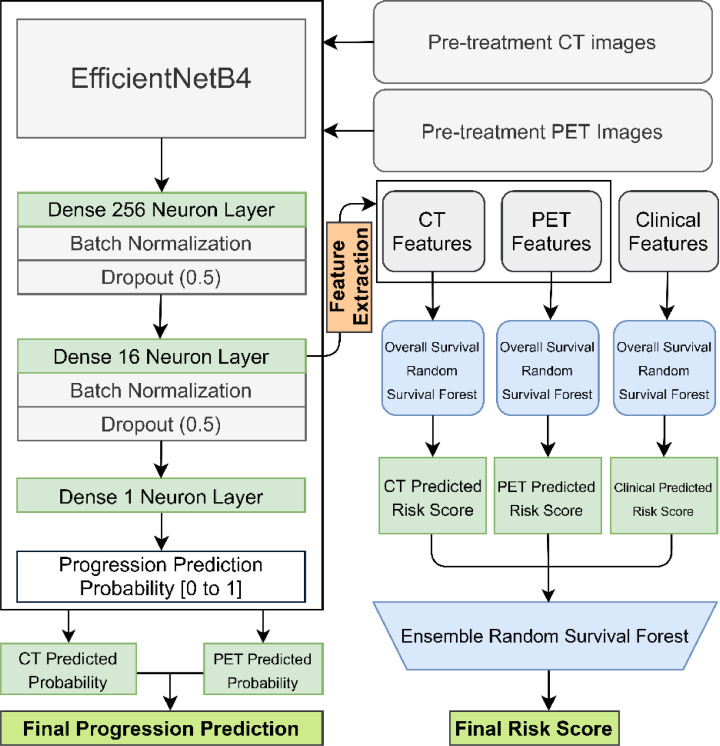
A retrospective review across three institutions identified patients with a pre-procedure FDG-PET/CT and an associated malignancy diagnosis. Lesions were manually and automatically segmented, and convolutional neural networks (CNNs) were trained using FDG-PET/CT inputs to predict malignancy progression. Performance was evaluated using area under the receiver operating characteristic curve (AUC), accuracy, sensitivity, and specificity. Image features were extracted from CNNs and by radiomics feature extraction, and random survival forests (RSF) were constructed to predict OS. Concordance index (C-index) and integrated brier score (IBS) were used to evaluate OS prediction.
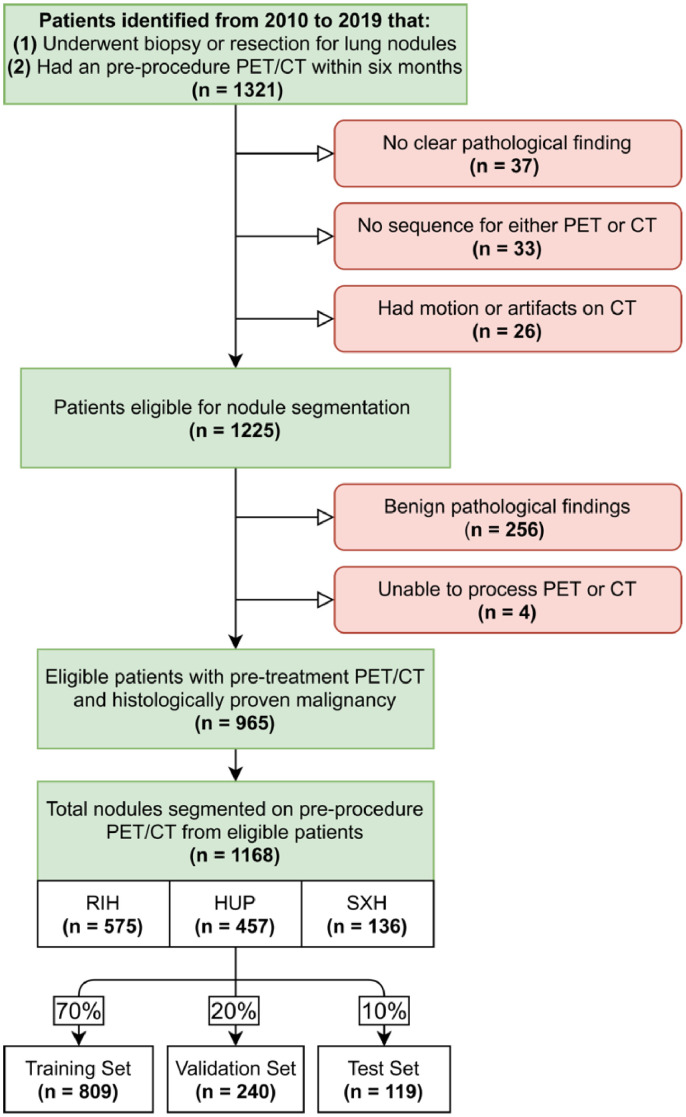
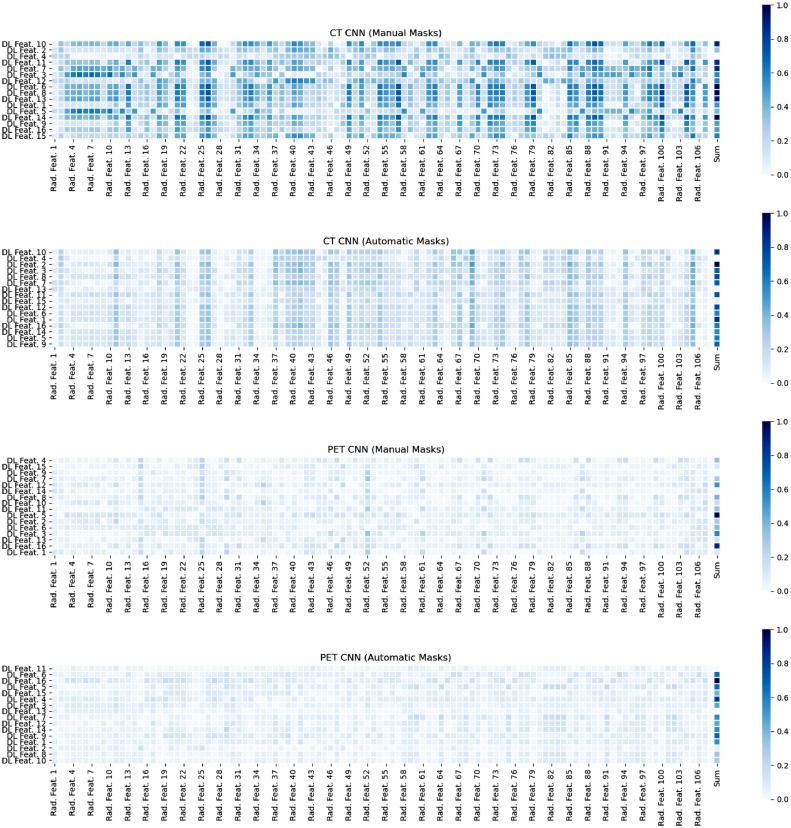
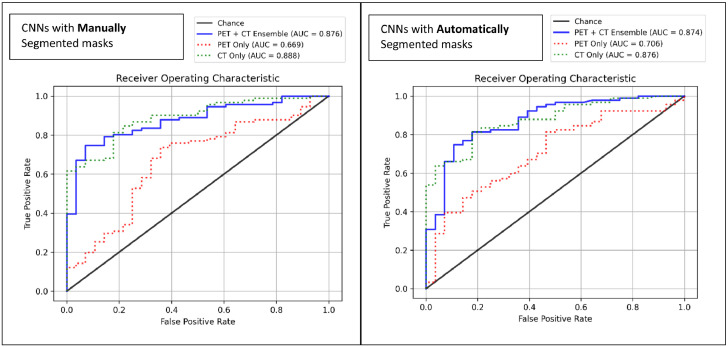
1168 nodules (n=965 patients) were identified. 792 nodules had progression and 376 were progression-free. The most common malignancies were adenocarcinoma (n=740) and squamous cell carcinoma (n=179). For progression risk, the PET+CT ensemble model with manual segmentation (accuracy=0.790, AUC=0.876) performed similarly to the CT only (accuracy=0.723, AUC=0.888) and better compared to the PET only (accuracy=0.664, AUC=0.669) models. For OS prediction with deep learning features, the PET+CT+clinical RSF ensemble model (C-index=0.737) performed similarly to the CT only (C-index=0.730) and better than the PET only (C-index=0.595), and clinical only (C-index=0.595) models. RSF models constructed with radiomics features had comparable performance to those with CNN features.
CNNs trained using pre-treatment FDG-PET/CT and extracted performed well in predicting lung malignancy progression and OS. OS prediction performance with CNN features was comparable to a radiomics approach. The prognostic models could inform treatment options and improve patient care.
NIH NHLBI training grant (5T35HL094308-12, John Sollee).
使用机器学习对预处理的 FDG-PET/CT 扫描进行分析,以预测肺癌的进展和总生存期 (OS)。
在三个机构进行的回顾性研究中,确定了进行预程序 FDG-PET/CT 检查并伴有恶性肿瘤诊断的患者。手动和自动分割病变,使用 FDG-PET/CT 输入训练卷积神经网络 (CNN) 以预测恶性肿瘤进展。使用接受者操作特征曲线下的面积 (AUC)、准确性、敏感性和特异性来评估性能。从 CNN 和放射组学特征提取中提取图像特征,并构建随机生存森林 (RSF) 来预测 OS。一致性指数 (C-index) 和综合布赖尔评分 (IBS) 用于评估 OS 预测。
确定了 1168 个结节 (n=965 例)。792 个结节发生进展,376 个结节无进展。最常见的恶性肿瘤是腺癌 (n=740) 和鳞状细胞癌 (n=179)。对于进展风险,具有手动分割的 PET+CT 联合模型 (准确性=0.790,AUC=0.876) 与仅 CT (准确性=0.723,AUC=0.888) 模型相似,并且优于仅 PET (准确性=0.664,AUC=0.669) 模型。对于使用深度学习特征的 OS 预测,PET+CT+临床 RSF 联合模型 (C-index=0.737) 与仅 CT (C-index=0.730) 相似,优于仅 PET (C-index=0.595),和临床单独 (C-index=0.595) 模型。使用放射组学特征构建的 RSF 模型与使用 CNN 特征构建的模型具有相似的性能。
使用预处理 FDG-PET/CT 训练的 CNN 表现良好,可预测肺癌恶性肿瘤的进展和 OS。使用 CNN 特征的 OS 预测性能与放射组学方法相当。该预测模型可以为治疗方案提供信息,并改善患者护理。
NIH NHLBI 培训资助 (5T35HL094308-12,John Sollee)。