Department of Cardiology, Daping Hospital, The Third Military Medical University, Chongqing, PR China; Department of Cardiology, General Hospital of Western Theater Command, Chengdu, PR China; Chongqing Key Laboratory for Hypertension Research, Chongqing Cardiovascular Clinical Research Center, Chongqing Institute of Cardiology, Chongqing, PR China.
Department of Cardiology, Daping Hospital, The Third Military Medical University, Chongqing, PR China; Chongqing Key Laboratory for Hypertension Research, Chongqing Cardiovascular Clinical Research Center, Chongqing Institute of Cardiology, Chongqing, PR China.
EBioMedicine. 2022 Aug;82:104139. doi: 10.1016/j.ebiom.2022.104139. Epub 2022 Jul 8.
While the adult mammalian heart undergoes only modest renewal through cardiomyocyte proliferation, boosting this process is considered a promising therapeutic strategy to repair cardiac injury. This study explored the role and mechanism of dual-specificity tyrosine regulated kinase 1A (DYRK1A) in regulating cardiomyocyte cell cycle activation and cardiac repair after myocardial infarction (MI).
DYRK1A-knockout mice and DYRK1A inhibitors were used to investigate the role of DYRK1A in cardiomyocyte cell cycle activation and cardiac repair following MI. Additionally, we explored the underlying mechanisms by combining genome-wide transcriptomic, epigenomic, and proteomic analyses.
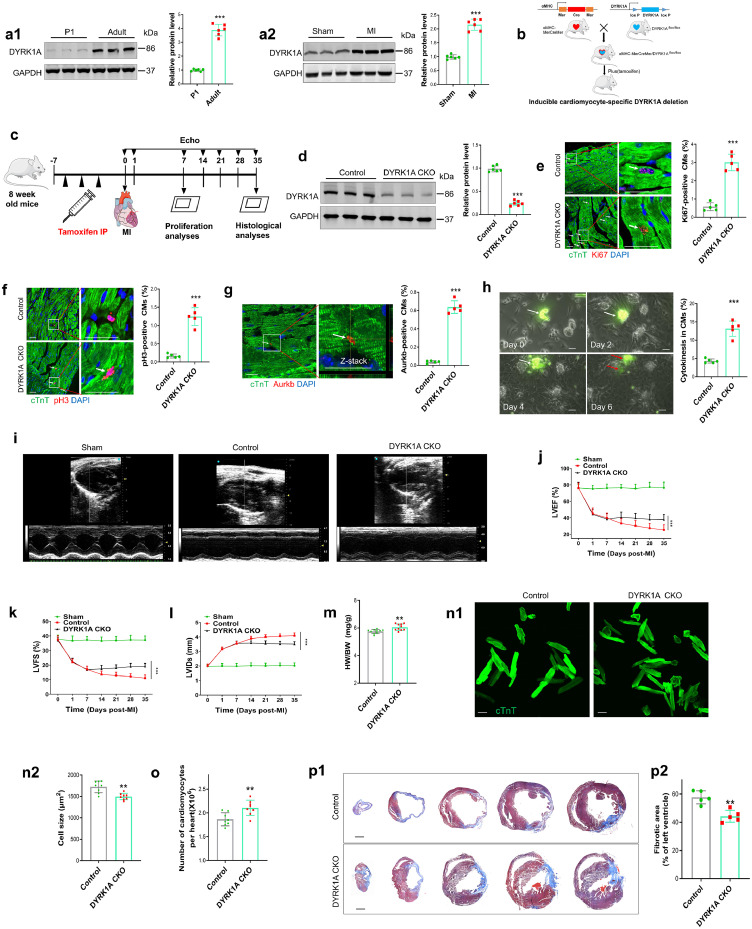
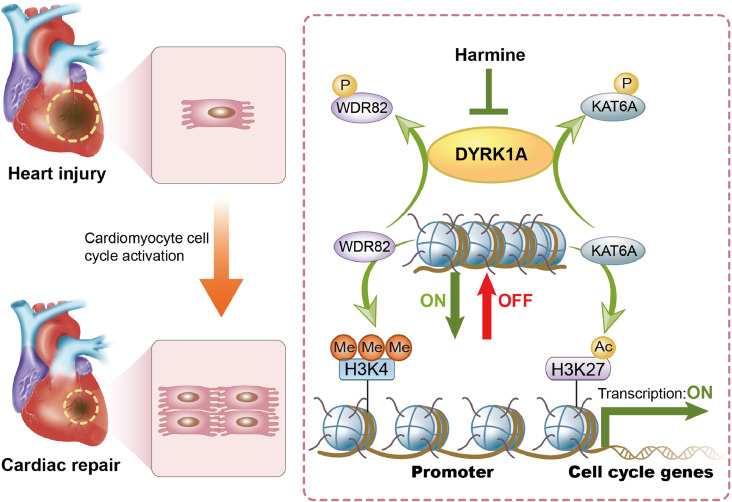
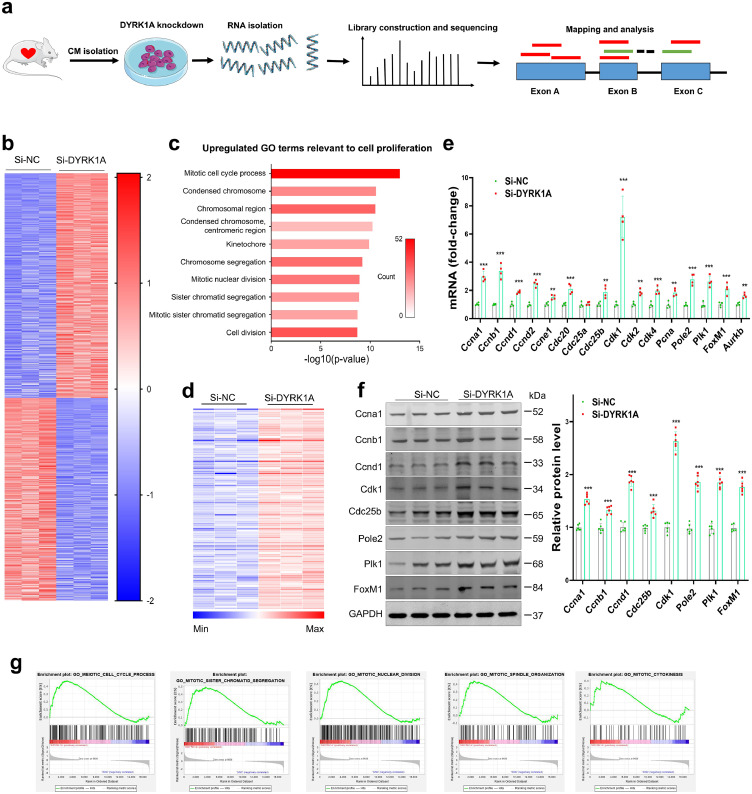
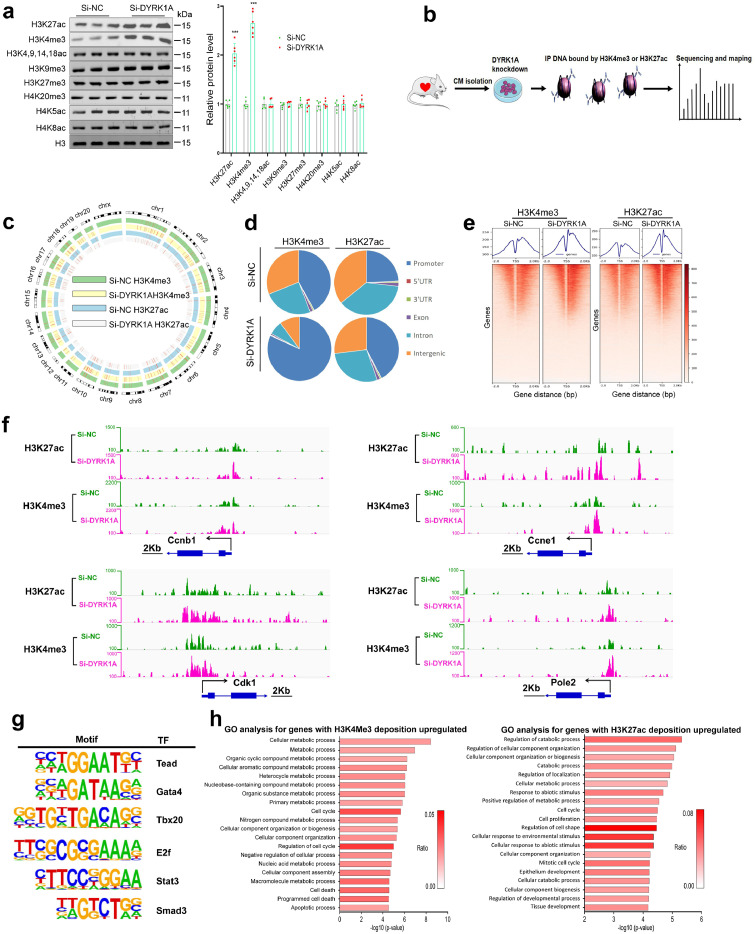
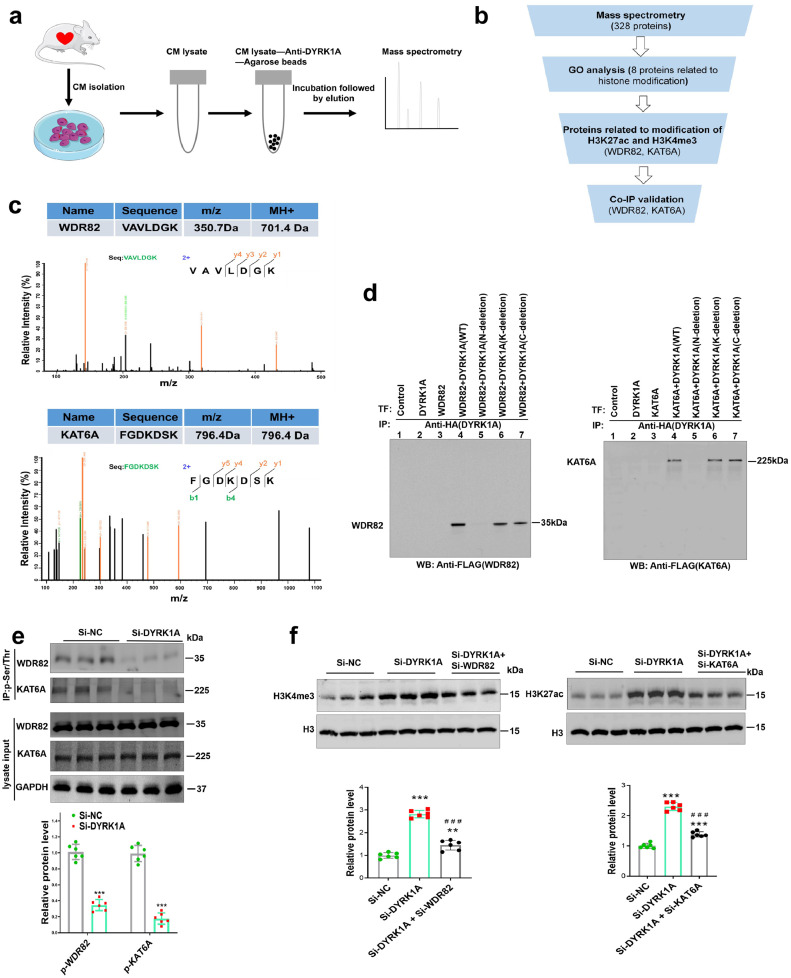
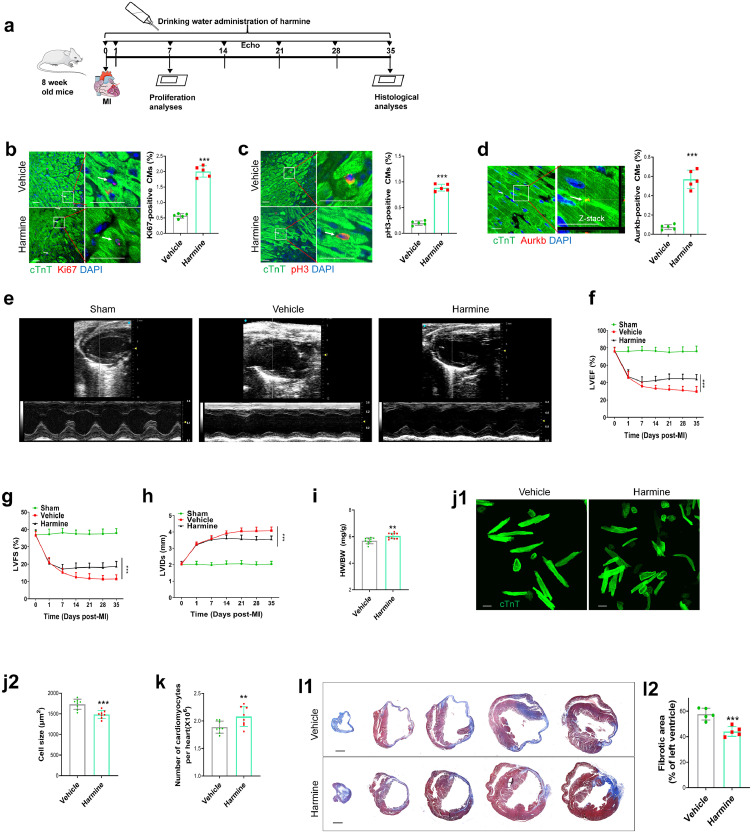
In adult mice subjected to MI, both conditional deletion and pharmacological inhibition of DYRK1A induced cardiomyocyte cell cycle activation and cardiac repair with improved cardiac function. Combining genome-wide transcriptomic and epigenomic analyses revealed that DYRK1A knockdown resulted in robust cardiomyocyte cell cycle activation (shown by the enhanced expression of many genes governing cell proliferation) associated with increased deposition of trimethylated histone 3 Lys4 (H3K4me3) and acetylated histone 3 Lys27 (H3K27ac) on the promoter regions of these genes. Mechanistically, via unbiased mass spectrometry, we discovered that WD repeat-containing protein 82 and lysine acetyltransferase 6A were key mediators in the epigenetic modification of H3K4me3 and H3K27ac and subsequent pro-proliferative transcriptome and cardiomyocyte cell cycle activation.
Our results reveal a significant role of DYRK1A in cardiac repair and suggest a drug target with translational potential for treating cardiomyopathy.
This study was supported in part by grants from the National Natural Science Foundation of China (81930008, 82022005, 82070296, 82102834), National Key R&D Program of China (2018YFC1312700), Program of Innovative Research Team by the National Natural Science Foundation (81721001), and National Institutes of Health (5R01DK039308-31, 7R37HL023081-37, 5P01HL074940-11).
虽然成年哺乳动物的心脏通过心肌细胞增殖仅经历适度的更新,但促进这一过程被认为是修复心脏损伤的一种有前途的治疗策略。本研究探讨了双特异性酪氨酸调节激酶 1A(DYRK1A)在调节心肌梗死后心肌细胞周期激活和心脏修复中的作用和机制。
使用 DYRK1A 敲除小鼠和 DYRK1A 抑制剂来研究 DYRK1A 在心肌梗死后心肌细胞周期激活和心脏修复中的作用。此外,我们通过结合全基因组转录组、表观基因组和蛋白质组学分析来探索潜在的机制。
在接受心肌梗死的成年小鼠中,条件性缺失和药理学抑制 DYRK1A 均可诱导心肌细胞周期激活和心脏修复,改善心功能。全基因组转录组和表观基因组分析的结合表明,DYRK1A 敲低导致心肌细胞周期的强烈激活(表现为许多控制细胞增殖的基因表达增强),与这些基因启动子区域上三甲基化组蛋白 3 赖氨酸 4(H3K4me3)和乙酰化组蛋白 3 赖氨酸 27(H3K27ac)的沉积增加有关。在机制上,通过无偏质谱分析,我们发现 WD 重复蛋白 82 和赖氨酸乙酰转移酶 6A 是 H3K4me3 和 H3K27ac 表观遗传修饰以及随后的促增殖转录组和心肌细胞周期激活的关键介质。
我们的结果揭示了 DYRK1A 在心脏修复中的重要作用,并提出了一种具有治疗心肌病转化潜力的药物靶点。
本研究部分得到了中国国家自然科学基金(81930008、82022005、82070296、82102834)、国家重点研发计划(2018YFC1312700)、国家自然科学基金创新研究群体项目(81721001)和美国国立卫生研究院(5R01DK039308-31、7R37HL023081-37、5P01HL074940-11)的资助。