Kuijpers Marijn
Leibniz-Forschungsinstitut für Molekulare Pharmakologie (FMP), Robert-Rössle-Straße 10, 13125 Berlin, Germany.
Department of Molecular Neurobiology, Donders Institute for Brain, Cognition and Behaviour and Faculty of Science, Radboud University, Nijmegen, The Netherlands.
Neuronal Signal. 2022 Jun 15;6(2):NS20210063. doi: 10.1042/NS20210063. eCollection 2022 Jun.
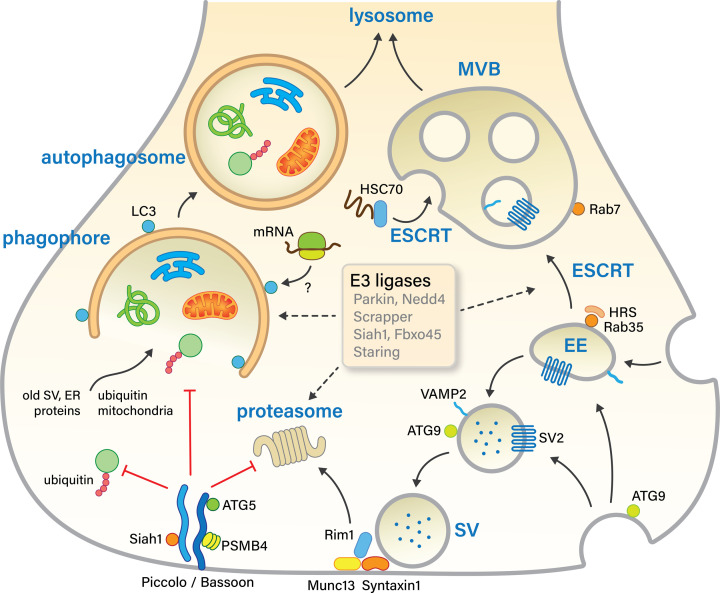
Synapses maintain their molecular composition, plasticity and function through the concerted action of protein synthesis and removal. The complex and polarized neuronal architecture poses specific challenges to the logistics of protein and organelle turnover since protein synthesis and degradation mainly happen in the cell soma. In addition, post-mitotic neurons accumulate damage over a lifetime, challenging neuronal degradative pathways and making them particularly susceptible to the effects of aging. This review will summarize the current knowledge on neuronal protein turnover mechanisms with a particular focus on the presynapse, including the proteasome, autophagy and the endolysosomal route and their roles in regulating presynaptic proteostasis and function. In addition, the author will discuss how physiological brain aging, which entails a progressive decline in cognitive functions, affects synapses and the degradative machinery.
突触通过蛋白质合成与清除的协同作用来维持其分子组成、可塑性和功能。复杂且极化的神经元结构对蛋白质和细胞器更新的物流提出了特定挑战,因为蛋白质合成和降解主要发生在细胞体中。此外,有丝分裂后的神经元在一生中会积累损伤,这对神经元降解途径构成挑战,并使其特别容易受到衰老影响。本综述将总结当前关于神经元蛋白质更新机制的知识,特别关注突触前膜,包括蛋白酶体、自噬和内溶酶体途径及其在调节突触前蛋白质稳态和功能中的作用。此外,作者还将讨论生理性脑衰老(这会导致认知功能逐渐下降)如何影响突触和降解机制。