Li Rui, Hu Yaoyuan, Hou Shuhong
Department of General Surgery, Shengjing Hospital of China Medical University, Shenyang, China.
Front Microbiol. 2022 Jun 22;13:928846. doi: 10.3389/fmicb.2022.928846. eCollection 2022.
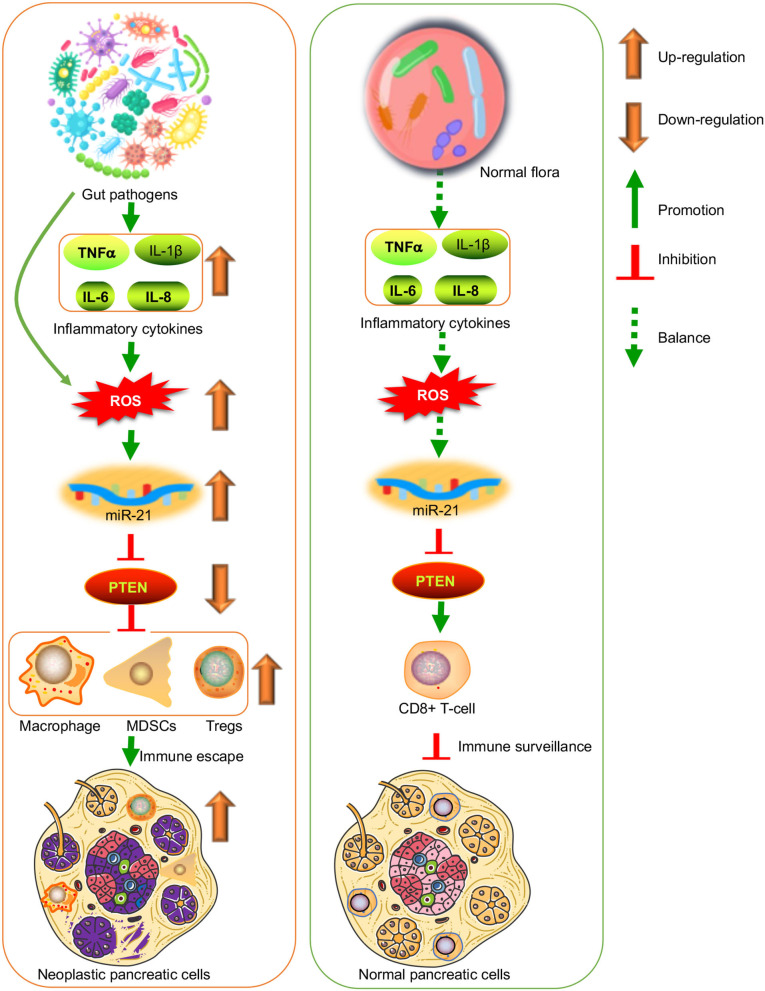
Oral-gut pathogens are closely associated with pancreatic cancer, such as , and , but the related mechanisms remain not well understood. Phosphatase and tensin homolog (PTEN, a widely known tumor suppressor) play a key role in the anti-cancer immune system. Pancreatic cancer cells with PTEN loss are often in the immunosuppressive tumor microenvironment regulated by myeloid-derived suppressor cells (MDSCs), regulatory T cells (Tregs), and M2 macrophages, which are regarded as the mechanism in the immune escape of cancers. The miR-21, as an oncogene in human cancers, plays an important role in pancreatic cancer progression, downregulates the levels of PTEN, and may promote cancer to evade host immune surveillance. Some oral-gut pathogens have been found to promote miR-21 expression and reduce PTEN expression. On the other hand, most gut pathogens infection is thought to produce reactive oxygen species (ROS) or activate inflammatory cytokines, which may also induce ROS-mediated miR-21 expression. These pathogens' infection is involved with the cell density of MDSCs, Tregs, and M2 macrophages. Therefore, it is quite reasonable to propose that oral-gut pathogens possibly promote pancreatic cancer escaping from host immune surveillance by activating the miR-21/PTEN axis and immune-suppressive cells. The present exploration suggests that an increased understanding of the pattern of the effects of gut pathogens on the miR-21/PTEN axis will lead to better insights into the specific mechanisms associated with the immune escape of pancreatic cancer caused by oral-gut microbiota.
口腔-肠道病原体与胰腺癌密切相关,例如[具体病原体1]、[具体病原体2]和[具体病原体3],但其相关机制仍未完全明确。磷酸酶和张力蛋白同源物(PTEN,一种广为人知的肿瘤抑制因子)在抗癌免疫系统中发挥关键作用。PTEN缺失的胰腺癌细胞通常处于由髓源性抑制细胞(MDSC)、调节性T细胞(Treg)和M2巨噬细胞调控的免疫抑制肿瘤微环境中,这被认为是癌症免疫逃逸的机制。miR-21作为人类癌症中的一种癌基因,在胰腺癌进展中起重要作用,下调PTEN水平,并可能促进癌症逃避宿主免疫监视。已发现一些口腔-肠道病原体可促进miR-21表达并降低PTEN表达。另一方面,大多数肠道病原体感染被认为会产生活性氧(ROS)或激活炎性细胞因子,这也可能诱导ROS介导的miR-21表达。这些病原体的感染与MDSC、Treg和M2巨噬细胞的细胞密度有关。因此,提出口腔-肠道病原体可能通过激活miR-21/PTEN轴和免疫抑制细胞来促进胰腺癌逃避宿主免疫监视是很合理的。目前的探索表明,进一步了解肠道病原体对miR-21/PTEN轴的作用模式将有助于更好地洞察与口腔-肠道微生物群导致的胰腺癌免疫逃逸相关的具体机制。