Kunovsky Lumir, Dite Petr, Jabandziev Petr, Dolina Jiri, Vaculova Jitka, Blaho Martin, Bojkova Martina, Dvorackova Jana, Uvirova Magdalena, Kala Zdenek, Trna Jan
Department of Surgery, University Hospital Brno and Faculty of Medicine, Masaryk University, Brno 62500, Czech Republic.
Department of Gastroenterology and Internal Medicine, University Hospital Brno and Faculty of Medicine, Masaryk University, Brno 62500, Czech Republic.
World J Gastrointest Oncol. 2021 Aug 15;13(8):835-844. doi: 10.4251/wjgo.v13.i8.835.
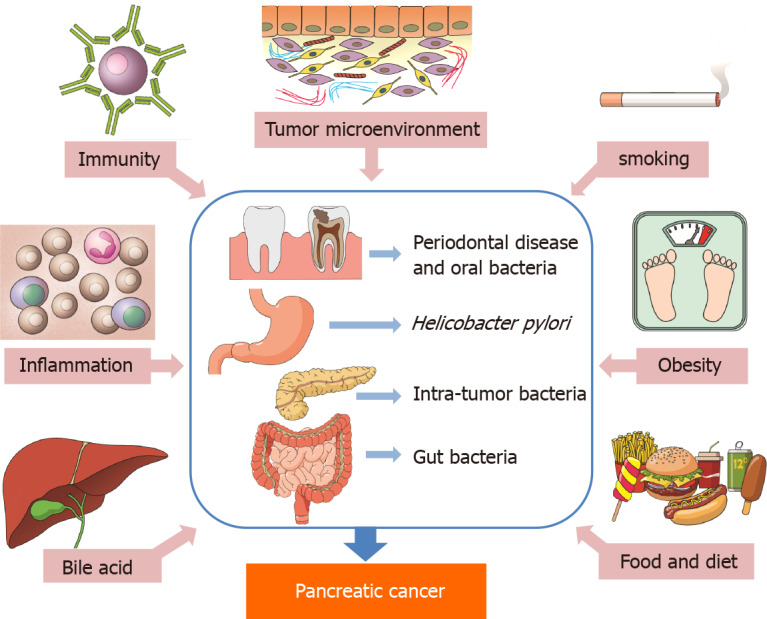
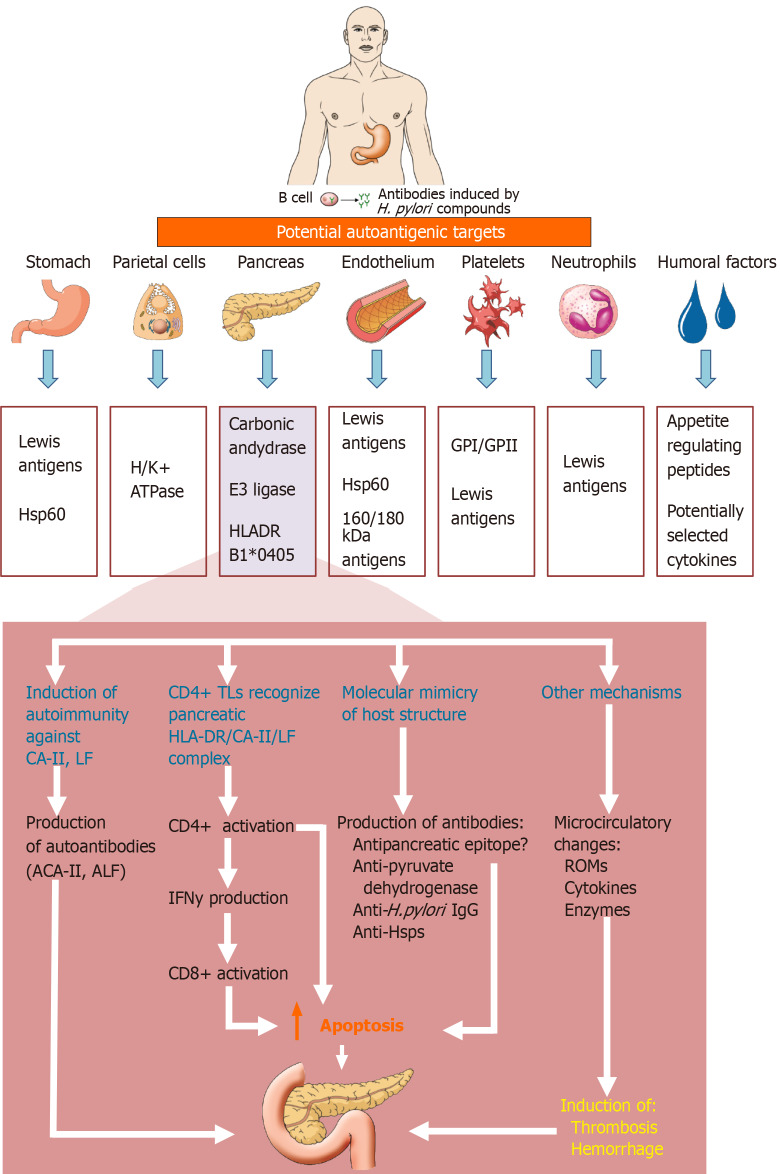
() is an infectious agent influencing as much as 50% of the world's population. It is the causative agent for several diseases, most especially gastric and duodenal peptic ulcer, gastric adenocarcinoma and mucosa-associated lymphoid tissue lymphoma of the stomach. A number of other, extragastric manifestations also are associated with infection. These include neurological disorders, such as Alzheimer's disease, demyelinating multiple sclerosis and Parkinson's disease. There is also evidence for a relationship between infection and such dermatological diseases as psoriasis and rosacea as well as a connection with infection and open-angle glaucoma. Generally little is known about the relationship between infection and diseases of the pancreas. Most evidence about and its potential role in the development of pancreatic diseases concerns pancreatic adenocarcinoma and autoimmune forms of chronic pancreatitis. There is data (albeit not fully consistent) indicating modestly increased pancreatic cancer risk in -positive patients. The pathogenetic mechanism of this increase is not yet fully elucidated, but several theories have been proposed. Reduction of antral D-cells in -positive patients causes a suppression of somatostatin secretion that, in turn, stimulates increased secretin secretion. That stimulates pancreatic growth and thus increases the risk of carcinogenesis. Alternatively, , as a part of microbiome dysbiosis and the so-called oncobiome, is proven to be associated with pancreatic adenocarcinoma development the promotion of cellular proliferation. The role of in the inflammation characteristic of autoimmune pancreatitis seems to be explained by a mechanism of molecular mimicry among several proteins (mostly enzymes) of and pancreatic tissue. Patients with autoimmune pancreatitis often show positivity for antibodies against proteins. , as a part of microbiome dysbiosis, also is viewed as a potential trigger of autoimmune inflammation of the pancreas. It is precisely these relationships (and associated equivocal conclusions) that constitute a center of attention among pancreatologists, immunologists and pathologists. In order to obtain clear and valid results, more studies on sufficiently large cohorts of patients are needed. The topic is itself sufficiently significant to draw the interest of clinicians and inspire further systematic research. Next-generation sequencing could play an important role in investigating the microbiome as a potential diagnostic and prognostic biomarker for pancreatic cancer.
(某种病原体)是一种感染因子,影响着全球多达50%的人口。它是多种疾病的病原体,尤其是胃和十二指肠消化性溃疡、胃腺癌以及胃黏膜相关淋巴组织淋巴瘤。许多其他胃外表现也与(该病原体)感染有关。这些包括神经疾病,如阿尔茨海默病、脱髓鞘性多发性硬化症和帕金森病。也有证据表明(该病原体)感染与银屑病和酒渣鼻等皮肤病之间存在关联,以及与感染和开角型青光眼之间存在联系。一般来说,关于(该病原体)感染与胰腺疾病之间的关系知之甚少。关于(该病原体)及其在胰腺疾病发展中潜在作用的大多数证据涉及胰腺腺癌和自身免疫性慢性胰腺炎。有数据(尽管并不完全一致)表明(该病原体)阳性患者患胰腺癌的风险略有增加。这种增加的发病机制尚未完全阐明,但已经提出了几种理论。(该病原体)阳性患者胃窦D细胞减少会导致生长抑素分泌受到抑制,进而刺激促胰液素分泌增加。这会刺激胰腺生长,从而增加致癌风险。或者,作为微生物群失调和所谓肿瘤微生物群的一部分,(该病原体)被证明与胰腺腺癌的发展有关——促进细胞增殖。(该病原体)在自身免疫性胰腺炎炎症特征中的作用似乎可以通过(该病原体)的几种蛋白质(主要是酶)与胰腺组织之间的分子模拟机制来解释。自身免疫性胰腺炎患者通常对针对(该病原体)蛋白质的抗体呈阳性。作为微生物群失调的一部分,(该病原体)也被视为胰腺自身免疫性炎症的潜在触发因素。正是这些关系(以及相关的模棱两可的结论)构成了胰腺病学家、免疫学家和病理学家关注的焦点。为了获得清晰有效的结果,需要对足够大的患者队列进行更多研究。这个话题本身就足够重要,能够引起临床医生的兴趣并激发进一步的系统研究。下一代测序在研究微生物群作为胰腺癌潜在的诊断和预后生物标志物方面可能发挥重要作用。