Hatcher Abigail M, Neilands Torsten B, Rebombo Dumisani, Weiser Sheri D, Christofides Nicola J
Department of Health Behavior, Gillings School of Global Public Health, University of North Carolina System, Chapel Hill, North Carolina, USA.
School of Public Health, Faculty of Health Sciences, University of the Witwatersrand, Johannesburg, South Africa.
BMJ Nutr Prev Health. 2022 Feb 7;5(1):36-43. doi: 10.1136/bmjnph-2021-000288. eCollection 2022.
Although food insecurity has been associated with intimate partner violence (IPV), few studies examine it longitudinally or among male perpetrators.
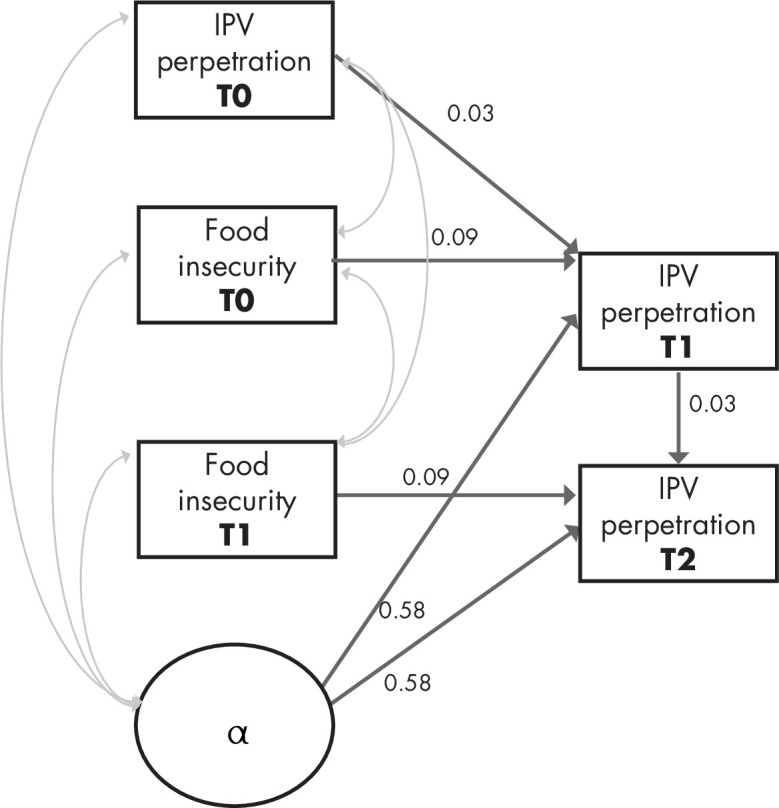
We used secondary data from a trial that followed 2479 men in a peri-urban settlement in South Africa (February 2016-August 2018). Men self-completed questionnaires at baseline (T0), 12 months (T1) and 24 months (T2) on food security, household type, relationship status, childhood abuse exposure, alcohol use, and perpetration of physical and/or sexual IPV. Cross-lagged dynamic panel modelling examines the strength and direction of associations over time.
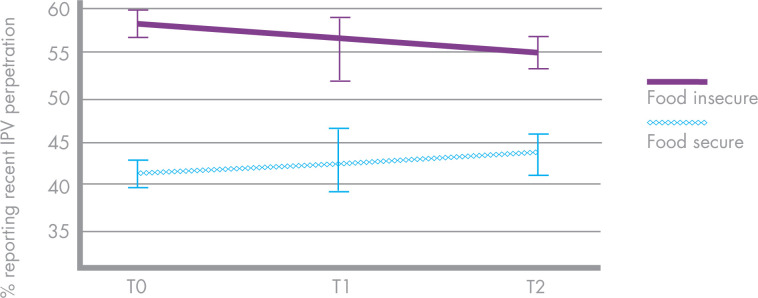
At baseline, rates of IPV perpetration (52.0%) and food insecurity (65.5%) were high. Food insecure men had significantly higher odds of IPV perpetration at T0, T1 and T2 (ORs of 1.9, 1.4 and 1.4, respectively). In longitudinal models, food insecurity predicted men's IPV perpetration 1 year later. The model had excellent fit after controlling for housing, relationship status, age, childhood abuse and potential effect of IPV on later food insecurity (standardised coefficient=0.09, p=0.031. root mean squared error of approximation=0.016, comparative fit index=0.994). IPV perpetration did not predict later food security (p=0.276).
Food insecurity had an independent, longitudinal association with men's IPV perpetration in a peri-urban South African settlement. These findings suggest food security could be a modifiable risk factor of partner violence.
NCT02823288.
尽管粮食不安全与亲密伴侣暴力(IPV)有关,但很少有研究对其进行纵向研究或针对男性施暴者展开研究。
我们使用了一项试验的二次数据,该试验对南非一个城郊定居点的2479名男性进行了跟踪(2016年2月至2018年8月)。男性在基线期(T0)、12个月(T1)和24个月(T2)自行填写关于粮食安全、家庭类型、恋爱状况、童年期受虐经历、饮酒情况以及身体和/或性方面亲密伴侣暴力施暴情况的问卷。交叉滞后动态面板模型检验了随时间变化的关联强度和方向。
在基线期,亲密伴侣暴力施暴率(52.0%)和粮食不安全率(65.5%)都很高。粮食不安全的男性在T0、T1和T2时实施亲密伴侣暴力的几率显著更高(比值比分别为1.9、1.4和1.4)。在纵向模型中,粮食不安全可预测男性在1年后实施亲密伴侣暴力的情况。在控制了住房、恋爱状况、年龄、童年期受虐经历以及亲密伴侣暴力对后期粮食不安全的潜在影响后,该模型拟合效果极佳(标准化系数=0.09,p=0.031,近似均方根误差=0.016,比较拟合指数=0.994)。实施亲密伴侣暴力并不能预测后期的粮食安全情况(p=0.276)。
在南非一个城郊定居点,粮食不安全与男性实施亲密伴侣暴力存在独立的纵向关联。这些发现表明,粮食安全可能是伴侣暴力的一个可改变的风险因素。
NCT02823288。