Li Xin, Liu Minghui, Liu Hongyu, Chen Jun
Department of Lung Cancer Surgery, Tianjin Medical University General Hospital, Tianjin 300052, P.R. China.
Tianjin Key Laboratory of Lung Cancer Metastasis and Tumor Microenvironment, Tianjin Lung Cancer Institute, Tianjin Medical University General Hospital, Tianjin 300052, P.R. China.
Oncol Lett. 2022 Jun 28;24(2):287. doi: 10.3892/ol.2022.13407. eCollection 2022 Aug.
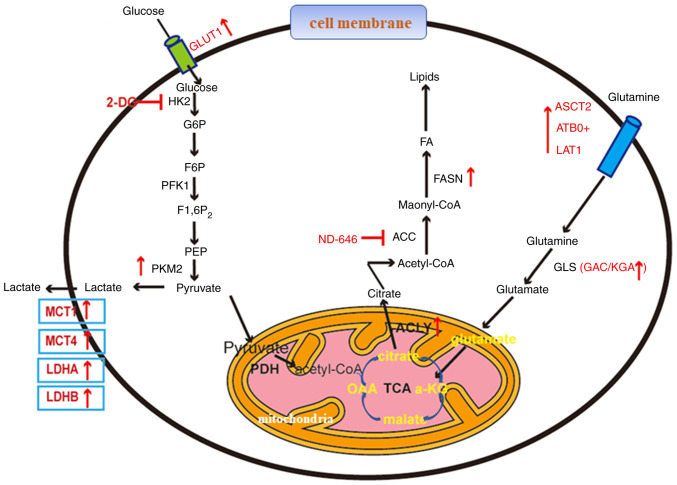
Metabolic reprogramming is an important characteristic of tumor cells. Tumor cells reprogram their metabolic pathways to meet the material, energy and redox force needs for rapid proliferation. Metabolic reprogramming changes the level or type of specific metabolites inside and outside cells, and promotes tumor growth by affecting gene expression, cell state and the tumor microenvironment. Glucose metabolism, glutamine metabolism and lipid metabolism are significant metabolic pathways in tumors. Targeting metabolic reprogramming can significantly inhibit tumor growth and induce apoptosis. Metabolic reprogramming also plays an important role in maintaining the growth advantage of tumor cells and enhancing the chemotherapy tolerance of lung cancer. This review summarizes abnormal changes in the metabolism of glucose, fat and amino acids in lung cancer, and the underlying molecular mechanism, with the aim of providing novel ideas for the prevention, early diagnosis and treatment of lung cancer.
代谢重编程是肿瘤细胞的一个重要特征。肿瘤细胞重新编程其代谢途径,以满足快速增殖所需的物质、能量和氧化还原力需求。代谢重编程改变细胞内外特定代谢物的水平或类型,并通过影响基因表达、细胞状态和肿瘤微环境来促进肿瘤生长。葡萄糖代谢、谷氨酰胺代谢和脂质代谢是肿瘤中重要的代谢途径。靶向代谢重编程可显著抑制肿瘤生长并诱导细胞凋亡。代谢重编程在维持肿瘤细胞的生长优势和增强肺癌的化疗耐受性方面也发挥着重要作用。本综述总结了肺癌中葡萄糖、脂肪和氨基酸代谢的异常变化及其潜在分子机制,旨在为肺癌的预防、早期诊断和治疗提供新思路。