Henry Amanda, Yang Jennifer, Grattan Sarah, Roberts Lynne, Lainchbury Anne, Shanthosh Janani, Cullen Patricia, Everitt Louise
Discipline of Women's Health, School of Clinical Medicine, UNSW Medicine and Health, University of New South Wales (NSW), Sydney, NSW, Australia.
Department of Women's and Children's Health, St George Hospital, Sydney, NSW, Australia.
Front Glob Womens Health. 2022 Jun 22;3:819953. doi: 10.3389/fgwh.2022.819953. eCollection 2022.
Australian antenatal care includes specific screening and service provision for domestic and family violence (DFV) and mental health. However, the COVID-19 pandemic resulted in major care changes, including greatly expanded telehealth. Given difficulties in a safe assessment and management of disclosures telehealth, DFV and mental health service provision might be substantially impacted. This study therefore aimed to assess COVID-19 effects on DFV and mental health screening, as well as broader service provision from the perspective of local maternity service providers.
Mixed-methods study of staff surveys and interviews of staff directly involved in pregnancy care (doctors, midwives, and allied health) in three Sydney (Australia) maternity units, from October 2020 to March 2021. Surveys and interviews interrogated perceived effects of the COVID-19 pandemic on delivery (ensuring required services occurred), timeliness, and quality of (a) overall maternity care and (b) DFV and mental health screening and care; and also advantages and disadvantages of telehealth. Surveys were descriptively analyzed. Interviews were conducted online, recorded, and transcribed verbatim prior to thematic analysis.
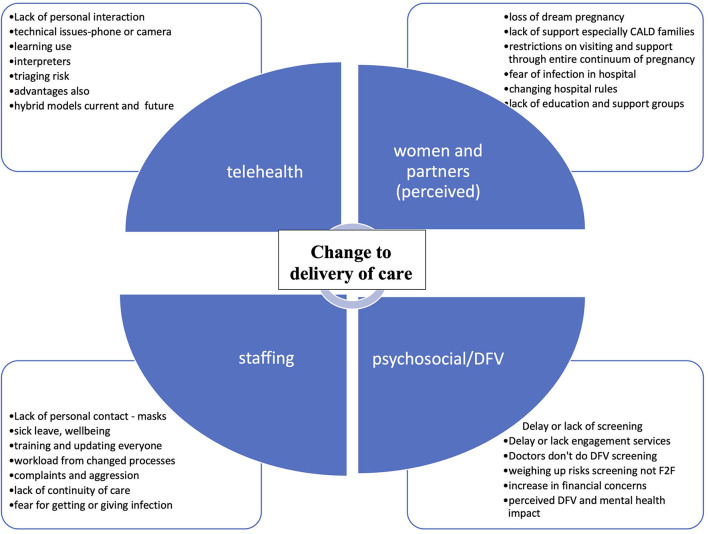
In total, 17 interviews were conducted and 109 survey responses were received. Breakdown of survey respondents was 67% of midwives, 21% of doctors, and 10% of allied health. Over half of survey respondents felt the pandemic had a negative effect on delivery, timeliness, and quality of overall pregnancy care, and DFV and mental health screening and management. Perceived telehealth positives included convenience for women (73%) and reducing women's travel times (69%). Negative features included no physical examination (90%), difficulty regarding non-verbal cues (84%), difficulty if interpreter required (71%), and unsure if safe to ask some questions (62%). About 50% felt telehealth should continue post-pandemic, but for <25% of visits. Those perceived suitable for telehealth were low-risk and multiparous women, whereas those unsuited were high-risk pregnancy, non-English speaking, and/or mental health/psychosocial/DFV concerns. "Change to delivery of care" was the central interview theme, with subthemes of impact on mental health/DFV screening, telehealth (both positive and negative), staff impact (e.g., continuity of care disruption), and perceived impact on women and partners.
While telehealth may have an ongoing, post-pandemic role in Australian maternity care, staff believe that this should be limited in scope, mostly for low-risk pregnancies. Women with high risk due to physical health or mental health, DFV, and/or other social concerns were considered unsuited to telehealth.
澳大利亚的产前护理包括针对家庭和家庭暴力(DFV)以及心理健康的特定筛查和服务提供。然而,新冠疫情导致了主要的护理变化,包括远程医疗的大幅扩展。鉴于在远程医疗中对披露信息进行安全评估和管理存在困难,DFV和心理健康服务的提供可能会受到重大影响。因此,本研究旨在从当地产科服务提供者的角度评估新冠疫情对DFV和心理健康筛查以及更广泛的服务提供的影响。
2020年10月至2021年3月,对澳大利亚悉尼三个产科单位中直接参与孕期护理的工作人员(医生、助产士和相关健康专业人员)进行了混合方法研究,包括员工调查和访谈。调查和访谈询问了新冠疫情对(a)整体产科护理以及(b)DFV和心理健康筛查与护理的提供(确保所需服务得以提供)、及时性和质量的感知影响;还询问了远程医疗的优缺点。对调查进行了描述性分析。访谈在网上进行,记录下来,并在进行主题分析之前逐字转录。
总共进行了17次访谈,收到了109份调查回复。调查对象的构成是67%为助产士,21%为医生,10%为相关健康专业人员。超过一半的调查对象认为疫情对整体孕期护理以及DFV和心理健康筛查与管理的提供、及时性和质量产生了负面影响。远程医疗的积极方面包括对女性方便(73%)以及减少女性的出行时间(69%)。消极方面包括无法进行体格检查(90%)、难以解读非语言线索(84%)、如果需要口译员会有困难(71%)以及不确定询问某些问题是否安全(62%)。约50%的人认为疫情后远程医疗应该继续,但就诊比例应低于25%。那些被认为适合远程医疗的是低风险和经产妇,而那些不适合的是高危妊娠、非英语使用者以及/或者有心理健康/心理社会/DFV问题的人。“护理提供方式的改变”是访谈的核心主题,并伴有对心理健康/DFV筛查的影响、远程医疗(包括积极和消极方面)、员工影响(例如,护理连续性中断)以及对女性和伴侣的感知影响等子主题。
虽然远程医疗在疫情后的澳大利亚产科护理中可能会持续发挥作用,但工作人员认为其范围应受到限制,主要适用于低风险妊娠。因身体健康或心理健康、DFV以及/或者其他社会问题而处于高风险的女性被认为不适合远程医疗。
