Michalski Meghan, Rowed Kylie, Lavery Jessica A, Moskowitz Chaya S, Capaci Catherine, Stene Guro, Edvardsen Elisabeth, Eves Neil D, Jones Lee W, Scott Jessica M
Memorial Sloan Kettering Cancer Center, New York, New York, USA.
Weill Cornell Medical College, New York, New York, USA.
JACC CardioOncol. 2022 Jun 21;4(2):210-219. doi: 10.1016/j.jaccao.2022.05.003. eCollection 2022 Jun.
Estimated peak oxygen consumption (Vopeak) is widely used in oncology; however, estimated Vopeak equations were developed in noncancer settings.
The aim of this study was to evaluate the validity of estimated Vopeak in women with primary breast cancer and to develop oncology-specific estimated Vopeak equations.
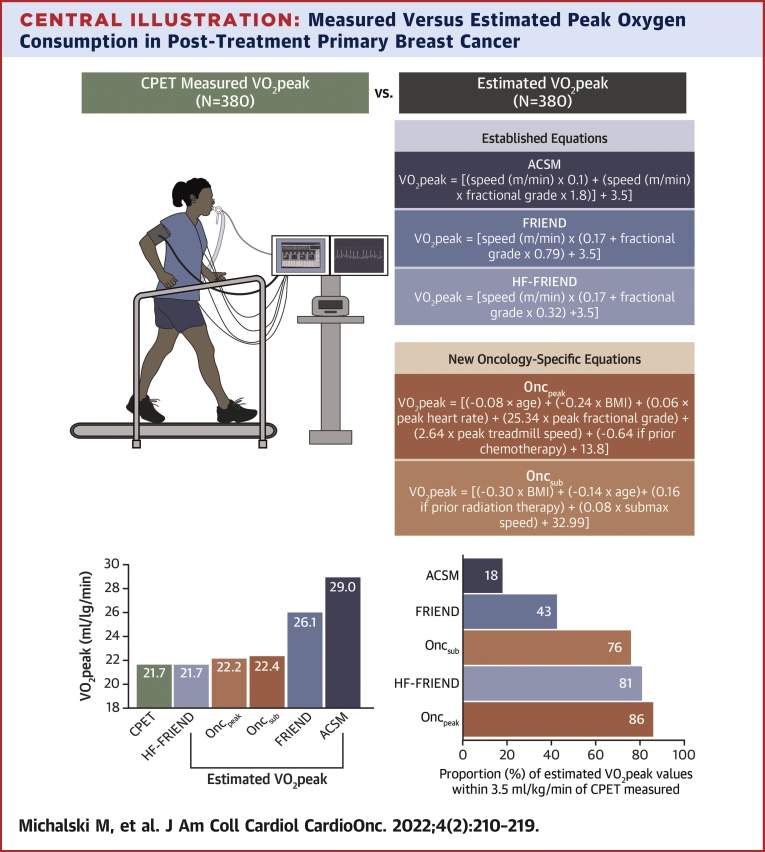
Vopeak was directly measured (TrueOne 2400, Parvo Medics) during 380 cardiopulmonary exercise tests in women previously treated for breast cancer (mean age: 59 ± 10 years; 3.1 ± 1.2 years post-therapy). The American College of Sports Medicine (ACSM), the Fitness Registry and the Importance of Exercise National Database (FRIEND), and heart failure (HF)-FRIEND equations were used to estimate Vopeak. New equations were developed using patient and peak (Onc) or submaximal (Onc) exercise test characteristics.
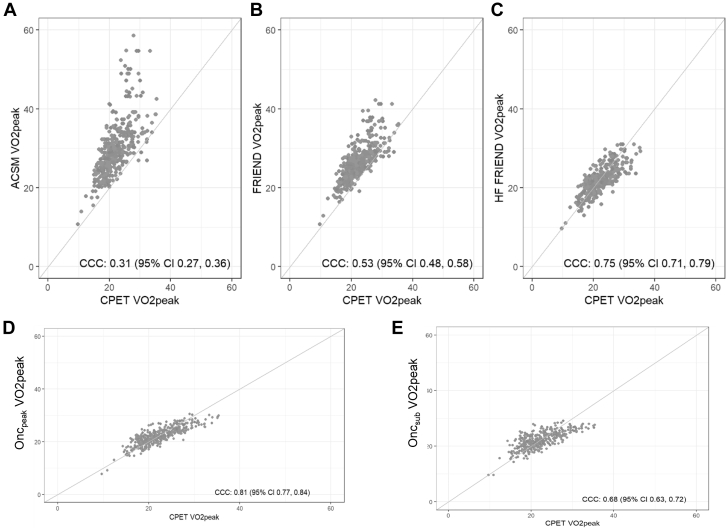
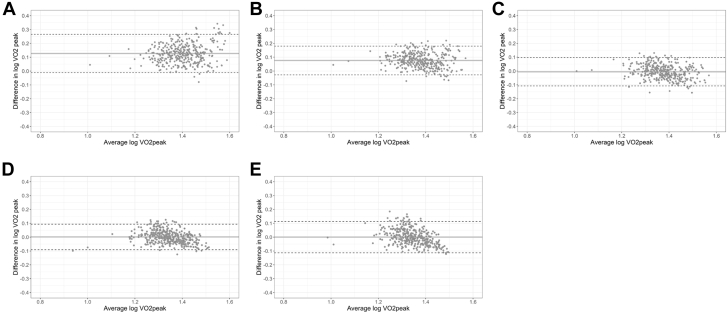
The median differences between measured and estimated Vopeak were 7.0 mL O·kg·min, 3.9 mL O·kg·min, and -0.2 mL O·kg·min for ACSM, FRIEND, and HF-FRIEND, respectively. The number of estimated Vopeak values within ±3.5 mL O·kg·min of the measured values was 70 (18%), 164 (43%), and 306 (81%) for ACSM, FRIEND, and HF-FRIEND, respectively. The Onc and Onc models included body mass index, age, a history of chemotherapy or radiation, the peak measured heart rate, and the treadmill grade and/or speed. The median differences between measured and estimated Vopeak were 0.02 mL O·kg·min (Onc) and -0.2 mL O·kg·min (Onc). Eighty-six percent (n = 325) and 76% (n = 283) estimated Vopeak values were within ±3.5 mL O·kg·min of the measured Vopeak values for Onc and Onc, respectively.
HF-FRIEND or oncology-specific equations could be applied to estimate Vopeak in patients previously treated for breast cancer in settings where cardiopulmonary exercise tests are not available. (Trial Comparing the Effects of Linear Versus Nonlinear Aerobic Training in Women With Operable Breast Cancer [EXCITE]; NCT01186367.
估计的峰值耗氧量(Vopeak)在肿瘤学中被广泛应用;然而,估计Vopeak的公式是在非癌症环境中开发的。
本研究的目的是评估原发性乳腺癌女性中估计Vopeak的有效性,并开发针对肿瘤学的估计Vopeak公式。
在380例曾接受乳腺癌治疗的女性(平均年龄:59±10岁;治疗后3.1±1.2年)的心肺运动试验中,直接测量Vopeak(TrueOne 2400,Parvo Medics)。使用美国运动医学学院(ACSM)、健身注册与运动国家数据库重要性(FRIEND)以及心力衰竭(HF)-FRIEND公式来估计Vopeak。利用患者和峰值(Onc)或次最大(Onc)运动试验特征开发新的公式。
对于ACSM、FRIEND和HF-FRIEND,测量值与估计Vopeak之间的中位数差异分别为7.0毫升氧·千克·分钟、3.9毫升氧·千克·分钟和-0.2毫升氧·千克·分钟。对于ACSM、FRIEND和HF-FRIEND,估计Vopeak值在测量值±3.5毫升氧·千克·分钟范围内的数量分别为70(18%)、164(43%)和306(81%)。Onc和Onc模型包括体重指数、年龄、化疗或放疗史、测量的峰值心率以及跑步机坡度和/或速度。测量值与估计Vopeak之间的中位数差异分别为0.02毫升氧·千克·分钟(Onc)和-0.2毫升氧·千克·分钟(Onc)。对于Onc和Onc,分别有86%(n = 325)和76%(n = 283)的估计Vopeak值在测量的Vopeak值±3.5毫升氧·千克·分钟范围内。
在无法进行心肺运动试验的情况下,HF-FRIEND或针对肿瘤学的公式可用于估计曾接受乳腺癌治疗患者的Vopeak。(可手术乳腺癌女性线性与非线性有氧运动训练效果比较试验[EXCITE];NCT01186367)