Edinburgh Clinical Trials Unit, University of Edinburgh, Edinburgh, UK.
Institute of Health & Wellbeing, University of Glasgow, Glasgow, UK.
Pharm Stat. 2022 Jul;21(4):740-756. doi: 10.1002/pst.2219.
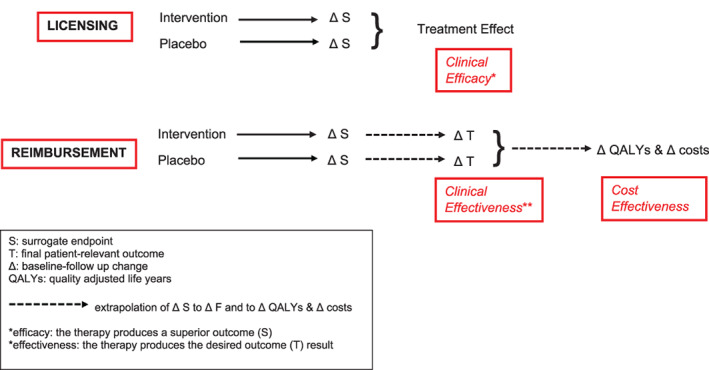
The desire, by patients and society, for faster access to therapies has driven a long tradition of the use of surrogate endpoints in the evaluation of pharmaceuticals and, more recently, biologics and other innovative medical technologies. The consequent need for statistical validation of potential surrogate outcome measures is a prime example on the theme of statistical support for decision-making in health technology assessment (HTA). Following the pioneering methodology based on hypothesis testing that Prentice presented in 1989, a host of further methods, both frequentist and Bayesian, have been developed to enable the value of a putative surrogate outcome to be determined. This rich methodological seam has generated practical methods for surrogate evaluation, the most recent of which are based on the principles of information theory and bring together ideas from the causal effects and causal association paradigms. Following our synopsis of statistical methods, we then consider how regulatory authorities (on licensing) and payer and HTA agencies (on reimbursement) use clinical trial evidence based on surrogate outcomes. We review existing HTA surrogate outcome evaluative frameworks. We conclude with recommendations for further steps: (1) prioritisation by regulators and payers of the application of formal surrogate outcome evaluative frameworks, (2) application of formal Bayesian decision-analytic methods to support reimbursement decisions, and (3) greater utilization of conditional surrogate-based licensing and reimbursement approvals, with subsequent reassessment of treatments in confirmatory trials based on final patient-relevant outcomes.
患者和社会希望更快地获得治疗方法,这推动了长期以来在评估药物方面使用替代终点的传统,最近还推动了生物制剂和其他创新医疗技术的使用。因此,需要对潜在替代结局测量指标进行统计验证,这是主题为支持卫生技术评估(HTA)决策的统计支持的一个主要例子。继 1989 年 Prentice 提出的基于假设检验的开创性方法之后,已经开发了许多进一步的方法,包括频率主义和贝叶斯方法,以确定假定替代结局的价值。这种丰富的方法学为替代评估提供了实用方法,其中最新的方法基于信息理论的原则,并汇集了因果效应和因果关联范式的思想。在我们对统计方法进行概述之后,我们将考虑监管机构(在许可方面)和支付者和 HTA 机构(在报销方面)如何使用基于替代结局的临床试验证据。我们回顾了现有的 HTA 替代结局评估框架。我们的结论是提出进一步的建议:(1)监管机构和支付者优先考虑正式的替代结局评估框架的应用,(2)应用正式的贝叶斯决策分析方法来支持报销决策,以及(3)更多地利用基于条件的替代物进行许可和报销批准,并在最终基于患者相关结局的验证性试验中重新评估治疗方法。