Experimental Psychology, Helmholtz Institute, Faculty of Social and Behavioral Sciences, Utrecht University, Utrecht, The Netherlands.
PLoS One. 2022 Jul 12;17(7):e0271164. doi: 10.1371/journal.pone.0271164. eCollection 2022.
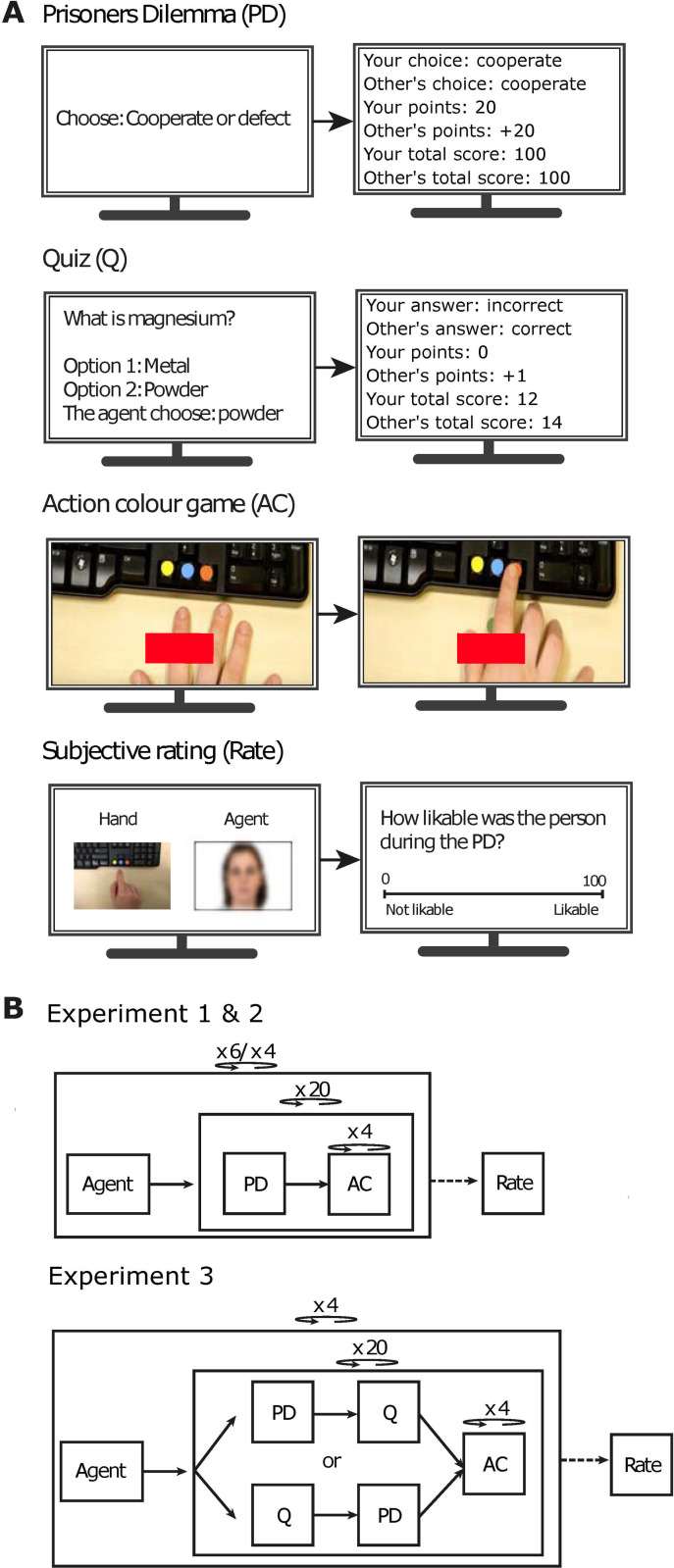
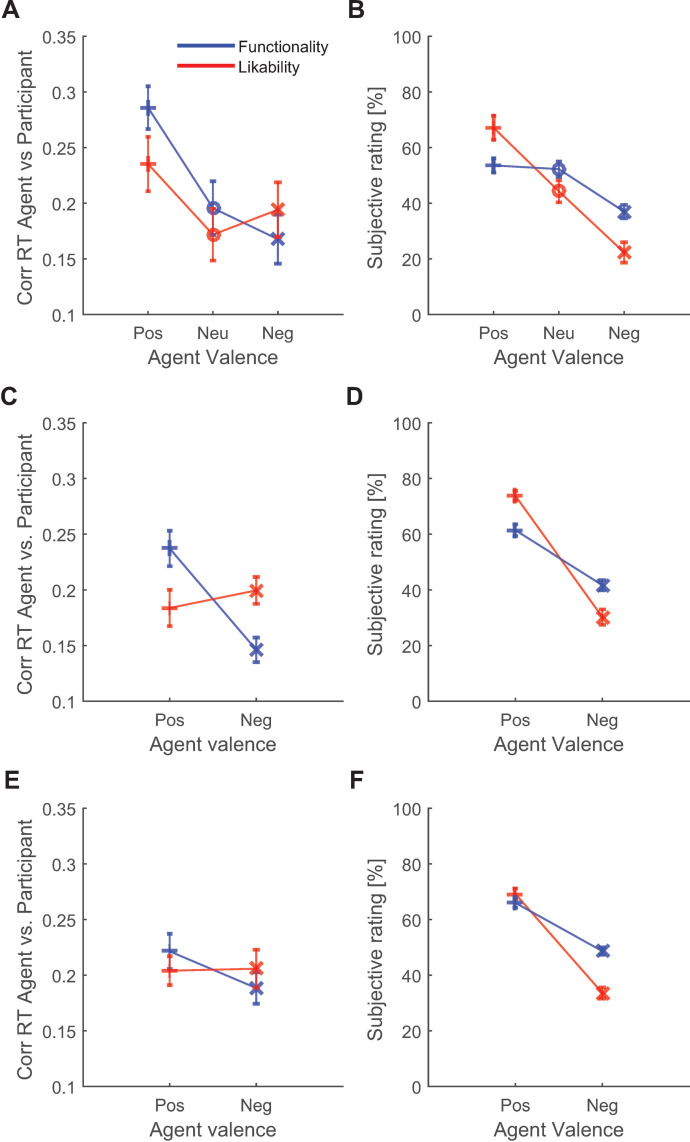
Shaping one owns actions by observing others' actions is driven by the deep-rooted mechanism of perception-action coupling. It typically occurs automatically, expressed as for example the unintentional synchronization of reaction times in interactive games. Theories on perception-action coupling highlight its benefits such as the joint coordination of actions to cooperatively perform tasks properly, the learning of novel actions from others, and the bonding with likable others. However, such functional aspects and how they shape perception-action coupling have never been compared quantitatively. Here we tested a total of hundred-fifteen participants that played a stimulus-response task while, in parallel, they observed videos of agents that played the exact same task several milliseconds in advance. We compared to what degree the reaction times of actions of agents, who varied their behavior in terms of functionality and likability in preceding prisoner dilemma games and quizzes, shape the reaction times of human test participants. To manipulate functionality and likability, we varied the predictability of cooperative behavior and correctness of actions of agents, respectively, resulting in likable (cooperative), dislikable (uncooperative), functional (correct actions), and dysfunctional (incorrect actions) agents. The results of three experiments showed that the participants' reaction times correlated most with the reaction times of agents that expressed functional behavior. However, the likability of agents had no effects on reaction time correlations. These findings suggest that, at least in the current computer task, participants are more likely to adopt the timing of actions from people that perform correct actions than from people that they like.
通过观察他人的行为来塑造自己的行为,这是由感知-动作耦合的深层机制驱动的。它通常是自动发生的,例如在互动游戏中无意识地同步反应时间。感知-动作耦合理论强调了它的好处,例如协同完成任务的动作的联合协调、从他人那里学习新的动作以及与讨人喜欢的人建立联系。然而,这种功能方面以及它们如何塑造感知-动作耦合从未被定量比较过。在这里,我们测试了总共 115 名参与者,他们在玩刺激-反应任务的同时,平行地观看了代理在几毫秒前玩完全相同任务的视频。我们比较了代理在之前的囚徒困境游戏和测验中改变其行为的功能和喜好程度对人类测试参与者的反应时间的影响程度。为了操纵功能和喜好度,我们分别改变了代理合作行为的可预测性和动作的正确性,从而产生了令人喜欢(合作)、不喜欢(不合作)、功能(正确动作)和功能失调(错误动作)的代理。三个实验的结果表明,参与者的反应时间与表现出功能行为的代理的反应时间相关性最大。然而,代理的喜好度对反应时间相关性没有影响。这些发现表明,至少在当前的计算机任务中,参与者更有可能采用正确动作的人的时间,而不是他们喜欢的人的时间。