Department of Radiation Oncology, University of Alabama at Birmingham, Birmingham, Alabama, USA.
J Appl Clin Med Phys. 2022 Aug;23(8):e13697. doi: 10.1002/acm2.13697. Epub 2022 Jul 12.
To validate surface imaging (SI)-reported offsets using a six degree-of-freedom couch and an anthropomorphic phantom for commissioning and routine quality assurance of an SI system used for stereotactic radiosurgery (SRS).
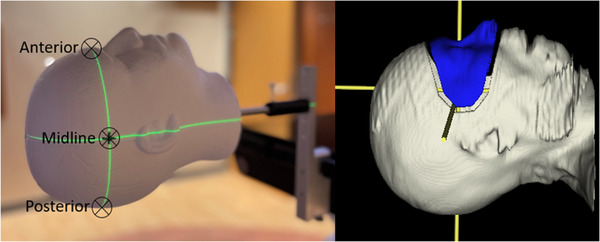
An anthropomorphic phantom with a radiopaque ball bearing (BB) placed either anterior, midline, or posterior, was tracked with SI with a typical SRS region of interest. Couch motion in all six degrees of freedom was programmed and delivered on a linac. SI system logs were synchronized with linac trajectory logs. Ten random couch positions were selected at couch 0°, 45°, 90°, 270°, 315° with megavolt (MV) images taken to account for couch walkout. The SI residual error (ε), the difference between SI reported offset and MV or trajectory log position, was calculated. Residual errors were measured with and without one SI pod blocked.
The median [range] of magnitude of translational ε was 0.13 [0.07, 0.21], 0.16 [0.11, 0.26], 0.61 [0.50, 0.68], 0.49 [0.42, 0.55], 0.55 [0.38, 0.72] mm for couch rotations of 0°, 45°, 90°, 270°, 315°, respectively, for the midline BB and no pod blocked. The range of all translational ε from all couch angles (with and without pod block) at different BB positions is [0.05, 0.96] mm. The absolute range of difference when changing BB position when no pod is blocked in median translational ε is [0.01, 0.40] mm with the maximum at BB posterior. The absolute range of difference when not changing BB positions with and without pod block in median translational ε is [0.01, 0.37] mm with the maximum at BB posterior and couch 315°.
SI system and linac trajectory log analysis can be used to assess SI system performance with automated couch motion to validate SI accuracy.
使用六自由度治疗床和人体模型验证表面成像(SI)报告的偏移量,以对用于立体定向放射外科(SRS)的 SI 系统进行常规质量保证和启动阶段的验证。
将带有不透射线球轴承(BB)的人体模型置于前、中线或后位置,通过典型的 SRS 感兴趣区域进行 SI 跟踪。在直线加速器上编程并输送所有六个自由度的治疗床运动。SI 系统日志与直线加速器轨迹日志同步。在治疗床 0°、45°、90°、270°和 315°的 10 个随机位置,拍摄兆伏(MV)图像以考虑治疗床的走动,选择 10 个随机治疗床位置。计算 SI 残余误差(ε),即 SI 报告的偏移量与 MV 或轨迹日志位置之间的差异。测量有和没有一个 SI 探头被遮挡时的残余误差。
在没有探头被遮挡的情况下,中线 BB 的平移 ε 的中值[范围]为 0.13 [0.07,0.21]、0.16 [0.11,0.26]、0.61 [0.50,0.68]、0.49 [0.42,0.55]、0.55 [0.38,0.72]mm,对于治疗床旋转 0°、45°、90°、270°和 315°。所有平移 ε 的范围(有和没有探头遮挡)在不同的 BB 位置为[0.05,0.96]mm。当没有探头被遮挡时,改变 BB 位置时,平移 ε 的中值绝对差值范围为[0.01,0.40]mm,最大差值位于 BB 后部。当不改变 BB 位置时,有和没有探头遮挡的平移 ε 的中值绝对差值范围为[0.01,0.37]mm,最大差值位于 BB 后部和治疗床 315°。
可以使用 SI 系统和直线加速器轨迹日志分析来评估具有自动治疗床运动的 SI 系统性能,以验证 SI 系统的准确性。