Zhang Lei, Vijayan Sarath, Huang Sheng, Song Yulin, Li Tianfang, Li Xiang, Hipp Elizabeth, Chan Maria F, Kuo Hsiang-Chi, Tang Xiaoli, Tang Grace, Lim Seng Boh, Lovelock Dale Michael, Ballangrud Ase, Li Guang
Department of Medical Physics, Memorial Sloan Kettering Cancer Center, New York, NY, USA.
Department of Medical Physics, Memorial Sloan Kettering Cancer Center, Bergen, NJ, USA.
J Appl Clin Med Phys. 2021 May;22(5):182-190. doi: 10.1002/acm2.13240. Epub 2021 Mar 29.
This study aimed to evaluate and compare different system calibration methods from a large cohort of systems to establish a commissioning procedure for surface-guided frameless cranial stereotactic radiosurgery (SRS) with intrafractional motion monitoring and gating. Using optical surface imaging (OSI) to guide non-coplanar SRS treatments, the determination of OSI couch-angle dependency, baseline drift, and gated-delivered-dose equivalency are essential.
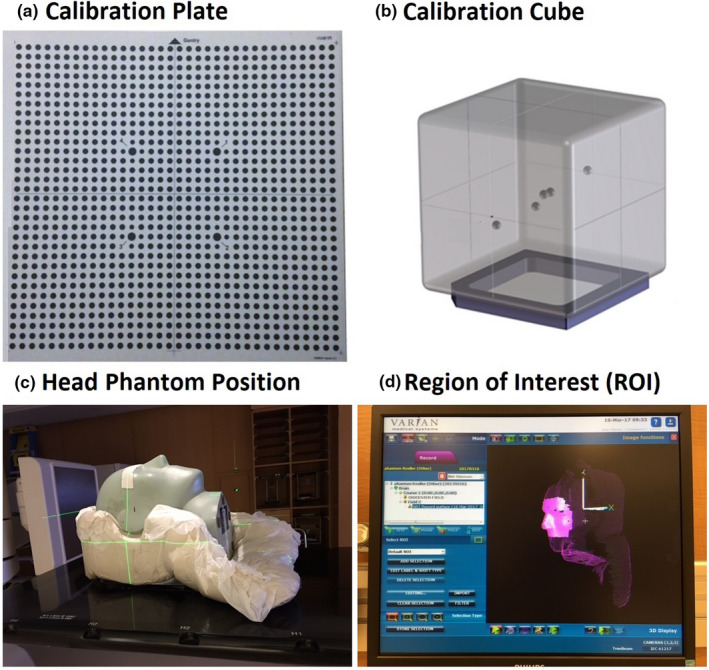
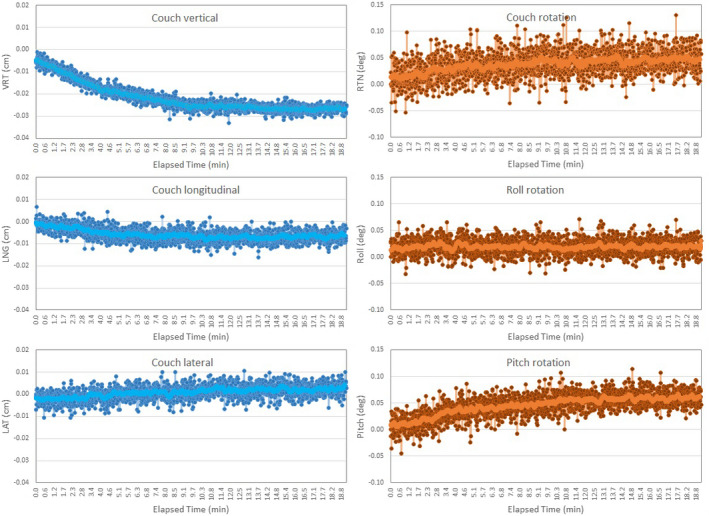
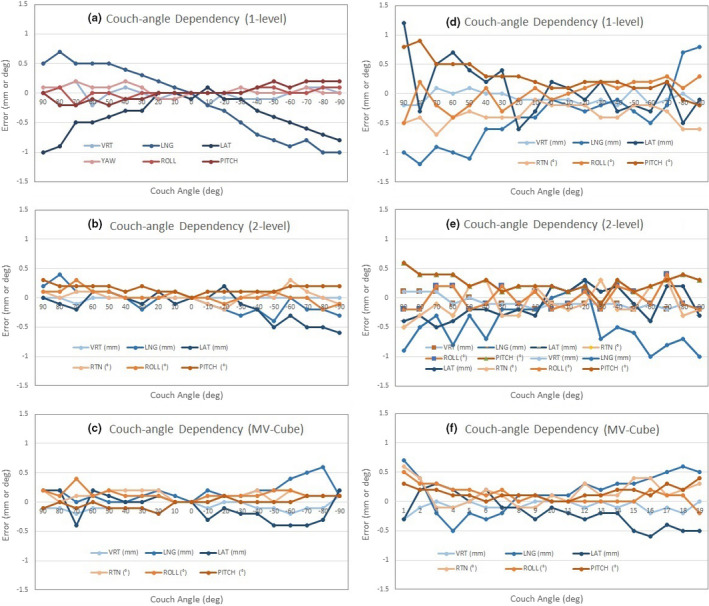
Eleven trained physicists evaluated 17 OSI systems at nine clinical centers within our institution. Three calibration methods were examined, including 1-level (2D), 2-level plate (3D) calibration for both surface image reconstruction and isocenter determination, and cube phantom calibration to assess OSI-megavoltage (MV) isocenter concordance. After each calibration, a couch-angle dependency error was measured as the maximum registration error within the couch rotation range. A head phantom was immobilized on the treatment couch and the isocenter was set in the middle of the brain, marked with the room lasers. An on-site reference image was acquired at couch zero, the facial region of interest (ROI) was defined, and static verification images were captured every 10° for 0°-90° and 360°-270°. The baseline drift was assessed with real-time monitoring of the motionless phantom over 20 min. The gated-delivered-dose equivalency was assessed using the electron portal imaging device and gamma test (1%/1mm) in reference to non-gated delivery.
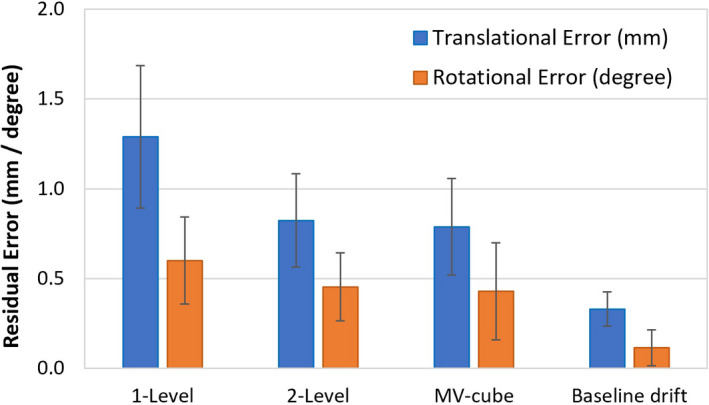
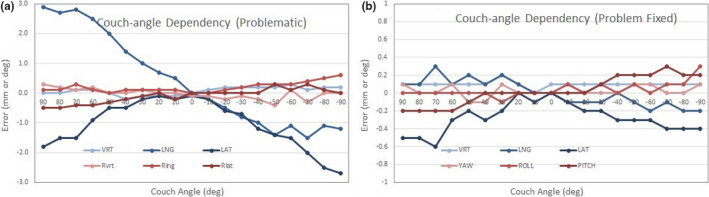
The maximum couch-angle dependency error occurs in longitudinal and lateral directions and is reduced significantly (P < 0.05) from 1-level (1.3 ± 0.4 mm) to 2-level (0.8 ± 0.3 mm) calibration. The MV cube calibration does not further reduce the couch-angle dependency error (0.8 ± 0.2 mm) on average. The baseline drift error plateaus at 0.3 ± 0.1 mm after 10 min. The gated-delivered-dose equivalency has a >98% gamma-test passing rate.
A commissioning method is recommended using the 3D plate calibration, which is verified by radiation isocenter and validated with couch-angle dependency, baseline drift, and gated-delivered-dose equivalency tests. This method characterizes OSI uncertainties, ensuring motion-monitoring accuracy for SRS treatments.
本研究旨在评估和比较大量系统的不同系统校准方法,以建立一种用于表面引导的无框架颅部立体定向放射外科手术(SRS)并进行分次内运动监测和门控的调试程序。使用光学表面成像(OSI)来引导非共面SRS治疗时,确定OSI治疗床角度依赖性、基线漂移和门控输送剂量等效性至关重要。
11名经过培训的物理学家在我们机构内的9个临床中心评估了17个OSI系统。研究了三种校准方法,包括用于表面图像重建和等中心确定的1级(二维)、2级平板(三维)校准,以及用于评估OSI兆伏(MV)等中心一致性的立方体模体校准。每次校准后,测量治疗床角度依赖性误差,即治疗床旋转范围内的最大配准误差。将头部模体固定在治疗床上,将等中心设置在脑中部,用室内激光标记。在治疗床为零度时获取现场参考图像,定义面部感兴趣区域(ROI),并在0°至90°和360°至270°范围内每隔10°采集静态验证图像。通过对静止模体进行20分钟的实时监测来评估基线漂移。使用电子门静脉成像设备和伽马测试(1%/1毫米)参照非门控输送来评估门控输送剂量等效性。
最大治疗床角度依赖性误差出现在纵向和横向方向,从1级校准(1.3±0.4毫米)到2级校准(0.8±0.3毫米)显著降低(P<0.05)。MV立方体校准平均未进一步降低治疗床角度依赖性误差(0.8±0.2毫米)。10分钟后基线漂移误差稳定在0.3±0.1毫米。门控输送剂量等效性的伽马测试通过率>98%。
建议采用三维平板校准的调试方法,该方法通过放射等中心进行验证,并通过治疗床角度依赖性、基线漂移和门控输送剂量等效性测试进行确认。该方法可表征OSI的不确定性,确保SRS治疗的运动监测准确性。