OMNI Research Group (Fakhraei, Erwin, Alibhai, Murphy, Dingwall-Harvey, Rennicks White, Dimanlig-Cruz, LaRose, Grattan, Walker, El-Chaâr), Clinical Epidemiology Program, Ottawa Hospital Research Institute; School of Epidemiology and Public Health (Fakhraei, Walker, Fell, El-Chaâr), University of Ottawa; Children's Hospital of Eastern Ontario (CHEO) Research Institute (Fakhraei, Fell); Better Outcomes Registry & Network (Erwin, Dimanlig-Cruz, Alton, Walker); Faculty of Medicine (Alibhai, El-Chaâr), University of Ottawa; Department of Obstetrics, Gynecology, and Newborn Care (Rennicks White, Walker, El-Chaâr), The Ottawa Hospital; Departments of Biochemistry, Microbiology and Immunology (Jia, Liu, Arnold, Galipeau, Shir-Mohammadi, Langlois), Obstetrics and Gynecology (Dy, Walker, El-Chaâr), and International and Global Health Office (Dy, Walker), University of Ottawa, Ottawa, Ont.
CMAJ Open. 2022 Jul 12;10(3):E643-E651. doi: 10.9778/cmajo.20210228. Print 2022 Jul-Sep.
There is limited information on the prevalence of SARS-CoV-2 infection in obstetric settings in Canada, beyond the first wave of the COVID-19 pandemic (February to June 2020). We sought to describe the prevalence of SARS-CoV-2 infection in pregnant people admitted to triage units at a tertiary care hospital in Ottawa, Canada.
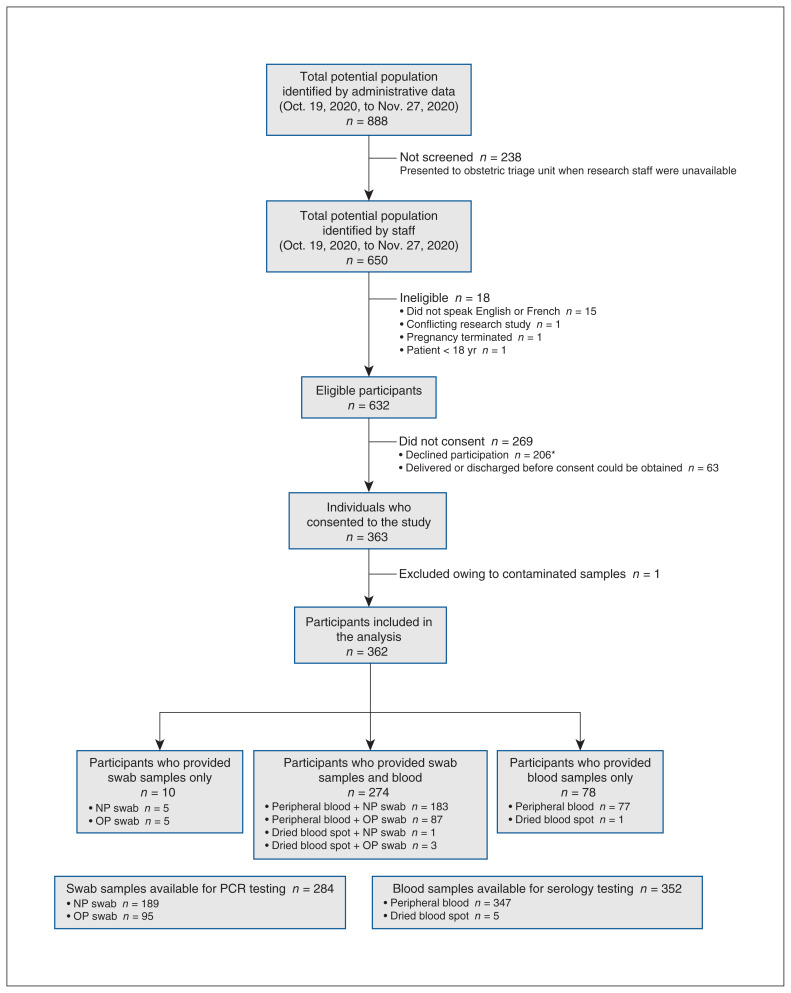
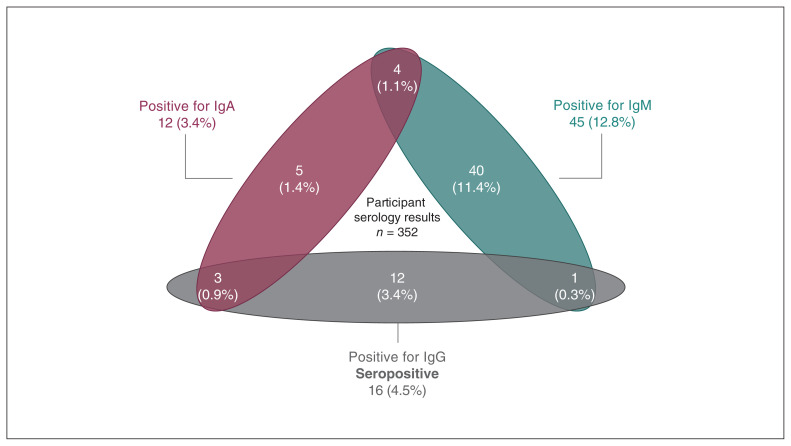
We conducted a descriptive study of pregnant people admitted to obstetric triage assessment units at The Ottawa Hospital between Oct. 19 and Nov. 27, 2020 (second local wave of the COVID-19 pandemic). Participants underwent SARS-CoV-2 polymerase chain reaction (PCR) (via naso- or oropharyngeal swabs) and serology testing upon admission. We excluded individuals younger than 18 years, those who did not speak English or French, those who enrolled in conflicting studies, those admitted for pregnancy termination and those triaged between 11:31 pm and 7:29 am. Swab and serology samples were analyzed using digital droplet PCR and enzyme-linked immunosorbent assays, respectively. We defined SARS-CoV-2 seropositivity as a positive result for immunoglobulin (Ig) G, either alone or in combination with IgM or IgA.
Of the 632 eligible patients, 363 (57.4%) consented to participation and 362 collectively provided 284 swab and 352 blood samples eligible for analysis. Common reasons for declining participation included feeling overwhelmed or anxious, being worried about repercussions of testing, pain or discomfort with testing or disinterest in research. Participants were mostly multiparous (53.9%) and in their third trimester upon admission (88.4%). In all, 18 (4.9%) participants had evidence of SARS-CoV-2 exposure; 2 (0.7%) of 284 were positive for SARS-CoV-2 by PCR and 16 (4.5%) of 352 were positive for IgG antibodies to SARS-CoV-2.
During the second local wave of the COVID-19 pandemic, the prevalence of active SARS-CoV-2 infection among obstetric patients in Ottawa was 0.7% and seroprevalence was 4.5%. Our low participation rate highlights the need for improvements in patient education and public health messaging on the benefits of SARS-CoV-2 testing programs.
在加拿大,除了 COVID-19 大流行的第一波(2020 年 2 月至 6 月)之外,关于产科环境中 SARS-CoV-2 感染的流行情况的信息有限。我们旨在描述在加拿大渥太华一家三级保健医院的产科分诊单位收治的孕妇中 SARS-CoV-2 感染的流行情况。
我们对 2020 年 10 月 19 日至 11 月 27 日期间在渥太华医院产科分诊评估单位收治的孕妇进行了描述性研究(COVID-19 大流行的第二波本地)。参与者入院时接受了 SARS-CoV-2 聚合酶链反应(PCR)(通过鼻咽或口咽拭子)和血清学检测。我们排除了年龄小于 18 岁的人、不会说英语或法语的人、参加冲突研究的人、因妊娠终止而入院的人和在晚上 11:31 至早上 7:29 之间分诊的人。使用数字液滴 PCR 和酶联免疫吸附测定法分别分析拭子和血清学样本。我们将 SARS-CoV-2 血清学阳性定义为 IgG 阳性,无论是单独还是与 IgM 或 IgA 一起。
在 632 名符合条件的患者中,有 363 名(57.4%)同意参加,共有 362 名患者共提供了 284 份拭子和 352 份血液样本进行分析。拒绝参与的常见原因包括感到不知所措或焦虑、担心检测的后果、检测的疼痛或不适或对研究不感兴趣。参与者主要为多胎产妇(53.9%),入院时处于第三孕期(88.4%)。共有 18 名(4.9%)参与者有 SARS-CoV-2 暴露的证据;284 名中 2 名(0.7%)通过 PCR 检测到 SARS-CoV-2 阳性,352 名中 16 名(4.5%)对 SARS-CoV-2 的 IgG 抗体呈阳性。
在 COVID-19 大流行的第二波本地期间,渥太华产科患者中活跃的 SARS-CoV-2 感染的流行率为 0.7%,血清流行率为 4.5%。我们的低参与率突显了需要改进患者教育和关于 SARS-CoV-2 检测计划益处的公共卫生宣传。