Mazza Stéphanie, Bastuji Hélène, Rey Amandine E
HESPER Laboratory, Université Lyon 1, Université de Lyon, Lyon, France.
Central Integration of Pain, Lyon Neuroscience Research Center, Inserm U1028, Université Lyon 1, Université de Lyon, Lyon, France.
Front Psychiatry. 2020 Jun 10;11:495. doi: 10.3389/fpsyt.2020.00495. eCollection 2020.
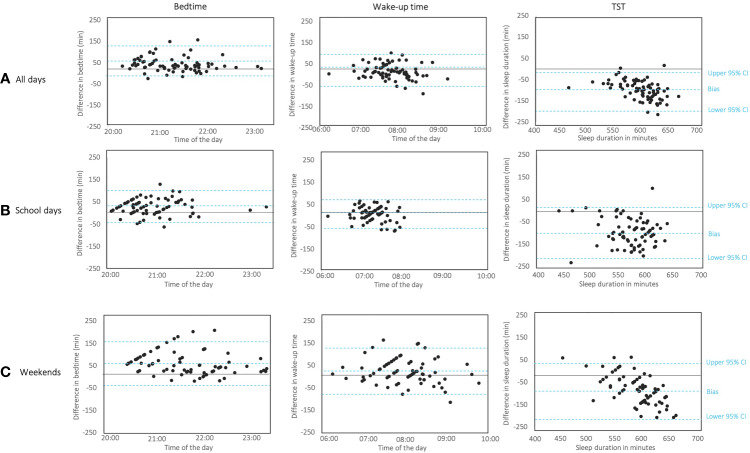
In research and clinical contexts, parents' report and sleep diary filled in by parents are often used to characterize sleep-wake rhythms in children. The current study aimed to investigate children self-perception of their sleep, by comparing sleep diaries filled in by themselves, actigraphic sleep recordings, and parental subjective estimation. Eighty children aged 8-9 years wore actigraph wristwatches and completed sleep diaries for 7 days, while their parents completed a sleep-schedule questionnaire about their child' sleep. The level of agreement and correlation between sleep parameters derived from these three methods were measured. Sleep parameters were considered for the whole week and school days and weekends separately and a comparison between children with high and low sleep efficiency was carried out. Compared to actigraphy, children overestimated their sleep duration by 92 min and demonstrated significant difficulty to assess the amount of time they spent awake during the night. The estimations were better in children with high sleep efficiency compared to those with low sleep efficiency. Parents estimated that their children went to bed 36 min earlier and obtained 36.5 min more sleep than objective estimations with actigraphy. Children and parents' accuracy to estimate sleep parameters was different during school days and weekends, supporting the importance of analyzing separately school days and weekends when measuring sleep in children. Actigraphy and sleep diaries showed good agreement for bedtime and wake-up time, but not for SOL and WASO. A satisfactory agreement for TST was observed during school days only, but not during weekends. Even if parents provided more accurate sleep estimation than children, parents' report, and actigraphic data were weakly correlated and levels of agreement were insufficient. These results suggested that sleep diary completed by children provides interesting measures of self-perception, while actigraphy may provide additional information about nocturnal wake times. Sleep diary associated with actigraphy could be an interesting tool to evaluate parameters that could contribute to adjust subjective perception to objective sleep values.
在研究和临床环境中,父母的报告以及父母填写的睡眠日记常被用于描述儿童的睡眠-觉醒节律。本研究旨在通过比较儿童自己填写的睡眠日记、活动记录仪睡眠记录以及父母的主观估计,来调查儿童对自身睡眠的自我认知。80名8至9岁的儿童佩戴活动记录仪手环,并填写7天的睡眠日记,同时他们的父母完成一份关于孩子睡眠时间表的问卷。测量了从这三种方法得出的睡眠参数之间的一致性水平和相关性。分别考虑了整周、上学日和周末的睡眠参数,并对睡眠效率高和低的儿童进行了比较。与活动记录仪相比,儿童高估了他们的睡眠时间92分钟,并且在评估夜间清醒时间方面存在显著困难。与睡眠效率低的儿童相比,睡眠效率高的儿童估计更准确。父母估计他们的孩子比活动记录仪的客观估计早睡36分钟,多睡36.5分钟。儿童和父母在上学日和周末估计睡眠参数的准确性不同,这支持了在测量儿童睡眠时分别分析上学日和周末的重要性。活动记录仪和睡眠日记在就寝时间和起床时间方面显示出良好的一致性,但在睡眠潜伏期和夜间觉醒时间方面不一致。仅在上学日观察到总睡眠时间有令人满意的一致性,周末则没有。即使父母提供的睡眠估计比儿童更准确,但父母的报告与活动记录仪数据之间的相关性较弱,一致性水平也不足。这些结果表明,儿童填写的睡眠日记提供了有趣的自我认知测量方法,而活动记录仪可能提供有关夜间觉醒时间的额外信息。与活动记录仪相关的睡眠日记可能是评估有助于将主观认知调整为客观睡眠值的参数的有趣工具。