Public Health Nutrition Unit, Department of Public Health and Primary Care, Ghent University, Campus UZ Gent, Corneel Heymanslaan 10, 9000, Ghent, Belgium.
Departments of Pediatrics and Internal Medicine and College of Population Health, University of New Mexico Health Sciences Center, Albuquerque, NM, USA.
Eur J Nutr. 2022 Dec;61(8):4107-4120. doi: 10.1007/s00394-022-02936-6. Epub 2022 Jul 13.
Public health interventions to address stunting and wasting should be evaluated for possibly contributing to obesity risk. The present study tested the hypothesis that small-quantity lipid-based nutrient supplements (SQ-LNS) might increase fat deposition, and that additional zinc provided via SQ-LNS or in the form of dispersible tablets would increase fat-free mass (FFM) accretion.
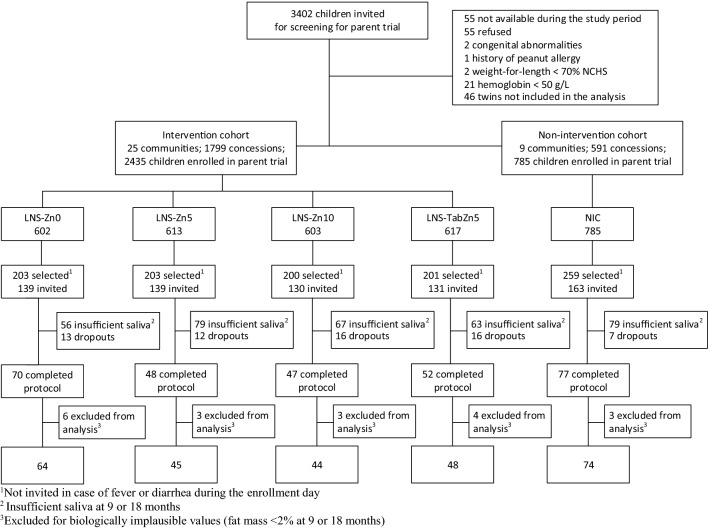
Using a two-stage, cluster-randomized trial design, 34 communities were randomly assigned to the intervention cohort (IC) or non-intervention cohort (NIC), and family compounds within the IC were randomly assigned to receive different amounts of zinc (0, 5 or 10 mg zinc) incorporated in SQ-LNS or 5 mg zinc in the form of dispersible tablets along with treatment for diarrhea, malaria and fever. Body composition was assessed in a subset of IC (n = 201) and NIC (n = 74) children at 9 and 18 months using the deuterium dilution method. A mixed linear model was used to examine average change in FFM and % fat mass (%FM) among intervention groups and by cohort.
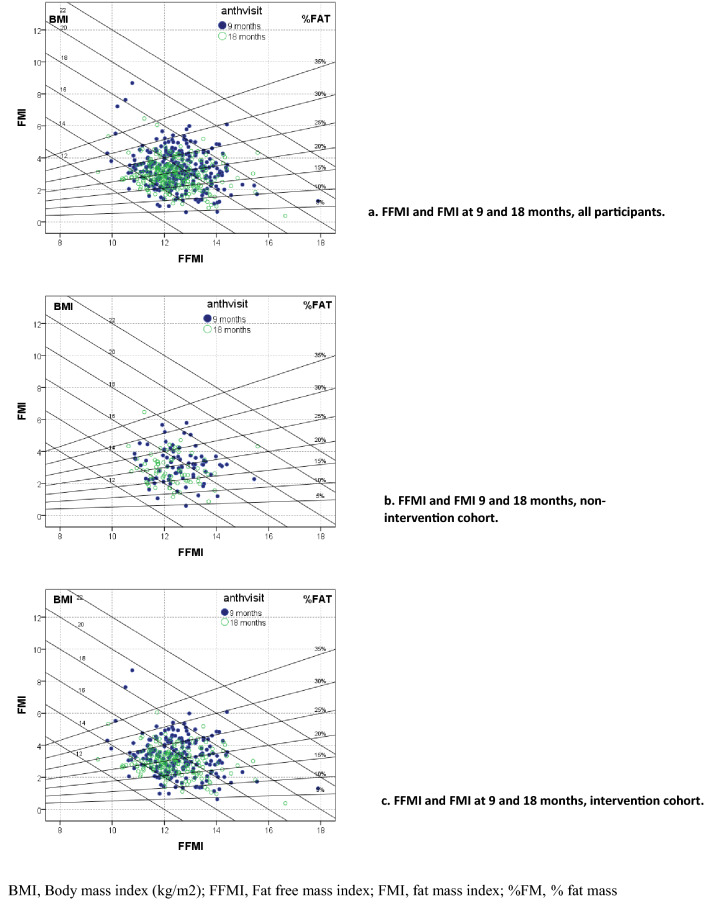
Children in the IC had significantly greater change in FFM (Mean (95% Confidence Interval)) (1.57 (1.49, 1.64) kg) compared to the NIC (1.35 (1.23, 1.46) kg; p = 0.005). There were no significant differences in the change in %FM between the NIC and IC or among the intervention groups.
SQ-LNS, along with morbidity treatment increased weight gain and FFM in young children from 9 to 18 months of age without increasing FM deposition. Additional zinc supplementation did not affect changes in FFM or %FM.
The study was registered as a clinical trial with the US National Institute of Health ( www.
gov ; NCT00944281).
应对发育迟缓与消瘦的公共卫生干预措施,应评估其是否可能增加肥胖风险。本研究旨在验证以下假设,即小剂量脂质基营养素补充剂(SQ-LNS)可能会增加脂肪沉积,而通过 SQ-LNS 或分散片形式额外提供的锌会增加去脂体重(FFM)的积累。
采用两阶段、整群随机试验设计,将 34 个社区随机分为干预组(IC)或非干预组(NIC),并将 IC 内的家庭化合物随机分为接受不同量的锌(0、5 或 10mg 锌),与 SQ-LNS 结合使用,或与治疗腹泻、疟疾和发热的 5mg 锌分散片结合使用。在干预组(n=201)和非干预组(n=74)的儿童中,使用氘稀释法在 9 个月和 18 个月时评估身体成分。使用混合线性模型,根据干预组和队列检验 FFM 和体脂肪量(%FM)的平均变化。
IC 组儿童的 FFM 变化显著大于 NIC 组(平均值(95%置信区间)(1.57(1.49,1.64)kg)与 NIC 组(1.35(1.23,1.46)kg)相比;p=0.005)。NIC 组和 IC 组之间,以及干预组之间,%FM 的变化均无显著差异。
SQ-LNS 与疾病治疗一起,可增加 9 至 18 个月龄幼儿的体重增加和 FFM,而不会增加 FM 沉积。额外的锌补充剂不会影响 FFM 或%FM 的变化。
该研究在美国国立卫生研究院(www.clinicaltrials.gov;NCT00944281)进行了临床试验注册。