Abbeddou Souheila, Yakes Jimenez Elizabeth, Somé Jérome W, Ouédraogo Jean Bosco, Brown Kenneth H, Hess Sonja Y
Department of Nutrition, Program in International and Community Nutrition, University of California, One Shields Avenue, Davis, CA, 95616, USA.
Center for Education Policy Research, University of New Mexico, Albuquerque, NM, USA.
BMC Pediatr. 2017 Feb 2;17(1):46. doi: 10.1186/s12887-016-0765-9.
We assessed the effects of providing a package of interventions including small-quantity lipid-based nutrient supplements (SQ-LNS) containing 0, 5 or 10 mg zinc and illness treatment to Burkinabe children from 9 to 18 months of age, on biomarkers of zinc, iron and vitamin A status at 18 months and compared with a non-intervention cohort (NIC).
Using a two-stage cluster randomized trial design, communities were randomly assigned to the intervention cohort (IC) or NIC, and extended family compounds within the IC were randomly assigned to different treatment groups. IC children (n = 2435) were provided with 20 g SQ-LNS/d containing 0, 5 or 10 mg zinc, 6 mg of iron and 400 μg of vitamin A along with malaria and diarrhea treatment. NIC children (n = 785) did not receive the intervention package. At 9 and 18 months, hemoglobin (Hb), zinc, iron and vitamin A status were assessed in a sub-group (n = 404). Plasma concentrations of zinc (pZC), ferritin (pF), soluble transferrin receptor (sTfR) and retinol-binding protein (RBP) were adjusted for inflammation.
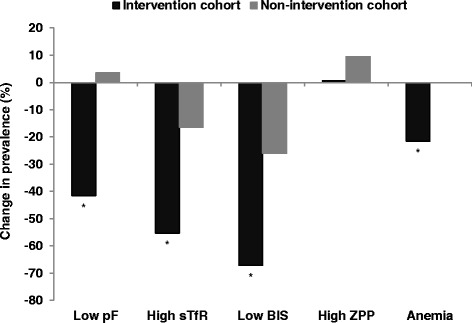
At baseline, 35% of children had low adjusted pZC (<65 μg/dL), 93% were anemic (Hb <110 g/L), 25% had low adjusted pF (<12 μg/L), 90% had high adjusted sTfR (>8.3 mg/L) and 47% had low adjusted RBP (<0.94 μmol/L), with no group-wise differences. Compared with the NIC, at 18 months IC children had significantly lower anemia prevalence (74 vs. 92%, p = 0.001) and lower iron deficiency prevalence (13% vs. 32% low adjusted pF and 41% vs. 71% high adjusted sTfR, p < 0.001), but no difference in pZC. Mean adjusted RBP was greater at 18 months in IC vs. NIC (0.94 μmol/L vs. 0.86 μmol/L, p = 0.015), but the prevalence of low RBP remained high in both cohorts. Within the IC, different amounts of zinc had no effect on the prevalence of low pZC or indicators of vitamin A deficiency, whereas children who received SQ-LNS with 10 mg zinc had a significantly lower mean pF at 18 months compared to children who received SQ-LNS with 5 mg zinc (p = 0.034).
SQ-LNS regardless of zinc amount and source provided along with illness treatment improved indicators of iron and vitamin A status, but not pZC.
NCT00944281 (July 21, 2009).
我们评估了为布基纳法索9至18个月大的儿童提供一套干预措施的效果,这些措施包括含有0、5或10毫克锌的小剂量脂质基营养补充剂(SQ-LNS)以及疾病治疗,并在18个月时对锌、铁和维生素A状态的生物标志物进行评估,同时与非干预队列(NIC)进行比较。
采用两阶段整群随机试验设计,将社区随机分配到干预队列(IC)或NIC,IC中的大家庭群组再随机分配到不同治疗组。IC组儿童(n = 2435)每天服用20克含有0、5或10毫克锌、6毫克铁和400微克维生素A的SQ-LNS,并接受疟疾和腹泻治疗。NIC组儿童(n = 785)未接受该干预措施。在9个月和18个月时,对一个亚组(n = 404)的血红蛋白(Hb)、锌、铁和维生素A状态进行评估。对血浆锌(pZC)、铁蛋白(pF)、可溶性转铁蛋白受体(sTfR)和视黄醇结合蛋白(RBP)浓度进行炎症校正。
基线时,35%的儿童校正后pZC较低(<65微克/分升),93%贫血(Hb<110克/升),25%校正后pF较低(<12微克/升),90%校正后sTfR较高(>8.3毫克/升),47%校正后RBP较低(<0.94微摩尔/升),各组间无差异。与NIC相比,18个月时IC组儿童贫血患病率显著较低(74%对92%,p = 0.001),铁缺乏患病率较低(校正后pF低者为13%对32%,校正后sTfR高者为41%对71%,p<0.001),但pZC无差异。IC组18个月时校正后RBP的平均值高于NIC组(0.94微摩尔/升对0.86微摩尔/升,p = 0.015),但两组中RBP低的患病率仍然很高。在IC组内,不同锌含量对校正后pZC低的患病率或维生素A缺乏指标无影响,而接受含10毫克锌的SQ-LNS的儿童在18个月时的平均pF显著低于接受含5毫克锌的SQ-LNS的儿童(p = 0.034)。
无论锌含量和来源如何,与疾病治疗一起提供的SQ-LNS改善了铁和维生素A状态指标,但未改善pZC。
NCT00944281(2009年7月21日)。