Universidade Federal do Piauí, Teresina, PI, Brazil.
Rev Paul Pediatr. 2022 Jul 6;41:e2021145. doi: 10.1590/1984-0462/2023/41/2021145. eCollection 2022.
To determine the prevalence of metabolic syndrome (MS) and its components among Brazilian adolescents.
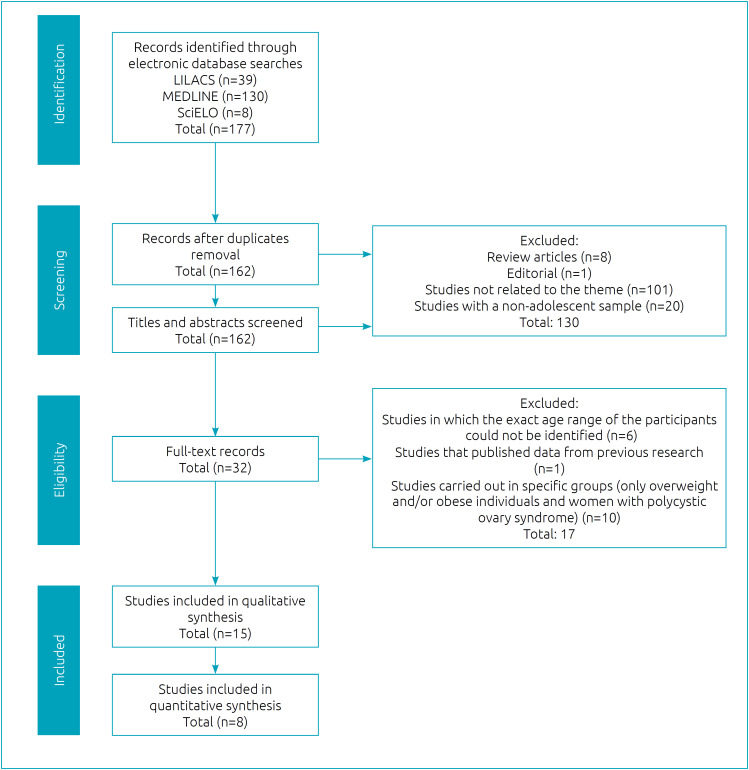
Databases, such as LILACS, MEDLINE, and SciELO, were searched for original cross-sectional studies published between 2010 and 2021. The inclusion criteria were determined based on the mnemonic CoCoPop - Condition, Context, and Population: studies determining the prevalence of MS and its components (condition) in the general population of Brazilian adolescents, female and male (population), enrolled in public or private schools in rural or urban areas (context). Reviews, editorials, and articles that did not directly relate to the prevalence of MS or that included non-adolescent age groups or groups with specific health conditions (obesity/overweight and others) were excluded.
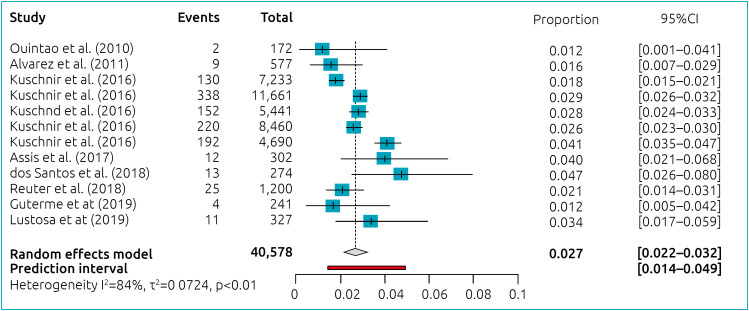
A total of 15 studies, including 43,227 adolescents, were identified. MS prevalence (95% confidence interval [95%CI]) was 2.9% (2.65-3.18) and 2.4% (1.90-2.90) (p<0.001) in males and females, respectively, by using the International Diabetes Federation (IDF) criteria. There was a significant difference in MS prevalence among Brazilian regions (Q=24.7; p<0.001). The lowest MS prevalence (95%CI) was determined for North Region of Brazil, 1.8% (1.52-2.13), and the highest for Northeast Region of Brazil, 2.9% (2.62-3.23). Regarding MS components, a higher prevalence (95%CI) was found for low high-density lipoprotein (HDL), 22.1% (12.49-36.17), followed by abdominal obesity, 11.0% (8.05-14.94), and arterial hypertension, 10.3% (7.84-13.48).
This study allowed the determination of the prevalence of MS and the MS components in Brazilian adolescents, highlighting relevant aspects to be addressed on public health management.
确定代谢综合征(MS)及其各组分在巴西青少年中的流行情况。
检索了 LILACS、MEDLINE 和 SciELO 等数据库,以获取 2010 年至 2021 年期间发表的原始横断面研究。根据记忆术 CoCoPop(条件、背景和人群)确定纳入标准:研究确定了 MS 及其各组分(条件)在巴西一般青少年人群中的流行情况,包括男性和女性(人群),在农村或城市地区的公立或私立学校注册(背景)。排除了与 MS 流行情况不直接相关的综述、社论以及不包括非青少年年龄组或特定健康状况(肥胖/超重和其他)的文章。
共确定了 15 项研究,纳入了 43227 名青少年。使用国际糖尿病联合会(IDF)标准,男性和女性的 MS 流行率(95%置信区间[95%CI])分别为 2.9%(2.65-3.18)和 2.4%(1.90-2.90)(p<0.001)。巴西各地区的 MS 流行率存在显著差异(Q=24.7;p<0.001)。巴西北部地区的 MS 流行率最低(95%CI)为 1.8%(1.52-2.13),东北部地区最高,为 2.9%(2.62-3.23)。关于 MS 各组分,低高密度脂蛋白(HDL)的流行率(95%CI)最高,为 22.1%(12.49-36.17),其次是腹部肥胖,为 11.0%(8.05-14.94),动脉高血压为 10.3%(7.84-13.48)。
本研究确定了巴西青少年中 MS 及其各组分的流行情况,突出了公共卫生管理中需要解决的重要方面。