Department of Dermatology, Peking University People's Hospital, Beijing 100044, China.
Department of Dermatology, Beijing Children's Hospital, Capital Medical University, Beijing 100045, China.
Chin Med J (Engl). 2022 Jun 5;135(11):1369-1375. doi: 10.1097/CM9.0000000000002172.
Urticaria is a common skin disease characterized by episodes of wheals, and it has a negative effect on patients' quality of life. Large-scale population-based epidemiological studies of urticaria are scarce in China. The aim of this survey was to determine the prevalence, clinical forms, and risk factors of urticaria in the Chinese population.
This survey was conducted in 35 cities from 31 provinces, autonomous regions, and municipalities of China. Two to three communities in each city were selected in this investigation. Participants completed questionnaires and received dermatological examinations. We analyzed the prevalence, clinical forms, and risk factors of urticaria.
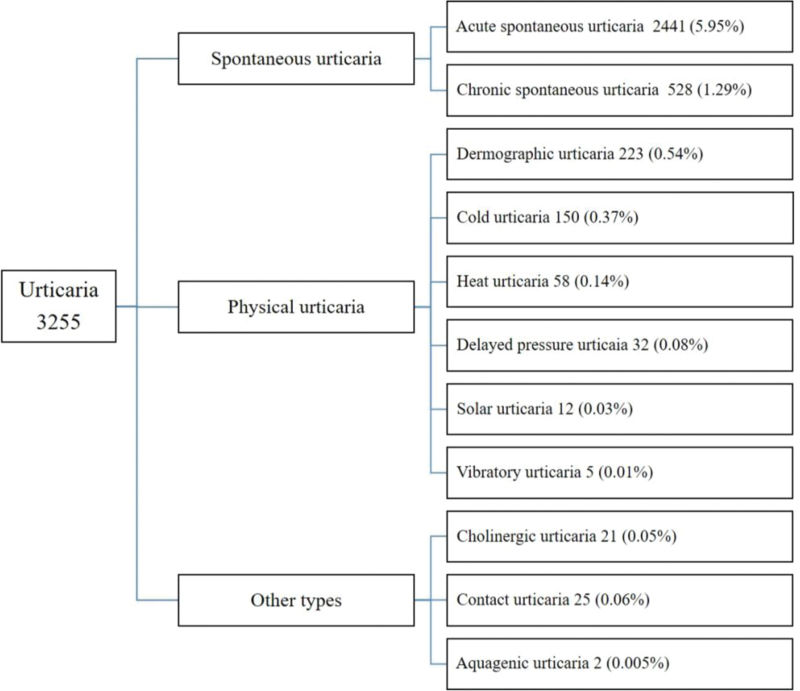
In total, 44,875 questionnaires were distributed and 41,041 valid questionnaires were collected (17,563 male and 23,478 female participants). The lifetime prevalence of urticaria was 7.30%, with 8.26% in female and 6.34% in male individuals ( P < 0.05). The point prevalence of urticaria was 0.75%, with 0.79% in female and 0.71% in male individuals ( P < 0.05). Concomitant angioedema was found in 6.16% of patients. Adults had a higher prevalence of urticaria than adolescents and children. Living in urban areas, exposure to pollutants, an anxious or depressed psychological status, a personal and family history of allergy, thyroid diseases, and Helicobacter pylori infection were associated with a higher prevalence of urticaria. Smoking was correlated with a reduced risk of urticaria.
This study demonstrated that the lifetime prevalence of urticaria was 7.30% and the point prevalence was 0.75% in the Chinese population; women had a higher prevalence of urticaria than men. Various factors were correlated with urticaria.
荨麻疹是一种常见的皮肤病,其特征为反复发作的风团,对患者的生活质量有负面影响。中国缺乏大规模的基于人群的荨麻疹流行病学研究。本研究旨在确定中国人群中荨麻疹的患病率、临床类型和危险因素。
本研究在中国 31 个省、自治区和直辖市的 35 个城市进行。在每个城市选择 2-3 个社区。参与者完成问卷并接受皮肤科检查。我们分析了荨麻疹的患病率、临床类型和危险因素。
共发放 44875 份问卷,回收有效问卷 41041 份(男性 17563 例,女性 23478 例)。荨麻疹的终身患病率为 7.30%,女性为 8.26%,男性为 6.34%(P<0.05)。荨麻疹的时点患病率为 0.75%,女性为 0.79%,男性为 0.71%(P<0.05)。同时伴有血管性水肿的患者占 6.16%。成人的荨麻疹患病率高于青少年和儿童。居住在城市、接触污染物、焦虑或抑郁心理状态、个人和家族过敏史、甲状腺疾病和幽门螺杆菌感染与荨麻疹的高患病率相关。吸烟与荨麻疹的低患病风险相关。
本研究表明,中国人群的荨麻疹终身患病率为 7.30%,时点患病率为 0.75%;女性的患病率高于男性。各种因素与荨麻疹相关。