German Center for Neurodegenerative Diseases (DZNE), Bonn-Cologne, Germany.
University of Cologne, Faculty of Medicine and University Hospital Cologne, Department of Nuclear Medicine, Multimodal Neuroimaging Group, Cologne, Germany.
Eur J Nucl Med Mol Imaging. 2022 Nov;49(13):4478-4489. doi: 10.1007/s00259-022-05879-6. Epub 2022 Jul 14.
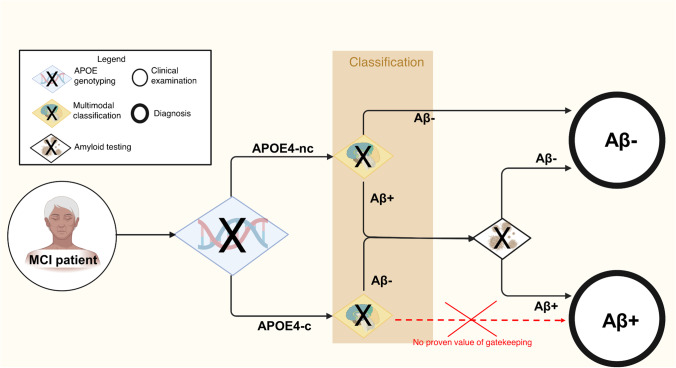
In patients with mild cognitive impairment (MCI), enhanced cerebral amyloid-β plaque burden is a high-risk factor to develop dementia with Alzheimer's disease (AD). Not all patients have immediate access to the assessment of amyloid status (A-status) via gold standard methods. It may therefore be of interest to find suitable biomarkers to preselect patients benefitting most from additional workup of the A-status. In this study, we propose a machine learning-based gatekeeping system for the prediction of A-status on the grounds of pre-existing information on APOE-genotype F-FDG PET, age, and sex.
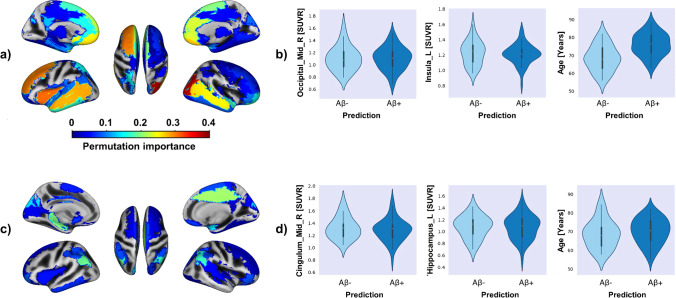
Three hundred and forty-two MCI patients were used to train different machine learning classifiers to predict A-status majority classes among APOE-ε4 non-carriers (APOE4-nc; majority class: amyloid negative (Aβ-)) and carriers (APOE4-c; majority class: amyloid positive (Aβ +)) from F-FDG-PET, age, and sex. Classifiers were tested on two different datasets. Finally, frequencies of progression to dementia were compared between gold standard and predicted A-status.
Aβ- in APOE4-nc and Aβ + in APOE4-c were predicted with a precision of 87% and a recall of 79% and 51%, respectively. Predicted A-status and gold standard A-status were at least equally indicative of risk of progression to dementia.
We developed an algorithm allowing approximation of A-status in MCI with good reliability using APOE-genotype, F-FDG PET, age, and sex information. The algorithm could enable better estimation of individual risk for developing AD based on existing biomarker information, and support efficient selection of patients who would benefit most from further etiological clarification. Further potential utility in clinical routine and clinical trials is discussed.
在轻度认知障碍(MCI)患者中,增强的脑淀粉样蛋白-β斑块负担是发展为阿尔茨海默病(AD)痴呆的高风险因素。并非所有患者都能立即通过金标准方法评估淀粉样蛋白状态(A 状态)。因此,找到合适的生物标志物来预选最受益于进一步 A 状态检查的患者可能是有意义的。在这项研究中,我们提出了一种基于机器学习的门禁系统,用于预测 A 状态,依据是 APOE 基因型 F-FDG PET、年龄和性别等预先存在的信息。
使用 342 名 MCI 患者来训练不同的机器学习分类器,以预测 APOE-ε4 非携带者(APOE4-nc;多数类别:淀粉样蛋白阴性(Aβ-))和携带者(APOE4-c;多数类别:淀粉样蛋白阳性(Aβ+))中 F-FDG-PET、年龄和性别之间的 A 状态多数类别。分类器在两个不同的数据集上进行了测试。最后,比较了金标准和预测 A 状态的痴呆进展频率。
APOE4-nc 中的 Aβ-和 APOE4-c 中的 Aβ+的预测精度分别为 87%、79%和 51%。预测的 A 状态和金标准的 A 状态至少同样能提示痴呆进展的风险。
我们开发了一种算法,使用 APOE 基因型、F-FDG PET、年龄和性别信息,可以可靠地近似 MCI 中的 A 状态。该算法可以根据现有生物标志物信息更好地估计个体发展为 AD 的风险,并支持有效选择最受益于进一步病因学澄清的患者。进一步讨论了其在临床常规和临床试验中的潜在应用。