School of Hygiene and Preventive Medicine, Department of Translational Medicine, Università degli Studi del Piemonte Orientale, Via Solaroli 17, 28100, Novara, Italy.
Epidemiologic Unit, Vercelli Local Health Authority, Largo Giuseppe Giusti 13, 13100, Vercelli, Italy.
J Prev (2022). 2022 Oct;43(5):639-658. doi: 10.1007/s10935-022-00693-0. Epub 2022 Jul 14.
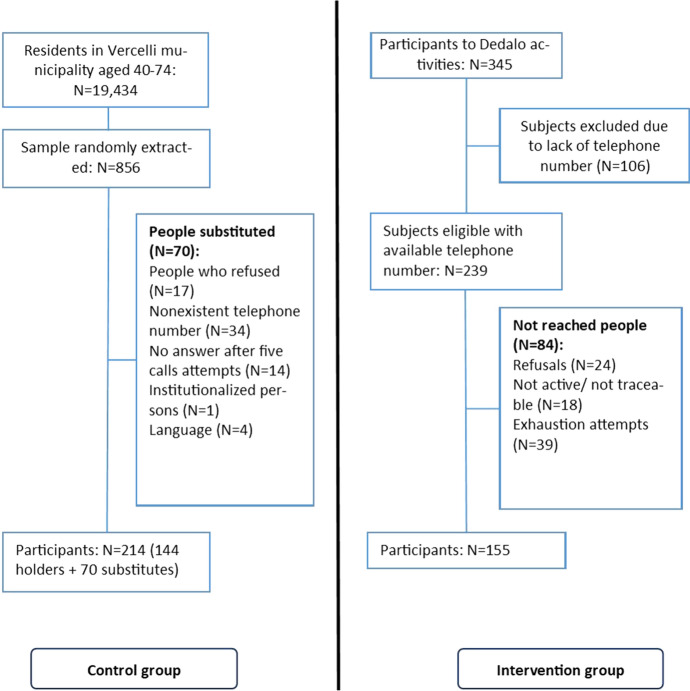
Noncommunicable diseases (NCDs) are the leading global cause of death. The Italian National Prevention Plan (INPP) highlights the importance of health promotion and NCD prevention while avoiding health inequalities. In line with the INPP guidelines, we initiated a multicomponent community-based intervention program, named the Dedalo project, to promote healthy and active aging among population living around the Vercelli's municipality, Italy. A cross-sectional analysis, that used the baseline data of a longitudinal study of the project, evaluated the program's ability to enroll participants participants who represent the socioeconomic conditions present in the municipality. To this end, we compared the main social characteristics and behaviors of 40-74-year-old subjects (n = 155), who had attended at least one Dedalo activity, to those of same age individuals (n = 124) randomly extracted from the general population. We found that most participants were women (81.3%) and had a higher SES compared to the general population. Furthermore, they were healthier-OR 0.52, 95% CI 0.31-0.87 for self-reported diseases-and displayed healthier behaviors-OR 0.20, 95% CI 0.08-0.46 for smokers; 0.32 95%, CI 0.16-0.64 for fruit/vegetable consumers; and 0.36 95% CI 0.20-0.64 for sweet beverages consumers. Overall, our initial evaluation indicates that the Dedalo project has so far struggled to enroll individuals with low SES, men with any SES, and subjects displaying unhealthy behaviors, thereby failing to meet the INPP goal of preventing NCDs while avoiding health disparities. Thus, efforts should be made to ensure that this community-based intervention program can effectively reach all the target population, in particular those individuals most exposed to behavioral risk factors.
非传染性疾病(NCDs)是全球主要死因。意大利国家预防计划(INPP)强调了促进健康和预防 NCD 以及避免健康不平等的重要性。根据 INPP 指南,我们启动了一个多组分基于社区的干预计划,名为 Dedalo 项目,旨在促进意大利韦尔切利市周边人群的健康和积极老龄化。一项横断面分析使用该项目的纵向研究的基线数据,评估了该计划招募参与者的能力,这些参与者代表了该市存在的社会经济条件。为此,我们比较了参加 Dedalo 活动的 40-74 岁参与者(n=155)的主要社会特征和行为与从一般人群中随机抽取的相同年龄个体(n=124)的主要社会特征和行为。我们发现,大多数参与者是女性(81.3%),社会经济地位较高与一般人群相比。此外,他们的健康状况更好-OR 0.52,95%CI 0.31-0.87 用于自报疾病;并且行为更健康-OR 0.20,95%CI 0.08-0.46 用于吸烟者;OR 0.32,95%CI 0.16-0.64 用于水果/蔬菜消费者;和 OR 0.36,95%CI 0.20-0.64 用于甜饮料消费者。总体而言,我们的初步评估表明,Dedalo 项目迄今为止一直在努力招募 SES 较低的个人、任何 SES 的男性以及表现出不健康行为的个人,从而未能实现 INPP 预防 NCD 同时避免健康差异的目标。因此,应努力确保该基于社区的干预计划能够有效地覆盖所有目标人群,特别是那些最易受到行为风险因素影响的人群。